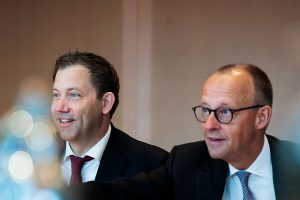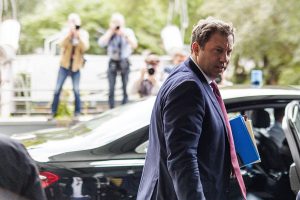
German finance minister Lars Klingbeil has spent €188,000 of public money on photographers and make-up since taking office on May 6, 2025, according to a written answer from his own ministry.
The figure was given by Dennis Rohde, a Social Democratic Party (SPD) politician and parliamentary state secretary at the finance ministry, in reply to a question from Hauke Finger, a member of the Bundestag for the Alternative for Germany (AfD).
It covers the period from Klingbeil’s appointment to September 24, 2026.
Tichys Einblick, which published the answer exclusively on October 5, reported the breakdown. The sum works out at about €11,000 a month.
Most of the sum, €165,035, went on external photographers and €22,656 on visagists, stylists and make-up artists.
The ministry said it uses outside photographers “to illustrate its communication” and has a framework contract with a photo agency.
Make-up is commissioned where the photographs require it, and on some occasions under separate service contracts.
That framework is not a small one. The ministry tendered photo and video services for 2026 and 2027 across the EU at up to €620,000 including VAT, with the option of a further 24 months. The documents provide for between 175 and 225 assignments a year and cover make-up, styling and hairdressing, as well as business-class travel for photographers and their assistants.
The yearly split shows both lines rising.
Photographers cost €78,436 from May 6, 2025 to the end of that year, and €86,599 from January to September 24, 2026.
Make-up cost €9,078 in 2025 and €13,578 so far this year.
The costs were incurred while Klingbeil “publicly rambles on with little credibility about the levered debt brake, the lack of budget consolidation and the growing pressure to save,” Finger said.
He called it a case of “preaching water and drinking wine” and said styling costs were up by half in 2026.
“That is not what credible fiscal policy looks like.”
Klingbeil, who is also vice-chancellor and SPD co-leader, has made consolidation a theme of his time in office while presiding over record borrowing. His draft budget for 2027 set spending at €543.3 billion, against €524.5 billion this year, with new borrowing of €110.8 billion, and left gaps of €51 billion in 2029 and about €60 billion in 2030 still to be closed.
The debt brake itself was loosened in March 2025, before he took office, when defence spending above 1 per cent of economic output was exempted from the borrowing limit and a €500 billion infrastructure fund created.
AfD co-leader Tino Chrupalla said: “Lars Klingbeil is no Robin Hood, but the Sheriff of Nottingham. He takes from one and from the other as well.”
Klingbeil had given up smoking, Chrupalla added, “but apparently not yet sugar.”
There had been no reforms, only savings and, “above all, in the end, increases for the citizens”, he said. “They all have to pay more or get less in return.”
Reform, he said, meant putting the state under an obligation: “not only that the citizen is squeezed, but that the state above all finally starts to save with itself.”
„Lars Klingbeil ist kein Robin Hood, sondern der Sheriff von Nottingham. Er nimmt den einen und den anderen auch. Mit dem Rauchen hat er aufgehört, mit dem Zucker anscheinend noch nicht.
Es gab nie Reformen, sondern es sind nur Einsparungen und vor allen Dingen am Ende… pic.twitter.com/cptSwJvNIe— AfD-Fraktion im Deutschen Bundestag 🇩🇪 (@AfDimBundestag) October 6, 2026