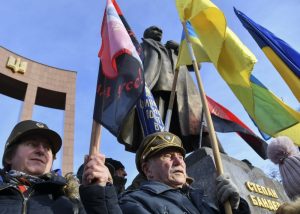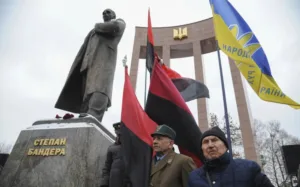

A decision by Ukraine’s Lviv Regional Council to designate 2027 as the Year of the Ukrainian Insurgent Army (UPA) and one of its leaders, Roman Shukhevych, has sparked an outcry in Poland, with both the government and President Karol Nawrocki condemning the decision and calling on the Ukrainian government to distance itself from Lviv’s council.
On October 20 the Lviv Regional Council declared 2027 the Year of the UPA with its commander Roman Shukhevych, and Oleh Olzhych, an activist of the Organisation of Ukrainian Nationalists (OUN). The resolution marks the 120th anniversary of the births of Shukhevych and Olzhych and the 85th anniversary of the UPA’s founding.
The OUN was a nationalist organisation that sought Ukrainian independence. The UPA, a partisan formation, emerged in 1942 from a more radical faction of the OUN, with Shukhevych serving as its military commander. Olzhych, a poet and archaeologist, belonged to the movement’s more moderate wing and died in the Sachsenhausen concentration camp in 1944.
Before the war Lviv was a city which became dominated by Poles after they had beaten an uprising by Ukrainians during the First World War. After the Second World War the city’s Poles were moved westward by the Soviet authorities after the city became a part of the Ukrainian republic in the USSR.
Poland’s politicians and institutions were unanimous in their condemnation of the Lviv regional council’s resolution on the UPA.
“This, unfortunately, smells of some kind of Russian provocation. The Ukrainian services should examine this decision-making process involving representatives of the regional council in Lviv,” said Rafał Leśkiewicz, spokesperson for the opposition aligned President Karol Nawrocki, speaking to Radio ZET on October 21 and adding that Poland expected a response from Ukrainian President Volodymyr Zelensky.
The Polish foreign ministry called the decision “contrary to European values,” and warned it could undermine recent progress made between the two countries towards reconciliation over their difficult shared history.
“Glorifying the UPA and criminal figures is contrary to European values and the strategic and good-neighbourly nature of relations between Poland and Ukraine,” foreign ministry spokesman Maciej Wewiór told reporters on October 20.
“Shukhevych is a criminal stained with the blood of thousands of innocent victims, people who were murdered simply because they were Poles,” he added, also noting that the UPA’s victims included Jews, Czechs, Armenians and Ukrainians themselves.
Wewiór warned that, while the Ukrainian and Polish governments have recently made progress towards reconciliation over historical issues, “irresponsible local activists are damaging these relations by honouring people clearly responsible for crimes and collaborating with the Nazis”.
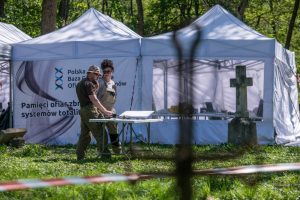
Wewiór was alluding to recent signs of progress on issues of history such as Ukraine lifting its ban on exhuming the remains of Volhynia massacre victims on its territory, which allowed Polish search teams to return to the former village of Puźniki, in the Ternopil region, in 2025.
Prime Minister Donald Tusk said he had warned Zelensky that gestures of this kind made life harder for those in Poland arguing for close ties with Kyiv, describing the resolution as unwise and as “suicidal tactics” on Ukraine’s part.
Deputy Prime Minister and foreign minister Radosław Sikorski, who serves in the centre-left coalition government led by Tusk, responded to Lviv’s decision by seeking to ban a Ukrainian regional councillor from entering the country after the lawmaker proposed honouring the Second World War commander whose forces massacred about 100,000 Polish civilians in Volhynia and eastern Galicia.
Sikorski said on October 21 that he had signed a request to add Sviatoslav Sheremeta, a member of the Lviv Regional Council in western Ukraine, to Poland’s list of unwanted foreigners because of his proposal to honour the UPA and its commander. The final decision rests with the head of Poland’s Office for Foreigners.
Poland’s top diplomat described Sheremeta as a “re-enactor of the Galizien Waffen-SS”, a Ukrainian volunteer division formed by Nazi Germany, and accused Shukhevych of issuing orders to “expel and murder Poles”.
Polish defence minister Władysław Kosiniak-Kamysz called the council’s decision “unacceptable” and said: “The Ukrainian authorities must distance themselves from this position.”
Kosiniak-Kamysz, who leads the centre-right Polish People’s Party, a junior partner in Tusk’s ruling coalition, has in the past warned that Ukraine would find it hard to join the EU if it did not deal with aspects of its history such as the crimes committed by the UPA. Poland, like all other member states, can veto accession of any state applying for EU membership.
Poland’s state Institute of National Remembrance (IPN) also condemned the resolutions. It called Shukhevych “an architect of the genocide in Volhynia” as well as the “co-founder of collaborationist units operating alongside Germany”. The institute puts the number of Poles killed in Volhynia at about 60,000.
It quoted an order issued by Shukhevych in which he wrote: “Cut them down to the last man. Burn villages inhabited exclusively by Poles; in mixed villages, eliminate only the Polish population.”
Ukraine’s foreign ministry said on October 21 that the resolution proposed by Sheremeta was passed at local level in the Lviv region and that no consultations had been held with the country’s central government to assess the impact on wider Polish-Ukrainian relations. It stressed that regional deputies answer neither to the Verkhovna Rada nor to the cabinet or the president.
The ministry said it was working to improve ties between the two neighbouring states and that the decision taken in Lviv would hinder those efforts.
It added: “At the same time, we appeal to the Polish side to refrain from taking sudden actions that could disrupt the normalization of relations. For our part, we confirm our readiness to constructively resolve all problematic issues in bilateral relations through diplomatic channels, in the spirit of good neighborliness.”
Sheremeta, who chairs the Lviv council’s culture committee and sits for former president Petro Poroshenko’s European Solidarity party, defended the proposal, saying: “This is our history, our heroes, and we should properly honour their memory”, adding that the resolution would “pave the way for large events”. He recalled that the council had already declared 2022 the Year of the UPA, with most of the planned commemorations abandoned after Russia’s full-scale invasion.
Deputy foreign minister Marcin Bosacki said on October 21 that Zelensky’s closest aides had promised Warsaw the decision would not come into force, and that notice of it had been taken down from the Lviv regional authorities’ website. That, he said, was not the same as formal annulment.
Polish news website Onet reported on October 22 that Warsaw had suspended talks with Kyiv on further financial support because of the resolution. The Polish defence ministry denied a separate report by Ukrainian outlet European Pravda that military aid had also been frozen.
The UPA fought for Ukrainian independence during the Second World War and continued its struggle against Soviet rule after the war but it was for a time allied to Nazi Germany against the USSR.
Shukhevych took command of the UPA in August 1943, as attacks on Polish civilians were underway.
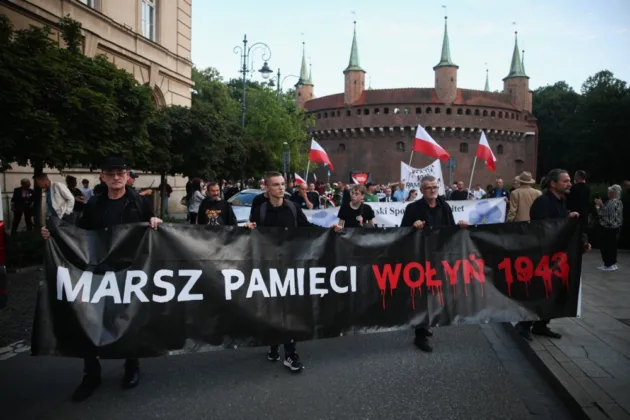
Poland regards the massacre as genocide, a designation adopted by its parliament in 2016, while many Ukrainians view the killings within the broader context of a wartime conflict in which both Polish and Ukrainian forces committed acts of violence.
The latest row initiated by the Lviv council’s resolution revives tensions between Warsaw and Kyiv over the UPA’s legacy and its commemoration in Ukraine.
In late May Ukrainian President Volodymyr Zelensky approved the title “Heroes of the UPA” for a Ukrainian military unit, drawing criticism in Poland.
In June, Polish President Karol Nawrocki revoked Zelensky’s Order of the White Eagle, Poland’s highest state honour, in response to the decision. Zelensky returned the award the following day.
Relations between Ukraine and Poland were at their best in 2022 when Poland backed Ukrainian resistance to the full scale Russian invasion with huge military and humanitarian aid.
An enormous wave of sympathy to Ukraine and its people led to hundreds of thousands of wartime refugees from Ukraine being hosted in Polish homes in that year.
The first sign of deterioration emerged in late 2022 when a stray Ukrainian air defence missile fell on a farm building killing two workers in eastern Poland and the Zelensky government, instead of apologising, insisted on claiming that the missile had been Russian.
In 2023 a major row ensued when Polish farmers protested against imports of Ukrainian grain facilitated by a decision of the EU. Poland imposed unilateral restrictions which led Zelensky to complain at the UN Security Council that Poland was helping the Putin regime.
The Polish authorities also became increasingly disappointed at Ukraine’s refusal to recognise Volhynia as genocide and its insistence on glorifying the UPA and its leaders.
The generous state assistance to Ukrainian refugees has also come under question with restrictions being imposed with regard to availability of benefits and health care as public opinion in Poland came to regard Ukrainians as having been given privileges and media reports began to circulate about Ukrainian criminal gangs and young Ukrainians using Poland as a place to hide from the draft to fight in the war against Russia.
In political terms the parties of the Right, even including the formerly Ukraine friendly PiS, have become much more circumspect towards both Ukraine and the Ukrainians. The most right-wing of the parties, the Polish Crown party led by MEP Grzegorz Braun, has called for the stopping of “the Ukrainization of Poland” and it opposed all forms of aid to both the country and its peoples.