
Poland and Romania founded the Bucharest Nine (B9) together, yet for a decade Warsaw has directed most of its political attention elsewhere. On October 20, councillors in Lviv voted to make 2027 a year honouring the Ukrainian Insurgent Army (UPA), whose units massacred Poles in Volhynia. Poland need not turn away from Ukraine. It should give Romania at least half the attention it has given Kyiv.
On November 4, 2015, less than two years after Russia seized Crimea, the then Polish and Romanian presidents, Andrzej Duda and Klaus Iohannis, brought nine NATO members, from Estonia to Bulgaria, together in Bucharest to coordinate their positions before alliance summits.
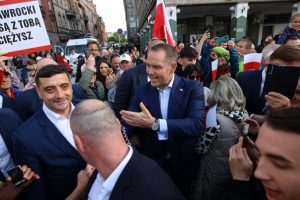
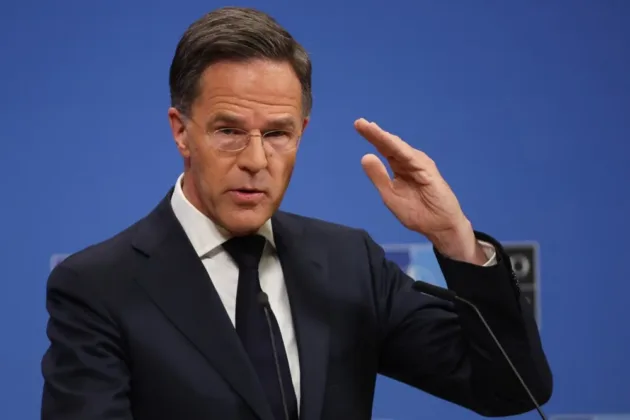
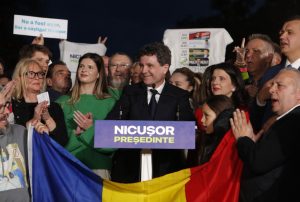
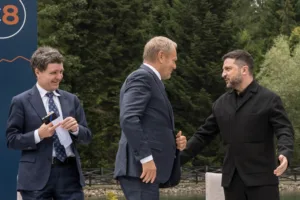
At its 11th summit, on May 13, the group returned to Bucharest. Presidents Nicușor Dan and Karol Nawrocki co-chaired the meeting, joined by the five Nordic countries, NATO secretary general Mark Rutte and Ukrainian President Volodymyr Zelensky. “Both Poland in the north and Romania in the south are fortresses on NATO’s eastern flank,” Nawrocki said during his three-day visit.
Their joint statement endorsed a “NATO 3.0” strategy of higher defence spending and described Russia as the most significant, long-term and direct threat to allied security.
The B9 is a forum for consultation, not an alliance, and some of its members read the war in Ukraine very differently from Warsaw or Vilnius. Polish ambitions for the group, meanwhile, point north.
In his inaugural address in August 2025, Nawrocki said he hoped the Bucharest Nine would in the longer term become a “Bucharest Eleven”. In March this year he invited Sweden to join.
With the Czech Republic, Slovakia and Hungary, Poland at least shares the Visegrád Group, however fractious it has become. Romania, the largest EU member state in southeastern Europe, deserves a relationship of its own.
Poland’s policy towards Ukraine has been romantic in the literary sense. Its intellectual lineage runs through Jerzy Giedroyc’s émigré journal Kultura, which argued during the Cold War that there could be no free Poland without a free Ukraine.
Poland was the first country to recognise Ukrainian independence, in December 1991. At the end of July this year, 953,060 Ukrainians still held temporary protection in Poland, more than a fifth of the EU total and second only to Germany.
Much of the West’s military aid to Ukraine has also passed through the airport at Rzeszów. A Russian victory would bring Russian troops to the Bug river, so helping Ukraine remains a matter of Polish security.
On May 26, Zelensky named a special-operations unit after the “Heroes of the UPA”, to restore what his decree called “the historical traditions of the national army”. For Poles, the UPA is remembered above all as the force responsible for the murder of about 100,000 Polish civilians in Volhynia and Eastern Galicia in 1943-1945, a crime Poland’s parliament declared a genocide in 2016.
Historians have also documented UPA units hunting down and killing Jews who had fled into the forests. On June 19, Nawrocki decided to strip Zelensky of the Order of the White Eagle, a move that still awaits the prime minister’s signature. Zelensky sent it back the next day.
On October 20, the Lviv Regional Council voted to declare 2027 the year of the UPA, of its commander Roman Shukhevych and of the nationalist poet Oleh Olzhych. Ukraine’s foreign ministry called the decision “counterproductive” and said Kyiv had not been consulted. The council’s acting chairman, Yuriy Kholod, has yet to sign the text and councillors now speak of an impasse. Warsaw put the councillor behind it, Sviatoslav Shcheremeta, on its list of undesirable persons, barring him from the Schengen area until 2031.
In January, 43 per cent of Poles told the Public Opinion Research Centre (CBOS) that they felt antipathy towards Ukrainians, against 29 per cent who expressed sympathy. Asked in August why attitudes had worsened, Poles most often named the dispute over Volhynia. In a July survey for the Ukrainian Institute of National Memory, 18.6 per cent of Ukrainians described relations with Poland as friendly.
On October 26, 1497, Stephen the Great of Moldavia routed King John Albert’s army in the Cosmin Forest. Polish schoolchildren still learn the rhyme “Za króla Olbrachta wyginęła szlachta”: under King Olbracht, the nobility perished. Romanians remember the battle more fondly. In 2006 they voted Stephen the greatest Romanian of all time.
On March 3, 1921, Poland and Romania, which shared a border until 1939, signed a defensive alliance in Bucharest, and since 2023 both have marked the date as the Day of Polish-Romanian Solidarity.
In September 1939, after Germany invaded, almost 80 tonnes of Polish gold were loaded onto trains at Śniatyń, near the Romanian border. Two days later they reached Constanța, where the British ship Eocene was waiting, and despite German pressure on Bucharest the gold made its way to Istanbul.
There is no Volhynia between Poles and Romanians. The small Polish minority in Bukovina even has its own representative in the Romanian parliament.
Romania has a population of 19 million and the Black Sea port of Constanța. Its Neptun Deep offshore gas field is due to start production in 2027, and energy minister Sebastian Burduja expects it to make Romania the EU’s largest gas producer.
In 2004, the year Poland joined the EU, Poland’s GDP per head in purchasing power standards stood at 51 per cent of the EU average and Romania’s at 34 per cent. For 2025, Eurostat puts Poland at 81 per cent and Romania at 78.
Trade between the two is worth about €12 billion a year, according to the Polish-Romanian chamber of commerce, and Poland is Romania’s fourth-largest supplier. Nawrocki pointed to almost 2,000 Polish companies operating in Romania.
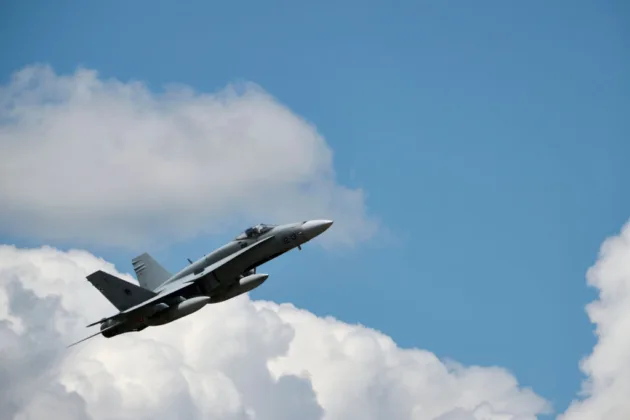
Both countries operate Patriot and HIMARS systems, and both have ordered Abrams tanks, K9 howitzers and F-35 fighters. Under the EU’s SAFE defence loans, shared among 19 member states, Poland received the largest allocation, €43.7 billion, and Romania the second-largest, €16.68 billion, together about two-fifths of the €150 billion.
In May, Poland’s WB Group signed a memorandum with Romaero on producing its Warmate loitering munitions in Bucharest. Polish soldiers have served in Romania, and Romanian air-defence troops in Poland, since 2017.
In October 2025, Washington ended the rotation of elements of a US brigade through Mihail Kogălniceanu, near Constanța. About 1,000 American troops remain in Romania. In Bucharest, Nawrocki called the security of the Black Sea and the Baltic “interconnected”.
The presidents have done their part: Dan came to Warsaw in March, and Nawrocki spent three days in Romania in May. The governments last held intergovernmental consultations in Bucharest in March 2023.
This year their foreign ministers agreed on a fifth round in Warsaw before the end of 2026. Making the meetings annual would be a start.
A joint programme using part of their SAFE allocations to produce ammunition, drones and air-defence systems would keep investment and jobs on the eastern flank. Rail-2-Sea, the planned line from Gdańsk to Constanța through Slovakia and Hungary, would carry goods in peacetime and armour in a crisis.
Bucharest has made Moldova’s European future a priority, and Warsaw has every reason to back it. Warsaw and Bucharest, at opposite ends of the flank, could give the B9 the core it now lacks.
None of this requires Poland to abandon Ukraine. Every złoty Poland spends in Ukraine buys protection against catastrophe. Every złoty it spends in Romania buys growth for both countries.