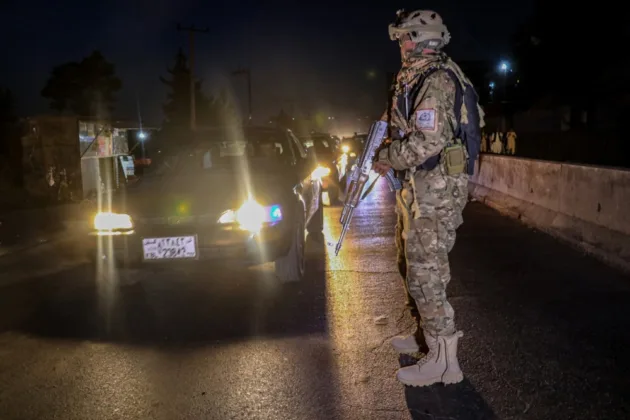



Pakistan has opened a new front in its political crisis by suspending the elected government of Khyber Pakhtunkhwa, the main stronghold of Imran Khan’s opposition and one of the country’s most unstable provinces.
The decision, taken on October 11 by President Asif Ali Zardari, allows Islamabad to take control of the province bordering Afghanistan, where Islamist insurgency, tensions with the military and protests against the central government have converged.
Shehbaz Sharif’s government has justified the intervention by citing deteriorating security conditions and the provincial authorities’ inability to contain attacks by Tehrik-i-Taliban Pakistan (TTP), the Pakistani Taliban. The prime minister’s office said the federal cabinet had cited the provincial government’s “deliberate disengagement from the fight against terrorism”.
Invoking Articles 232 and 234 of the Constitution, Islamabad has transferred the provincial government’s powers to the governor, Faisal Karim Kundi, assisted by an 11-member advisory council. Under Article 234 the proclamation lapses after two months unless Parliament extends it and cannot remain in force for more than six months. Both houses endorsed the emergency on October 14, with opposition members walking out in protest.
The move represents a direct blow to Pakistan Tehreek-e-Insaf (PTI), the party of Imran Khan, who has been imprisoned since 2023. Khyber Pakhtunkhwa was the only province still governed by his party, which has denounced the intervention as an operation designed to eliminate its last remaining foothold in government.
Opposition parties and rights groups say the use of emergency powers to remove a democratically elected administration undermines basic democratic principles. The intervention also further subordinates provincial institutions to a federal government widely seen as backed by the military establishment.
The detention of provincial chief minister Sohail Afridi and other political leaders has further heightened tensions, prompting Amnesty International to warn of arbitrary detentions, internet shutdowns and the risk of abuses associated with the military deployment. “Emergency measures are not a blank cheque to crack down on human rights, silence dissent, or concentrate power,” said Babu Ram Pant, the organisation’s deputy regional director for South Asia. PTI says Afridi has not been seen in public since October 11.
Former US envoy to Afghanistan Zalmay Khalilzad has also warned of the consequences. According to Khalilzad, the removal of the elected government could increase recruitment by the TTP, strengthen Pashtun separatist movements and provide Pakistan’s regional rivals with new opportunities to weaken its security establishment. The move, he wrote, would “further alienate the local population while worsening the overall security situation”.
Khalilzad believes Islamabad is seeking to fragment political support for Imran Khan, but warns that the strategy could ultimately strengthen extremist organisations. Despite these risks, the central government’s actual strategy remains unclear beyond its apparent determination to eliminate the opposition as quickly as possible.
The crisis also threatens to complicate Pakistan’s relations with the European Union, particularly given its dependence on the Generalised Scheme of Preferences Plus (GSP+).
This mechanism allows Islamabad to export a wide range of products to the European market duty-free in exchange for implementing 27 international conventions covering human rights, labour rights, environmental protection and good governance. Allegations of arbitrary detentions, restrictions on fundamental freedoms and military abuses could prompt a European review of Pakistan’s compliance with these commitments.
Brussels had already registered concerns before the intervention. The EU’s most recent monitoring report pointed to a rise in enforced disappearances in Khyber Pakhtunkhwa and Balochistan, and to preventive detention powers that allow suspects to be held without charge or meaningful judicial oversight.
For now, Brussels has not announced the withdrawal of GSP+. Any suspension would require an assessment and a formal procedure, but the economic consequences could be considerable.
According to a joint European Commission and European External Action Service report published on July 16, 2026, Pakistan exported approximately €7.5 billion worth of GSP+-eligible goods in 2024 and benefited from an estimated €732 million in tariff exemptions. The European Union accounts for around 28 per cent of Pakistan’s total exports. Textiles and clothing represent approximately three-quarters of its sales to the EU market.
Losing these advantages would force many manufacturers to face standard tariffs, which can reach around 12 per cent on certain garments. Companies would have to reduce their margins, raise prices or accept a loss of orders.
Judging by examples from other sectors, the most likely outcome is that European consumers would ultimately bear the costs rather than businesses. The €732 million figure represents estimated tariff savings, not an automatic economic loss. The actual impact would depend on how manufacturers and buyers respond, although it could damage industrial employment and foreign currency inflows.
The EU’s GSP reform, which will begin to apply in January 2027, will require Pakistan to reapply to maintain its preferential access beyond 2028. Under Regulation (EU) 2026/1395 the number of conventions beneficiaries must implement rises from 27 to 32.
Bangladesh emerges as the main potential beneficiary. Its powerful garment industry and duty-free access under the EU’s Everything But Arms initiative would allow it to capture some of the orders currently placed with Pakistani manufacturers.
China could also increase its exports thanks to its industrial capacity, while Türkiye would benefit from its geographical proximity and shorter delivery times.
Vietnam, which has a preferential trade agreement with the EU, and India, which is particularly competitive in cotton, fabrics and home textiles, would complete the group of potential beneficiaries.