









The centre-left Polish Government led by Prime Minister Donald Tusk has updated Poland’s nuclear power strategy, announcing that the country’s first ever nuclear plant would join the power grid in 2036, three years later than previously planned, and that the second plant would be ready in 2040, one year later than previously envisaged.
The delays were anticipated as a result of the present government deciding to conduct an audit of the last Conservative (PiS) government’s nuclear programme, which that administration adopted in 2020, and the fact that the new government chose to re-examine the arrangements reached by their predecessors for the construction of the first nuclear power plant by a US consortium.
The Tusk administration claims, though, that the country is still on track for nuclear power to become a major part of a more diversified energy mix, providing around 15 to 16 per cent of the total by 2040.
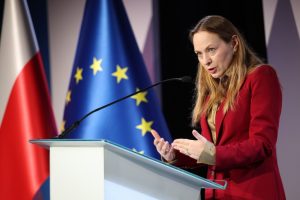
“This is not just a plan to develop new capacity, but also to build a strong Polish nuclear industry. We are building a nuclear sector that will drive the Polish economy and serve our security for decades to come,” said energy minister Miłosz Motyka when introducing the new strategy on October 2.
In reality the technology which will be used in the construction of the proposed power plants will be foreign.
The government’s strategy does aim, though, to increase the role of Polish companies in the sector. Domestic firms are expected to account for about 40 per cent of the value of the first reactor project, according to the government, with that share rising to around 70 per cent for subsequent reactors as Polish companies gradually develop the expertise, experience and acquire the necessary certifications. The energy ministry has put the value of the work flowing to domestic suppliers at some 100 billion zloty (€23.5 billion).
Under the updated Polish Nuclear Power Programme, Poland plans to develop two nuclear power plants with a combined capacity of around 6 GW to 9 GW, using large-scale Generation III+ reactors.
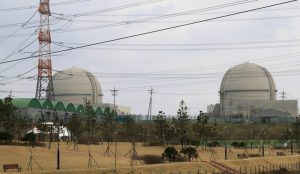
The first plant, which will have a total capacity of about 3.75 GW and will house three Westinghouse AP1000 reactors, is being built on the Baltic coast at Lubiatowo-Kopalino, in the municipality of Choczewo, Pomerania, northern Poland, in partnership with a US-based consortium made up of Westinghouse and Bechtel.
The European Commission cleared Polish state aid for the project on December 9, 2025, which is set to receive almost 60.2 billion zloty (€14.2 billion) in public support between 2025 and 2030.
On March 31, 2026, the investor, State-owned Polskie Elektrownie Jądrowe, submitted an application to the National Atomic Energy Agency (PAA) for a permit to construct the plant, a dossier of more than 40,000 pages on which the regulator has up to 24 months to rule. The pouring of the first nuclear concrete is scheduled for the final quarter of 2028.
The first reactor is now expected to enter commercial operation in 2036, three years later than previously planned, with the two remaining units following in 2037 and 2038.
Plans are already underway for another nuclear power plant, with construction scheduled to begin in 2032 and the first unit expected to be completed in 2040, one year later than previously planned.
The final decision on the location of the second plant has yet to be made but the favourites are two small cities in central Poland, Bełchatów and Konin, both of which have experience in power generation. Kozienice and Połaniec were also considered before the energy ministry singled out the first two, each of them built around a large coal-fired station.
Companies from the United States, France and Canada are currently competing to supply the technology and build it. South Korea had expressed an interest but withdrew after the previous PiS government’s preference for the plant to be built by the South Koreans in Konin was overturned by the Tusk government.
Poland is expected to choose its partner for that second nuclear power plant in 2027, with France being the favourites because of the Tusk government’s preference to do business with EU member states and desire to become even closer allies with the French after the two countries signed a defence treaty in Nancy, eastern France, on May 9, 2025.
The opposition Conservatives (PiS) are critical of the Tusk government over the delays in the nuclear power programme as well as delays in the construction of the Central Communication Port (CPK), a planned airport and rail hub west of Warsaw. They argue that the Tusk government is dragging its feet on these priority projects partly because of its problems with the budget deficit and its hostility to projects that were started by the last PiS government and which the then Tusk-led opposition had criticised for being “overblown and grandiose”.
But the expansion of nuclear power is part of the effort to reduce Poland’s reliance on coal which currently generates just over half of the nation’s power, the highest figure in the EU.
The trend, though, is towards diversifying the energy mix with coal declining from generating close to 90 per cent of power a decade ago while renewables have risen from 9 per cent to 29 per cent.
According to Poland’s national energy and climate plan, approved by the Council of Ministers on June 8, the country is targeting for coal to account for less than 5 per cent of the energy mix by 2040 while 15 per cent is to be derived from nuclear power, 8 per cent from gas, with most of the remainder coming from renewables such as onshore and offshore wind and solar.
Traditional large-scale nuclear plants are to be supplemented by the country developing small modular reactor (SMR) capacity.
SMRs, which are prefabricated in factories before being installed onsite, are much smaller than traditional reactors, and their proponents claim that these reactors provide a faster and more cost-effective way of generating energy from nuclear sources.
A group of leading Polish businessmen has announced that they are investing in a project to develop small modular nuclear reactors.
One of the businessmen concerned is Rafał Brzoska, the founder of the international parcel delivery group InPost, but the consortium is led by Poland’s richest man Michał Sołowow, whose Synthos Green Energy company is to benefit from 500 million zloty (€118 million) raised from Polish investors on October 1, part of 1.85 billion zloty (€435 million) in capital commitments that include 1.35 billion zloty from foreign backers, to roll out the BWRX-300 reactors in Central and Eastern Europe as well as the UK.
The BWRX-300 is a 300-megawatt water-cooled small modular reactor. Construction of the first ever unit began in Canada in 2025, at the Darlington site in Ontario, with completion planned for 2029 and commercial operation expected in 2030.
Sołowow is already involved in another nuclear project in partnership with Poland’s fuel, gas and renewables giant Orlen. That SMR-based venture, OSGE, was held up for years by disagreements between the partners, though Sołowow said on September 30 that the two sides had finally come to terms and expected to settle the remaining issues by the end of 2026. The first Polish BWRX-300 unit is planned for Włocławek, central Poland.
Analysts estimate that demand for electricity is set to rise by 40 per cent in Poland over the next 14 years, according to grid operator Polskie Sieci Elektroenergetyczne (PSE). Electricity prices have risen fast in recent years and are now the second most expensive in the EU in relation to the cost of living.
The arrival of power-hungry AI systems and data centres as well as the increasing demand for air conditioning are likely to mean these estimates are conservative.
The Polish nuclear power programme has been a work in progress since the 1980s when the communist government had actually chosen the first location for a nuclear power plant in the north of Poland, at Żarnowiec in Pomerania.
That plant would have been built with the use of technology from the USSR but the project was shelved as a result of economic problems Poland was facing and the political fallout from the Chernobyl disaster of 1986.
In the 1990s nuclear power was not seen as a priority at a time when the country was facing the challenges of switching to a market economy and applying to join NATO and the EU.
The debate over nuclear power returned in the 2000s but was affected by the nuclear disaster at Fukushima in Japan in 2011, after which Germany chose to close down its nuclear power capacity.
The Tusk government (2007-2015) which was in charge in Poland at the time was closely allied with Germany whose government and environmental organisations were opposed to Poland developing nuclear power.
One of the reasons for that was that Germany at the time was planning to use cheap Russian gas to be turned into electricity that could be exported to its neighbouring countries such as Poland.
The pressures of climate policies being pursued by the EU, though, meant that Poland had to reduce its dependence on coal in order to reduce emissions and therefore the next Conservative (PiS) government made developing nuclear power capacity one of its priorities.
PiS’s closeness to the first Trump administration in the US meant that the Americans were keen to help Poland as long as their businesses could benefit. This is why in 2020 the PiS government announced that the first nuclear power station would be built in the north of Poland in partnership with the US.
After the 2022 Russian full-scale invasion of Ukraine Germany moved away from its dependence on cheap gas from the Russians and began considering restarting nuclear power itself. This meant that German opposition to EU funding of nuclear power projects and to Polish nuclear capacity became much weaker.
At the same time the political climate around nuclear power changed throughout Europe, including Poland, because of rising energy needs and the fact that nuclear power produces no carbon emissions. This meant that there was little or no opposition in Poland to nuclear power when the decisions to build the first nuclear power station came.