





Polish broadcaster TV Republika, an outlet which is highly critical of the centre-left coalition government led by Prime Minister Donald Tusk, has been placed under investigation after its editor-in-chief Tomasz Sakiewicz claimed that there was no police presence while reporting from the scene of a mass shooting in Kraków, southern Poland. It is also being pursued over its reporting of a police arrest of a protester against the Tusk administration.
TV Republika is a conservative channel, partly funded by its own viewers, many of whose journalists came to the station after being purged from the state broadcaster TVP, which was taken over by the government via putting it into a state of liquidation in order to change management in December 2023.
The independent broadcaster has on several occasions been prevented from attending government press conferences but remains Poland’s most watched news channel, while the government-controlled TVP Info news channel has lost more than half of its viewers since the Tusk government came to power. On November 10, government spokesman Adam Szłapka said the station had not been accredited for that day’s government press conference.
Since May, TV Republika executives and journalists have been the victims of hoax calls to the police alleging that life-threatening incidents were occurring in their homes. In each case the police arrived and demanded to enter their premises and insisted on searching them.
The police claim that they were following procedures in each of these cases and eventually identified the alleged culprit of the hoax alarms. In Sakiewicz’s case, officers handcuffed his assistant. Prosecutors later concluded that police had acted in the mistaken belief that a suicidal minor was inside but that the intervention had been “carried out improperly”.
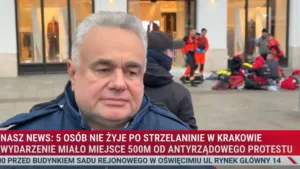
The government-controlled prosecution service, headed by justice minister and prosecutor general Waldemar Żurek, on November 12 announced that it has launched an investigation into TV Republika’s coverage of the mass shooting in Kraków on November 7 in which six people perished and 16 were wounded. Prosecutors have classified the shooting as a terrorist attack. The gunman, a 24-year-old identified as Michał O., died in hospital on November 9.
Sakiewicz happened to be in Kraków Old Town covering an anti-government demonstration in the city’s Main Market Square and went live on air to report the unfolding drama.
“I see the wounded, the dead, bodies in the market square, helicopters landing, ambulances – and I still don’t see any police, not a single officer. It’s unbelievable,” Sakiewicz said.
In a side street nearby, though, two police officers had chased down the gunman and in a firefight managed to stop him from killing or injuring more people, despite the officers having themselves been severely wounded.
Sakiewicz also did not notice that a police officer was standing nearby with a police armband for identification and reported a rumour, which proved to be false, that the shooting had been started by a group of foreigners.
During his report, Sakiewicz said “probably all the police reserves have been sent to Warsaw,” referring to a dispute between Poland’s opposition-allied President Karol Nawrocki and the Tusk government over the Constitutional Court and the legitimacy of judges elected to serve in it.
As a result, the prosecutors announced that they were investigating alleged defamation against the police, as well as the public insult of a group of people on the grounds of nationality over the claim about foreigners. “Freedom of speech does not give anyone immunity from legal consequences,” Żurek wrote.
On October 30, police officers were deployed at the Constitutional Court in Warsaw to install government-supporting judges and stop judges allied with the former Law and Justice (PiS) government from entering the building. That day, court president Bogdan Święczkowski and his deputy Bartłomiej Sochański were suspended. Nawrocki called it a “forcible takeover of a constitutional organ of the State”, while police denied that officers had entered the building.
The police presence was massive and has remained stationed at the court since. Reporters have highlighted that many officers deployed in Warsaw to guard the Constitutional Court came from other cities.
According to TV Republika, on November 7, the day of the attack in Kraków, 141 officers from the Kraków Police Prevention Unit were sent to Warsaw and only 10 officers were patrolling the entire Old Town in the crucial minutes before the attack.
A campaign has been organised online by Tusk supporters calling for TV Republika’s licence to be revoked by the media regulator, the National Broadcasting Council (KRRiT). This is unlikely to happen as the Tusk government’s nominees do not have a majority on that body’s governing board. KRRiT chair Agnieszka Glapiak has opened explanatory proceedings after the regulator received more than 5,000 complaints, among them one from culture minister Marta Cienkowska.
Under pressure from the outrage whipped up online, some advertisers, including electronics retailer RTV Euro AGD and Mastercard, have pulled out of placing their advertising with TV Republika.
Sakiewicz has denied any wrongdoing and has claimed the probe is part of an effort to “destroy democracy” and “take away freedom of speech” and has called on viewers of his channel to boycott those companies that withdraw advertising from TV Republika.
The TV Republika head has pointed out that during a live broadcast in a fast-moving situation there are bound to be mistakes made but that he was reporting what he was seeing and hearing. He also pointed to the fact that many police officers since October 30 have been deployed away from their home patch because of the operation the Tusk government launched during the takeover of the Constitutional Court.
His view was backed by President Karol Nawrocki’s spokesman Rafał Leśkiewicz.
“We made it clear that you have to put yourself in the shoes of someone reporting on those dramatic events from the scene. He may have said a few words too many, but that doesn’t mean you can now go after a television station operating under a lawfully issued licence and use a few sentences from its CEO as a pretext. That’s unacceptable. TV Republika, like other conservative broadcasters, regularly and accurately points out the failings of Donald Tusk’s government.”
The President’s aide criticised the government’s handling of information about the Kraków attack.
“We take a very critical view of the authorities’ actions. I ask the prime minister when he will hold Minister Marcin Kierwiński to account for spreading misinformation about the Kraków terrorist’s motives. He said the attacker had been inspired by right-wing ideologies. How could he have known that? There was no way he could have known. He said it, and that claim went out into the world. He hasn’t apologised for those remarks,” Leśkiewicz said, referring to comments by the interior minister made in the immediate aftermath of the attack.
Kierwiński said on November 7 that “everything indicates” the gunman was “fascinated by far-right ideologies”. He later described the remark as a preliminary assessment.
He reiterated that he would “defend all media outlets operating legally in Poland”.
“The machinery of government must not be used to hinder or prevent any media outlet from operating in Poland. I’ll stand up for any television station that comes under pressure from those in power. TV Republika was the first television station to report on what happened in Kraków,” added Leśkiewicz.
Meanwhile, on the same day the Kraków prosecutors announced their investigation over alleged defamation, police officers visited the Warsaw premises of TV Republika on the orders of the Regional Prosecutor’s Office in Szczecin and served the station with papers demanding the release of licensing documentation.
The government-controlled press agency PAP reported that TV Republika was issued with the demand as part of a separate investigation into coverage in October of the dispute around the Constitutional Court.
The probe was launched following a broadcast made by the station on October 16, on the basis of a notification filed by the interior minister, with police also requesting access to broadcast recordings and logs from that day.
The prosecutor’s office stated that the first alleged offence under investigation concerned “inciting, through a TV Republika programme, the disclosure of information relating to the private life of a female police officer, followed by its public dissemination without her consent, under circumstances that could pose a threat to the officer’s safety or that of her immediate family”.
The second concerned “the display of news tickers and statements by reporters containing offensive and degrading content directed at police officers while they were performing their official duties and in connection with those duties, as well as at the Prime Minister”.
The third alleged offence involved making unlawful threats of criminal prosecution against officers securing an assembly near the Constitutional Court, with the aim of forcing them to refrain from carrying out lawful official duties.
The station’s management refused, citing journalistic privilege, with its representatives stressing that the demand to hand over materials and disclose information about those involved in the broadcast undermined the fundamental principles governing the work of journalists. They emphasised that journalistic privilege was not discretionary but constituted one of the fundamental safeguards of media independence.
Editor-in-chief Tomasz Sakiewicz accused the police of participating in what he called a coup d’état during the takeover of the Constitutional Court. He questioned why the channel should hand over materials that could be used by police to defend themselves and suggested that national police chief Marek Boroń might himself face charges in the case.
The channel fears, though, that the matter will not rest there. Prosecutors can order the seizure of data storage devices, equipment and even servers used to broadcast the station signal, which could indirectly lead to the station having to go off air.
The case that brought police officers to TV Republika’s headquarters concerns events that took place outside the Constitutional Court on October 16 when a man, identified as Piotr W., was forcibly detained by police officers after running away from them. He was formally charged with assaulting police officers but a Warsaw court refused the prosecutor’s motion for his temporary detention on October 18.
The government-controlled TVP Info falsely reported that the man had attacked a policewoman with a knife when in fact he simply had a penknife inside his coat which he did not display during the incident, but neither the channel nor the press agency PAP, which issued such a report, has been brought to account for their disinformation.
Jarosław Kaczyński, who leads PiS, Poland’s main opposition party, slammed the investigations into TV Republika, calling them an attempt to “eliminate freedom of speech” by the Tusk administration.
President Nawrocki’s spokesman Rafał Leśkiewicz agreed that TV Republika was being victimised.
**”**We may have different views on how the media operate in Poland, but let’s judge them fairly. TV Republika has the same right to operate as any other media outlet in Poland. The steps prosecutors are taking today to intimidate the station are unacceptable in a democratic state governed by the rule of law,” he said.