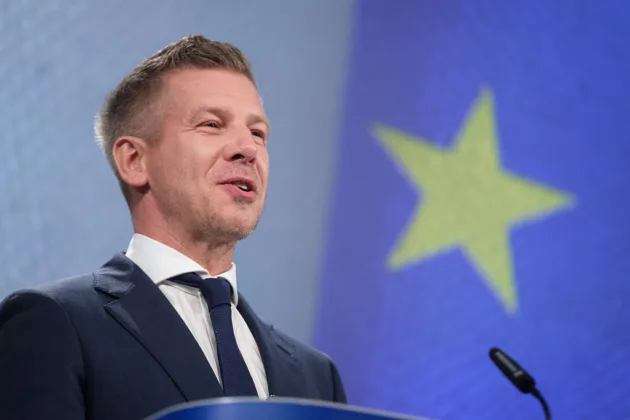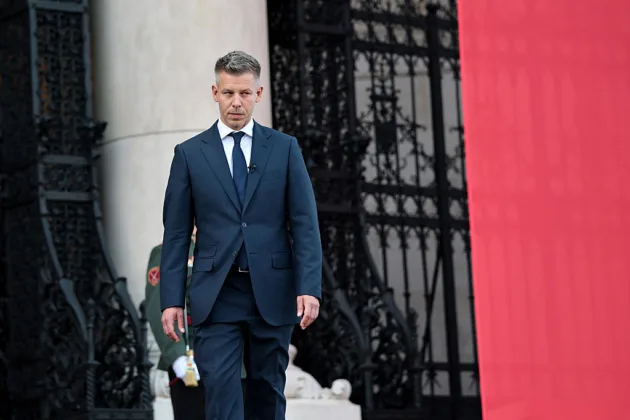



The Polish Association of Journalists (Stowarzyszenie Dziennikarzy Polskich, SDP) has condemned the action taken by the government of Prime Minister Péter Magyar against Hungarian public media and compared it with the actions of the Tusk government, which within days of taking office put public media into a state of liquidation.
Hungarian viewers have since July 7 been watching black stills with apologies for “lies” of the previous management of public media in the country. The main public news channel M1 and Kossuth Radio suspended their news output, while entertainment programming continued on other channels. M1 resumed broadcasting the following day, though without news or current affairs.
In a statement issued by the Polish Association of Journalists the Hungarian government’s move was called a “purge”.
“The purge in Hungarian media and attempts to subject them to control by the Magyar government constitute an attack on freedom of speech, an attempt to introduce censorship and a disregard for European values,” reads the statement, signed by SDP secretary general Hubert Bekrycht and published on July 8.
The Polish journalists have called for international protests against “destruction of Hungarian media” as they claim that it seems “certain that repression will not be confined just to public media.”
In their statement they recall events that took place in Poland in December 2023, just a few days after the present centre-left government led by Prime Minister Donald Tusk took power.
The Tusk government forcibly took over Polish television TVP, Polish state radio (Polskie Radio) and the Polish state press agency PAP with a decree being issued by culture minister Bartłomiej Sienkiewicz on December 20, 2023, that totally ignored the law on public media.
The law on public media in Poland makes the National Media Board , whose members are appointed by the Sejm and the President, responsible for appointments to the boards of publicly owned media outlets.
The ministerial decree was enforced by the police with news broadcasts stopped for two days as a purge of staff was carried out.
Fearing the courts might deem the action illegal the minister next put all public media into a state of liquidation on December 27, 2023, the conditions under which they are operating until this day.
No liquidation has in fact been carried out and no new legislation on public media passed, with public money continuing to flow to the state media entities as before.
The Tusk government had accused the previous management of extreme bias in favour of the Law and Justice (PiS) government that preceded the current administration. Though independent media monitors in their analysis have shown that pro-government bias in favour of the current government is no weaker than it had been in the period before.
Moreover, the changes introduced by PiS were carried out as a result of legislation passed in December 2015 and signed into law in January 2016 and no force or legal subterfuge had been used in the changes that were made.
The previous management of TVP had actually grown the audience of the broadcaster with its news channel rivalling the most popular commercial news channel TVN.
Since the Tusk takeover the viewing figures for TVP‘s news channel have fallen by almost two-thirds while the independent conservative broadcaster TV Republika and the independent YouTube channel Kanał Zero ratings have rocketed. According to Nielsen Media figures reported by Press, TV Republika led all Polish news channels in the first half of 2026 with a 5.51 per cent audience share, ahead of TVN24 on 5 per cent and TVP Info on 1.84 per cent.
The Polish Association of Journalists said in its statement that “the principles of free speech in the EU are being undermined” in Hungary and Poland but that the EU has failed to acknowledge that, making it all the more likely that other media will get attacked by these governments.
The statement goes on to say that since December 2023 when Tusk took office attacks on independent non-state media have intensified.
They were alluding to attacks on TV Republika with the broadcaster’s journalists hounded by prosecutors and not allowed in on government press conferences and the detention for several days of a journalist who had persisted in investigating Tusk’s attorney for money laundering.
The government has also moved to place liberal media outlets TVN and Polsat on a list of strategic companies the takeover of which requires government approval, a decision announced by Tusk on December 11, 2024 amid reports that a Portuguese fund linked to a Hungarian businessman close to Orbán was close to buying TVN from Warner Bros. Discovery.
What has changed markedly over the last decade is the solidarity between fellow journalists in protecting each other.
It was still there back in 2014, during the time of the last Tusk government, where there was outrage across all media when the security services stormed the offices of the weekly Wprost, which had published illicit recordings of conversations between state officials.
Over a decade later such solidarity is absent as journalists increasingly choose to take sides in the polarised partisan struggle between the Right and the globalist centre-left.
Sadly, during the period of the present government journalists working in the public and liberal media have sometimes expressed glee when conservative journalists have been harassed and vilified for their work.
Yet all journalists in Poland face problems with current legislation governing the work of their fraternity.
The fact that in Poland defamation is a criminal offence under Article 212 of the penal code, punishable by up to one year in prison, has led some journalists to face jail sentences for their publications. The EU’s rule of law reports have repeatedly criticised Poland for that law, yet no action has been taken.
Journalists also complain about the law which forces them to obtain authorisation from the interviewee for any published interviews. This leads to delays and the interviewees changing their minds about passages of the interview. The European Court of Human Rights ruled in Wizerkaniuk v Poland in 2011 that the provision breached freedom of expression, but it remains on the statute book.
Though in Poland, despite the challenges, thanks to the growth of TV Republika and the arrival of new media such as Kanał Zero, media pluralism has been preserved despite the government takeover of public media.