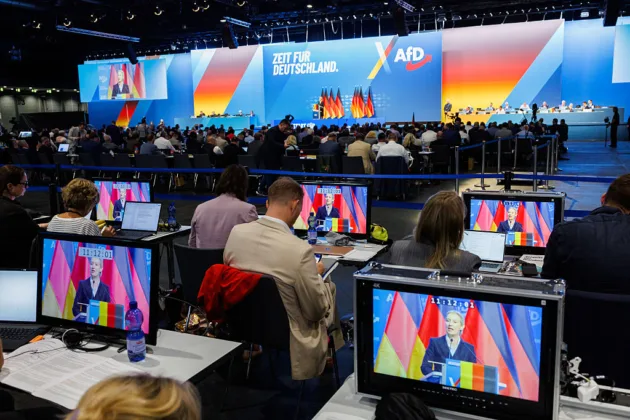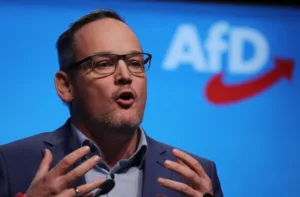




At East Germany’s municipal level, there is no longer a firewall with the Alternative for Germany (AfD) party, said Daniel Peters, State leader of the German Christian Democrats (CDU) in Mecklenburg-Western Pomerania.
He called for an overhaul on how to deal with the right-wing populist party in his country.
“In eastern Germany, there is no longer a firewall with the AfD at the municipal level,” Peters told daily Nordkurier on April 16.
Especially after the national success of the party in the February elections and its huge popularity in the East, the “exclusion and demonisation of the AfD must come to an end”, he said.
According to Peters, it would be a mistake to disparage the party.
“If we exclude and demonise the AfD, we push the AfD into exactly the role in which it feels particularly comfortable – namely, in the role of victim. From this role, the AfD also achieves the solidarity effects in the population,” he said.
Peters insisted he did not strive for substantive co-operation with the party but called for “formal normalisation in dealing with the AfD”.
“Not all AfD members and representatives are enemies of the Constitution,” he said.
Peters’ remarks came after national CDU heavyweight Jens Spahn called for a different approach to the AfD in an interview with newspaper Bild.
Spahn had indicated he was open to AfD politicians chairing parliamentary committees, as they were legally entitled to.
“I would simply recommend that we deal with the AfD as an opposition party in the same way in terms of procedures and processes as with any other opposition party,” he said.
As the largest opposition party, the AfD was in principle entitled to several committee chairmanships. But members of those committees were allowed to decide who became their chairman and left-wing parties have always voted against the AfD.
Other German parties have agreed not to co-operate with the AfD, which they have labelled as extremist. This principle was termed der Brandmauer (firewall).
In January, CDU leader Friedrich Merz accepted the support of the AfD for a motion on migration in the Bundestag, or parliament. This led to outrage on the Left. Afterwards, the CDU repeatedly stressed it would not to govern with the AfD.
“The AfD is not a party like any other,” Katja Mast, parliamentary manager of the SPD parliamentary group, told German daily Tagesspiegel. “We will protect our democratic institutions – above all our parliament – with all determination.”
The AfD was trying to “undermine our institutions”, Mast claimed. “This extremism meets with our determined resistance.
“The election of a Bundestag vice president or committee chairman is not an automatic question of entitlement but a decision of parliament and needs a majority,” she added.
Heidi Reichinnek, of the leftwing Die Linke, said her party would “never” vote for an AfD member in any function.
“These are enemies of democracy, who are at least in parts certainly right-wing extremists. We will certainly not roll out the carpet for a party that wants to destroy democracy from within,” she said.
US Vice-President JD Vance has said German politicians should work with all parties, including the hard-right and anti-immigrant Alternative for Germany. https://t.co/Y95LLAcjD6
— Brussels Signal (@brusselssignal) February 14, 2025