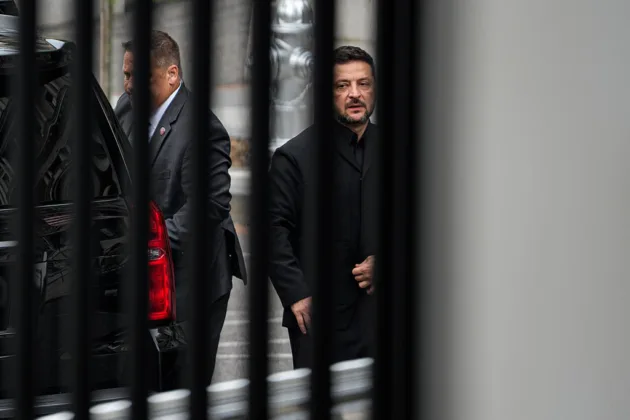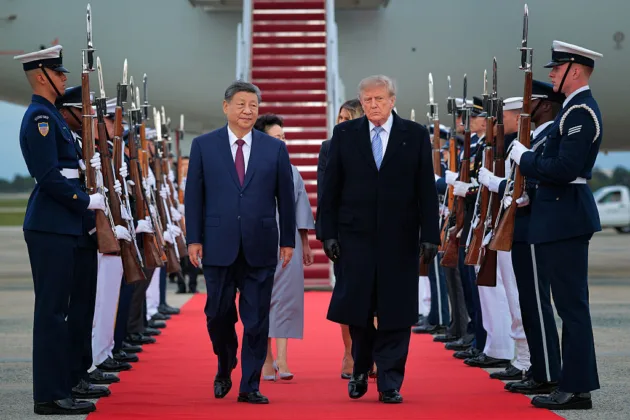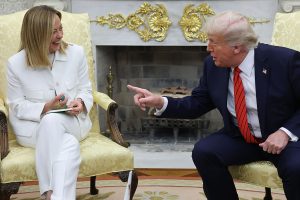


The White House meetings on August 18 between President Donald Trump and eight European leaders were extraordinary for a variety of reasons. For one, never had so many high-profile leaders visited the White House at once, and at such a pivotal moment. The pictures from the meetings, which included an Oval Office discussion, will almost assuredly feature in the history books. But what was even more extraordinary was that all of Trump’s guests – NATO’s General Secretary Mark Rutte, the United Kingdom’s Prime Minister Keir Starmer, France’s President Emmanuel Macron, Italy’s Prime Minister Giorgia Meloni, Germany’s Chancellor Friedrich Merz, Finland’s President Alexander Stubb, the European Commission’s President Ursula von der Leyen, and Ukraine’s Volodymyr Zelensky – left the meeting happy.
Just months ago, this would have seemed impossible. February’s Oval Office argument between Zelensky, Trump, and Vice President JD Vance seemed to put paid to any sort of breakthrough. Trump administration and congressional criticisms of Europe’s draconian speech laws also made it seem unlikely that any happy handshakes would happen anytime soon between the leader of the Free World and the leaders of the Old.
What changed?
As some in Brussels might have it, it was the firmness of the “Coalition of the Willing,” the troubling term (anyone remember Iraq?) that the aforementioned leaders have come up with for themselves, that convinced Trump to join in and consider America providing Ukraine with some sort of security guarantee.
But this rosy version of events is not borne out by reality. In fact, Monday’s events revealed a starkly opposite truth: There is no Coalition of the Willing. Instead, it’s a Coalition of the Unwilling – and the meeting on the 18th left them unmoved. The “Coalition of the Willing” is simply unable to will themselves to any action without the participation of the United States.
Europe has talked a big game for years now about how it is taking defence seriously. The actual numbers, of course, tell a different story. Promises of defence-spending increases which will only come to fruition in the mid-2030s and, in many cases, turned out to be merely hypothetical. NATO’s Rutte repeatedly talked about “Europeans stepping up” in a White House meeting with Trump earlier this year, offering the recent exception-filled 5-per-cent-of-GDP-on-defence target NATO members recently agreed to.
They have also talked big on how crucial it is to defend Ukraine and how the country cannot be pressured into doing anything it does not want to do. As Germany’s Merz put it, “The Russian demand that Kyiv give up the free parts of Donbas corresponds, to put it bluntly, to a proposal for the United States to have to give up Florida.” This is of course an absurd comparison – America has controlled Florida longer than an independent Ukrainian state has even existed, and it ignores the reality that there is currently a force occupying almost 90 per cent of the entirety of the Donbas (you could not get such numbers out of Florida unless you count mosquitoes and alligators) – but it reveals the depths to which Europeans say they are committed.
But yet, they need to come to the Oval Office to get Trump’s signoff. If you ask a Brussels establishmentarian why this is the case, they may answer honestly (though it may hurt them to say): America is the indispensable nation. No one can do what the United States can, which has a military budget higher than Russia’s and China’s (and the next seven countries) put together. Likewise, no one – sans Russia – has as many nuclear weapons.
But the thing is that America does not have to be indispensable to Europe’s security. This is a choice. The aforementioned advantages America has – nuclear weapons, a high military budget – are, fundamentally, excuses for a Coalition of the Unwilling. They are excuses because Europe could have the means at which to ward off Russia. Poland alone has already achieved enormous success in rearmament, to the degree where they could genuinely give Russia a real fight if it ever came down to it. If the rest of Europe rearmed as Poland has, they would likely face no issues against Russia in a ground war; at the very least, they would be able to hold their own.
Likewise, there is nothing requiring Europe to stay as de-nuclearized as it is. Yes, they are members of treaties like the Nuclear Non-Proliferation Treaty or even the Treaty on the Prohibition of Nuclear Weapons, but treaties can be abandoned. France and the United Kingdom already have nuclear arms; they could increase their stockpiles and diversify their delivery methods. The red tape that restricts European innovation could be cut. And social spending could be sacrificed for military spending.
While Europe has admittedly shown some initiative – von der Leyen is currently trying to cut red tape, though results are to be determined – it has mostly been halting and far from what is needed. They choose not to do these things because they are hard, not because they are easy (to ruin a famous phrase). It takes immense political will – and large amounts of political capital – to do them.
But instead, Europe prefers to be led by the United States. They will claim the partnership is equal, of course. But one of the pictures taken from the Oval Office meeting, and excitedly released by the White House, tells the true story: all eight European leaders sitting across from President Trump, who is positioned at their centre, akin to a headmaster speaking with lower-ranked teachers. Or even, perhaps, with his students.