
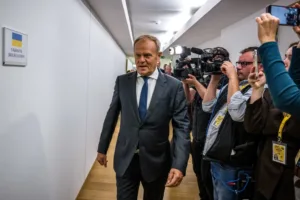





German Chancellor Friedrich Merz’s personal popularity has fallen to a new low, according to the latest ZDF Politbarometer survey published on August 20, 2026.
The poll is conducted by Forschungsgruppe Wahlen, a long-established Mannheim-based institute that has produced the ZDF Politbarometer since 1977. It questioned 1,319 eligible voters between August 17 and 19.
Respondents are asked “What do you think of…?” and rate politicians on a scale running from +5 (very positive) to –5 (very negative). On this measure Merz scored –1.9, his personal worst result.
The previous edition, carried out July 28-30, had put him at –1.5.
Defence minister Boris Pistorius (Social Democratic Party, SPD) remains clearly the most popular figure with a rating of +1.3, down from 1.5 in July.
Alternative for Germany (AfD) co-chair Alice Weidel sits at the bottom of the top-10 list on –2.5.
The survey also points to serious doubts about Merz’s authority inside his own party. Some 80 per cent of respondents, including 67 per cent of Christian Democratic Union (CDU) and Christian Social Union (CSU) supporters, believe the Christian Democrats are not fully behind their chairman and chancellor.
Dissatisfaction with his record in office has reached a high point as well, with 75 per cent unhappy with his work as chancellor and 20 per cent satisfied.
In the voting-intention projection the AfD leads on 27 per cent (down one point from the previous poll), followed by the CDU/CSU on 22 per cent (also down one).
The Greens stand at 14 per cent and the SPD at 12 per cent, level with Die Linke. A continuation of the current black-red coalition would still lack a parliamentary majority.
The same poll found 75 per cent opposed to scrapping the so-called Rente mit 63, a flagship pension reform that would end early retirement for workers with long contribution records. Majorities in every party’s support base rejected it.
The findings land weeks before elections in Saxony-Anhalt on September 6, 2026 and Mecklenburg-Vorpommern on September 20, 2026, with surveys placing the AfD first in both. Asked about the CDU’s refusal to govern with other parties, 61 per cent backed the ban on cooperation with the AfD, while 62 per cent called the equivalent line towards Die Linke wrong.
The figures mark a further deterioration for Merz since he took office in May 2025.
A Brussels Signal report on April 28, 2026 noted that he had become Germany’s least popular politician in a separate INSA ranking, with satisfaction levels collapsing both among the general public and within parts of his own conservative base.
The latest ZDF Politbarometer itself does not include a detailed breakdown of why respondents rate Merz so poorly.
Broader coverage and earlier polls, though, point to several recurring explanations for his sustained unpopularity.
These include unfulfilled promises, half-hearted reforms, poor economic results and a perceived readiness to compromise with the Left. Internally there is also growing criticism within his own Christian Democratic party.
German Chancellor Friedrich Merz has reached the first anniversary of his swearing-in on May 6, 2026, with little to celebrate. A year on from the day he became the first German leader to need a second Bundestag vote to take office, Merz has presided over a stagnant economy, a…
— Brussels Signal (@brusselssignal) May 6, 2026