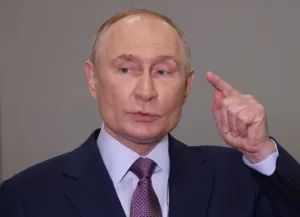

With the focus on the Middle East, there has been comparatively little attention paid for some months to the Ukraine War. It is now clear that Russia has failed decisively in the pursuit of President Vladimir Putin’s dream of reviving the Russian Empire of Peter the Great and Stalin. Readers will recall the almost universal expectation when the present Russian invasion of Ukraine was launched in February 2022, that easy victory awaited the Kremlin. Even the chairman of the US Joint Chiefs of Staff, General Mark Milley, who though an odious political manipulator whose conduct sometimes verged on treason, was assumed, ex officio, to know something about war, predicted Russian occupation of Kiev within a few days and of all Ukraine within a few weeks.
This war has already lasted almost six months longer than the great Russo-German conflict of 1941-1945. That was the last serious combat endeavour of Russian arms, and although they were heavily supplied by the Western allies, the Red Army endured 10,000 casualties a day for many months and the legacy of that terrible and cruel war in which more than five million prisoners of war, including Stalin’s son, were murdered, was undoubtedly a saga of great Russian bravery.
It is now obvious that 77 years without firing a shot in anger, other than in the prolonged fiasco in Afghanistan which involved a comparatively small insertion of Russian forces, reduced the Russian army to a flabby, undisciplined, demoralised, top-heavy, blunderbuss operation led by an undistinguished officer corps. Doubtless, if Putin’s army was defending its own motherland against a deadly enemy, as the Red Army was against the German Wehrmacht, it would’ve put in more impressive performance. But in this war, against an apparently much weaker adversary, Russia has effectively failed to get beyond the 20 percent of Ukraine that is Russian-speaking (though there is almost no evidence that they would prefer to live in Russia).
Russia has suffered over one million casualties, perhaps 200,000 deserters and at least 500,000 draft avoiders. Despite the initial Russian preponderance in sophisticated weapons, the Ukrainians have taken advantage of their enemies’ complacent tactics and wrought havoc with sophisticated drone attacks. Russia has a GDP smaller than Canada’s and conducting a war on this scale and for this long has been a terrible strain. It is obvious that Russia does not have the military capacity to reoccupy and digest its former provinces.
Ukraine was an ethnic mixture of Poles, Lithuanians, Russians, and Tartars and was fought over by the countries that composed its constituent ethnicities. It was only set up as a jurisdiction as a Soviet Republic under Lenin within the USSR in 1920. This is the basis of Putin’s contention that Ukraine never really existed and he made its reabsorption Russia’s chief ambition for reoccupation in what was known in Russia after the break-up of the Soviet Union as “the near abroad”. Putin snapped off two provinces of dissident Georgia and took back Crimea when the pro-Russian president of Ukraine was overthrown by Western elements with considerable assistance of the Western powers, in 2014.
Belarus is effectively a Russian satellite and the Kremlin exercises extensive influence in some of the Islamic Asian former Soviet Republics, including Kazakhstan. The pro-Russian faction in Moldova has so far been outmanoeuvred by the champions of a closer relationship with Romania, and the small Baltic republics of Latvia, Lithuania, and Estonia seem to have got away from the Kremlin by becoming members of NATO. But Ukraine was the great prize in a natural reconstruction of the USSR. This appeared to be facilitated by the enfeeblement of the Biden administration and the terrible failure of most of the NATO members except Poland and Estonia (and the UK and French nuclear forces) to maintain any deterrent force that the Russians were likely to take seriously. Europe’s performance, in beseeching the assistance of the United States to deal with the European problem of Ukraine and decrying the conduct of the Kremlin from the steeples and rooftops of Western Europe while financing Russian aggression by buying Russian oil and gas, has contributed importantly to American scepticism about the current state of NATO.
The Ukraine War was meant by Putin to herald the return of Russia to the front rank of the world’s powers after its shattering bloodless defeat in the Cold War. No one should underestimate the extent of the setback Russia has sustained. Of the world’s leaders, only President Trump has shown any recognition of the desirability of offering Putin as escape from this war that is not so demeaning that it consigns Russia to permanent vassalage to China. What is desirable is the unambiguous affirmation of the sovereignty and permanence of the major jurisdictions that seceded from the USSR. But it is also not in the interests of the West for the defeat of Russia to become a triumph for China.