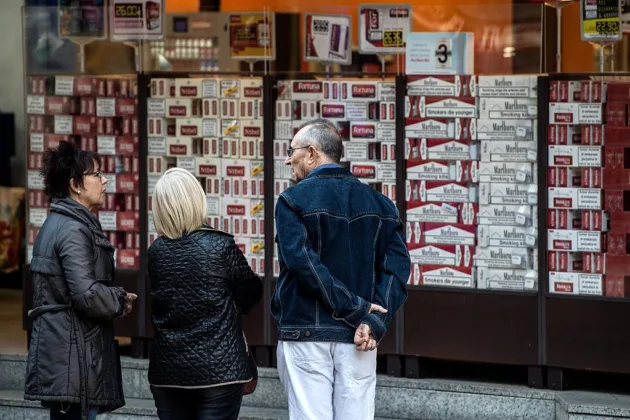









Negotiations on a major overhaul of the EU’s Tobacco Taxation Directive have collapsed, with Sweden refusing to support the proposal and effectively halting progress on one of the Commission’s flagship public health initiatives.
The Cypriot EU Council Presidency admitted defeat on June 3, stating that despite months of intensive talks, member states could not reach the required unanimous agreement.
“Unfortunately, despite our efforts in recent months, it is not possible to reach an agreement,” a Cypriot spokesperson said in a written statement.
As a result, the matter won’t be discussed on June 12, when member states’ ministers meet and will fall on the Irish Presidency instead.
Earlier, the Danish Presidency of the Council of the European Union had pushed for sweeping tobacco tax hikes.
Brussels wants to keep those taxes for its own budget and it is aiming for several billion euros in revenues.
The Commission’s proposal, tabled in 2025, aimed to significantly raise minimum excise duties on cigarettes (more than doubling them in some cases) and introduce new minimum taxes on emerging products such as e-cigarettes, heated tobacco, and nicotine pouches for the first time.
In the European Parliament’s committee on Economic Affairs, there was a majority agreement on a softer version of the tobacco taxation plans this week, but it didn’t make the Council’s agenda due to the lack of unanimity at the member states.
Tobacco taxation update: MEPs recommend lower duties and longer transition – PRESS RELEASEhttps://t.co/1iw2Yu10C3
— ECON Committee Press (@EP_Economics) June 3, 2026
After the vote in the committee, the rapporteur for both texts, Tomáš Kubín (PfE, CZ), said, “My aim has been to support a modern and more coherent framework, while making sure that the rules remain realistic, proportionate and enforceable.”
“I believe a differentiated treatment of products according to their specificities, patterns of use and risk profiles is essential. Moreover, through a more gradual implementation of the new rules, we can achieve greater predictability for Member States’ authorities.”
Kubín said it was to make the Directive “more workable in practice”.
Socialists and Democrats reacted with outrage on this agreement, accusing the European People’s party (EPP) of working with the far-right, again.
They accused the EPP of “hypocrisy”, for both supporting the EU’s Beating Cancer Plan, which aims to reduce tobacco use to less than 5 per cent of the population by 2040,and to “align with the far right to dismantle it”.
Cesar Luena, S&D negotiator on new EU legislation on tobacco taxation, said: “This is a deeply damaging result – for public health, for taxpayers, and for every European whose life could be saved by bolder action on tobacco. The only winners today are the tobacco barons, and now we know who works for them in this House.”
Jonás Fernández, S&D spokesperson on economic and monetary affairs, added that the report “delivers an unacceptable outcome”.
Italian MEP Marco Falcone (EPP – Forza Italia) said that the proposal to reform tobacco excise duties introduced the principle of “less risk, less tax” and struck a balance between protecting public health, safeguarding jobs and EU supply chains, and helping to curb the black market.
Sweden has been the main obstacle in the Council, fiercely opposing the proposed tax rates on nicotine pouches (snus and “white snus”), which are extremely popular in the country.
Swedish officials argue that the EU plan would impose a massive tax hike on a harm-reduction alternative that has helped Sweden achieve the lowest smoking rate in the EU.
Sweden has made it clear it will not accept Brussels dictating tax policy on products that have contributed to its success in reducing smoking-related harm.
The country is the only member state in Europe that reached the threshold of less than five per cent smokers, with alternative, less harmful tobacco products being ascribed a main driver of this success.
Finance Minister Elisabeth Svantesson and the Swedish government have repeatedly described the proposal as “completely unacceptable,” insisting that other member states should not be allowed to undermine Sweden’s proven tobacco harm-reduction strategy.
Stockholm has long argued that the leaked version of the directive would have driven the excise duty on nicotine pouches from SEK 207 (€19) to nearly SEK 1,600 (€147) per kilogram, representing an increase of almost 700 per cent, while channelling much of the resulting revenue to Brussels instead of Sweden.
“I will always put the interests of Swedes first. Other countries do not get to decide over our snus”, Svantesson said.
Because EU tax legislation requires unanimity, Sweden’s veto power has brought the entire reform to a standstill.
Other countries have also expressed reservations, but Sweden’s opposition has been the most vocal and decisive.
Welcoming the move, Dr Delon Human, leader of Smoke Free Sweden and former Secretary-General of the World Medical Association, said Sweden was protecting a successful approach that other European countries would do well to follow.
“This is a country that has all but eliminated smoking by making safer alternatives affordable, available and acceptable. Severely increasing taxes on those products would have punished the very people who did the responsible thing and switched. Sweden understands the value of harm reduction because it has lived the results”, he said.
The failure leaves the outdated 2011 Tobacco Taxation Directive in place for the foreseeable future, frustrating activist campaigners who wanted higher taxes.
Talks are now on hold and it remains unclear when or whether the file will be revived under the next Council presidency.
A leading addiction researcher warns the European Union is on the brink of a public health blunder, risking reversing decades of progress in reducing smoking–while ignoring its past success stories and lessons from US prohibition.https://t.co/H8mhNY3aLP
— Brussels Signal (@brusselssignal) March 30, 2026