





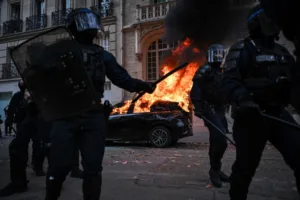


German police forcibly broke up a demonstration by Polish nationalists when the Poles attempted to march with a large cross to a memorial site for Polish victims of Nazi Germany during the Second World War.
Video footage of June 16 from the incident shows a group of men wearing yellow vests singing a patriotic song based on a poem written in opposition to attempts at the Germanisation of Poles under the Prussian partition in the early 20th century.
They were attempting to carry the cross to the site where the German authorities are planning to construct a memorial to Polish victims of the German occupation during the war.
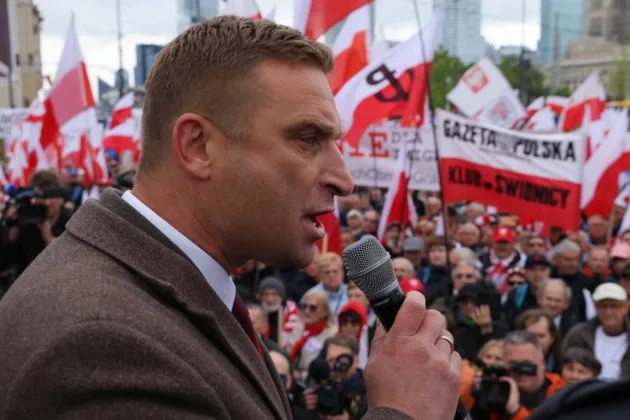
The German authorities have said that the demonstrators led by right-wing activist Robert Bąkiewicz who heads up the Border Defence Movement (ROG) did not have permission to demonstrate.
Bąkiewicz has in the past been the organizer of Independence marches in Warsaw that have been criticised by liberals for encouraging xenophobia and racism. He was also involved in protests against the actions by LGBT and pro-abortion demonstrators and is currently leading the ROG which organized controversial citizen patrols of the border with Germany at a time when the Germans were being accused of pushing back illegal migrants over the border and into Poland.
He has been indicted for allegedly insulting border guards whereas liberal demonstrators who compared Polish border guards protecting the border with Belarus to German Nazis during the war have had charges against them dropped.
In a statement, Berlin police said that they had told the group, through an interpreter, that they could either hold a stationary demonstration or proceed individually to the memorial site.
The group instead attempted to continue their march with a cross, resulting in intervention by the police, who confirmed they had “used coercive measures” against participants, who were handcuffed but then released. Those “coercive measures” resulted in several of the demonstrators being hospitalised with injuries alleged to include broken ribs.
Panie Ambasadorze @Amb_Berger! Właśnie pokazaliście całemu światu, że nie było żadnych bezosobowych nazistów – byli i są Niemcy. pic.twitter.com/Ze00Qxwk5u
— Ruch Obrony Granic (@ROGranic) June 16, 2026
Opposition figures from the Conservatives (PiS) have accused the German police of brutality and called on the Polish government to launch a protest at the treatment of Bąkiewicz, a man who was a PiS parliamentary candidate, and his allies.
Marcin Przydacz, foreign policy aide to the PiS aligned President Karol Nawrocki said that it was totally unacceptable to see “Polish citizens harassed, pushed around, and treated in such a manner by the German police”.
However the reaction of the centre-left government led by Prime Minister Donald Tusk was perfunctory with the foreign ministry’s spokesman Maciej Wiewiór merely saying that the Polish consul in Berlin was seeking to “establish the circumstance of the incident and the reasons for the arrests”.
Senior ministers went further and suggested that the demonstrators had only themselves to blame.
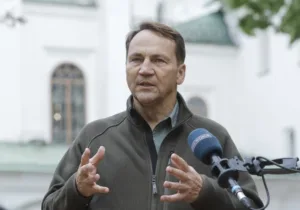
Foreign minister Radosław Sikorski posted on social media to say that Poles should understand that “local laws must be observed and instructions from security services obeyed”, adding that Polish consuls in providing assistance “cannot always protect against the consequences of unwise behaviour”.
Later, in a social media exchange with the Blanka Bąkiewicz, the daughter of Robert Bąkiewicz Sikorski mockingly attacked Bąkiewicz for his right wing views: “Please tell your daddy to be careful when ordering five beers in Germany, because promoting fascism, for obvious historical reasons, is strictly punished there.”
Defence minister Władysław Kosiniak-Kamysz went even further and speaking in the Polish Parliament actually condemned Bąkiewicz’s actions as “provocations launched solely to destroy relations between Poland and its allies” and which serve the interests of Russia.
The lack of liberal enthusiasm for defending the rights of Polish nationalist demonstrators stems from the bitter divisions on the Polish domestic political scene in which both foreign and defence policy have become victims of polarisation, with both sides accentuating rather than attempting to soothe differences.
There was never any likelihood therefore that the present government would react categorically to the fact that conservative nationalist demonstrators from Poland were treated with force by the Germany police.
But even the Tusk government is finding some aspects of relations with Germany difficult. In a goodwill gesture towards the Germans Tusk has said that his government would not pursue a massive reparations claim constructed in the days of the last PiS government, hoping that Germany would reciprocate with goodwill gestures on some form of compensation for Poland.
However, Germany thus far has not reciprocated, failing to produce any additional compensation, even for the few living victims of the war. The German position is that Poland was paid reparations from the war via the USSR in the 1950s, something to which the then communist Polish government controlled by the Soviets had agreed.
There has been talk of a centre commemorating relations between Germany and Poland being built in Berlin, but the project has not been received with much enthusiasm in Warsaw, especially in conservative circles.
PM Tusk is regarded by the Polish Right as being too accommodating towards the Germans, especially in relation to the stances he has taken within the EU. However, Tusk’s allies claim that the only way for Poland to exert more influence in the EU is through closer relations with Germany and France.
The position of the present Merz administration in Germany on issues such as Russia, nuclear energy, and migration are closer to what both the liberal and conservative circles believe to be in Poland’s interests, but disagreements remain with regard to the Green Deal and removal of the member states veto in the EU.
Polish conservatives are also committed to pressing for reparations for the sake of historical justice and remain suspicious of German domination inside the EU which they see as a form of neo-colonialism. The main opposition PiS also suspects Germany wants to return to business as usual with Russia as soon as the war in Ukraine is over.
It was because of that resistance from the conservative Right that on June 17 the Polish government entered into a defence cooperation agreement with Germany rather than a treaty which would have had to be signed by the President.