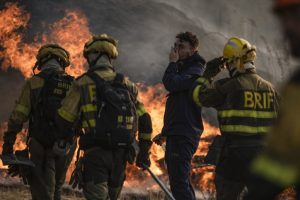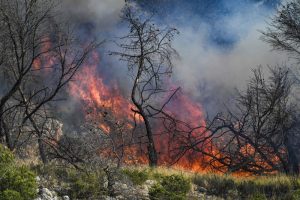










The Hellenic Fire Service has confirmed that three firefighters died tackling wildfires on Crete and in the Peloponnese on July 29, as the blazes ravaging southern Europe shifted eastwards.
Two of the men became trapped in their vehicle near the village of Krya Vrysi, in the Rethymno regional unit of central Crete, while moving between fire fronts. Initial reports indicated they were volunteers and may have died of asphyxiation, though the cause has not been formally established.
A third firefighter died near Gytheio in Laconia, in the southern Peloponnese, after being found unconscious outside the perimeter of a separate fire. He was taken to a hospital in the area and later pronounced dead.
Two more firefighters were lightly injured. The fire service said the dead men “fell heroically in the line of duty” while protecting lives and property.
Emergency messages sent through the 112 system ordered the evacuation of at least eight communities on Crete, among them Saktouria, Melampes and Agia Galini. Hundreds of residents and tourists were moved out by land and by sea.
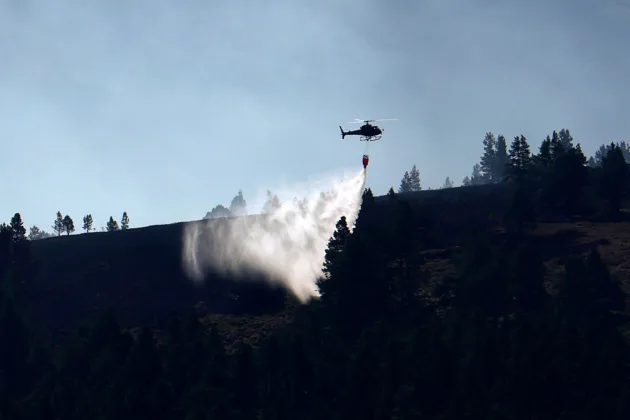
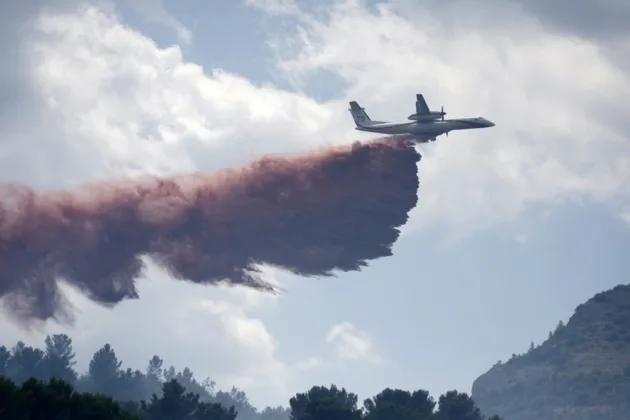
The Rethymno fire remained out of control on July 30, with 224 firefighters, 53 engines and 11 specialist forest units deployed alongside volunteers. Water-dropping aircraft were grounded for much of the morning because of the wind.
Maria Lioni, deputy regional governor of Rethymno, spoke of a “nightmare night and nightmare day”, saying the damage could not be assessed while the fire was still burning.
The fire service recorded 37 outbreaks across the country within 24 hours. It warned of very high to extreme risk on July 30 for Crete, Attica, Evia, the eastern Peloponnese, the Cyclades and the eastern Aegean islands, including Lesvos, Chios, Samos and Ikaria.
The deaths came a day after Brussels signalled the danger was moving away from the Iberian Peninsula. “The next risk, it’s already moving to Greece and also Central Europe,” Maria Zuber, head of the EU’s Emergency Response Coordination Centre, told reporters.
Zuber said Italy would face heightened risk from the start of August. The centre has sent seven aircraft and four helicopters to France and six aircraft and three ground teams to Spain, drawing on the rescEU reserve and on assets pooled by member states.
Some 434,976 hectares had burned across the EU by July 29, according to the European Forest Fire Information System. That is above the 346,836 hectares recorded by the same date in 2025, the worst year on record, and more than double the 20-year average.
Funerals for the two firefighters killed on Crete were held on July 30.