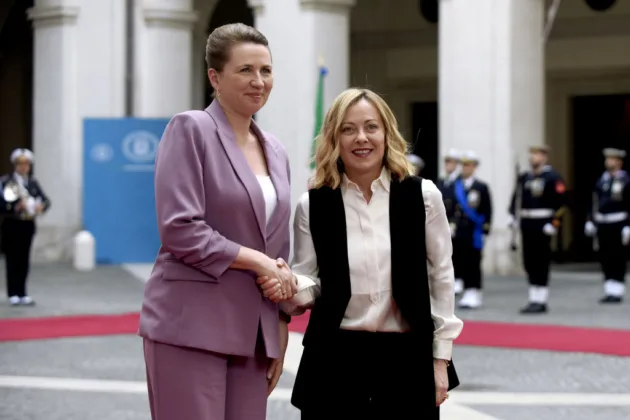




A political clash has emerged inside Europe’s socialist family over the increasingly close cooperation between Italian Prime Minister Giorgia Meloni and Danish Prime Minister Mette Frederiksen, a social democrat, in tackling illegal migration to Europe.
The dispute has exposed a deeper disagreement among European social democrats over how far the political Left should go in adopting tougher migration policies and whether cooperation with conservative governments such as Meloni’s can be justified in the name of tighter border controls.
The controversy stems from the two leaders’ coordinated response to the migration crisis that erupted in Ceuta, the Spanish enclave in North Africa, on July 30, when about 72,000 people crossed from Morocco in little more than a day, according to Spain’s interior ministry. Most returned within 48 hours.
On August 1, Italy and Denmark took the lead in a joint letter to European Council President António Costa, European Commission President Ursula von der Leyen and the Irish presidency of the Council of the European Union. It was eventually signed by 22 of the bloc’s 27 member states, with Spain, France, Portugal, Ireland and Luxembourg staying out.
The letter called for a stronger European response to illegal migration, arguing that the EU had “a duty to effectively deter and relentlessly combat illegal migration”. It called for stronger external borders and action against policies that could create “pull factors” for migrants, singling out Spain’s regularisation of irregular migrants and describing a Spanish Supreme Court ruling on pushbacks as the trigger for the crossings.
The cooperation between Meloni and Frederiksen became even more explicit on August 10, when the two prime ministers published a separate joint statement, titled “A joint message for Europe”, on their social media accounts. Despite coming from very different political backgrounds, they said they were united by a common desire to “defend Europe”.
“We do not accept uncontrolled immigration into Europe,” they wrote, arguing that illegal immigration was contributing to “rising crime rates, increasing pressure on public services and an erosion of public trust”. They called for more effective deportations and proposed creating “repatriation centres in third countries”, as well as other solutions outside Europe.
Meloni leads Italy’s conservative Right, while Frederiksen is the leader of Denmark’s Social Democrats. Their statement also went beyond migration, with the two leaders stressing the importance of protecting Europe’s “Christian cultural heritage” and saying that people coming to Europe should respect European values.
That alignment has now triggered an open confrontation inside the European socialist family. In a letter dated August 17 and made public the following day, Javi López, a vice-president of the European Parliament and a member of the Spanish Socialist Workers’ Party (PSOE), and Peppe Provenzano, foreign affairs chief of Italy’s Democratic Party (PD), wrote to Stefan Löfven, president of the Party of European Socialists (PES), criticising Frederiksen’s position.
Both men sit on the PES presidency and have asked Löfven to put the matter to the party’s next meeting and hold a vote on it.
“European solidarity cannot be selective,” López and Provenzano wrote, calling it “unacceptable” that, while another European partner was facing exceptional pressure, a member of their own political family had chosen to coordinate with Meloni. They also noted that Rome had suspended Schengen checks with Spain, a step they called propaganda because there is no free movement between Ceuta and the rest of the EU.
The two socialist politicians accused Frederiksen of adopting “the framework of the radical right”, which they said presents migration as “a permanent emergency” at a time when irregular arrivals in Europe have fallen by about 40 per cent since the start of the year. They stressed that the dispute was not merely about “a specific disagreement on migration policy”. Instead, they argued, “what is at stake is whether we accept that the extreme right sets the framework of the European debate”.
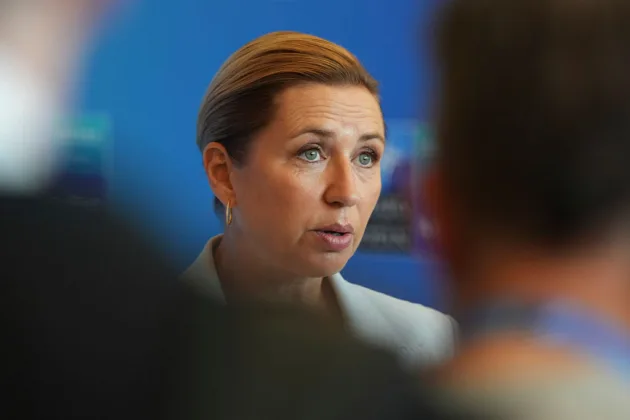
Frederiksen has been Denmark’s Prime Minister since 2019. She won a third term at a snap election on March 24, though her party took 21.8 per cent, its weakest score since 1903, and now heads a minority coalition.
Her position on migration is considerably tougher than that of many other European left-wing parties. She has pushed for policies aimed at reducing asylum applications, strengthening returns and deporting people who have no right to remain, and has backed handling asylum arrangements outside Europe.
Frederiksen’s supporters argue that social democrats risk losing working-class voters if they refuse to acknowledge concerns over irregular migration, integration and pressure on public services. Her critics, though, believe that adopting the language and priorities of the Right risks weakening the political identity of the Left.
For Meloni, the convergence is more straightforward. Since becoming Prime Minister, she has made migration a key priority, pushing for stronger EU external borders, faster returns and cooperation with non-EU countries. Her government has also promoted repatriation hubs in third countries, including through its deal with Albania, an approach Frederiksen has also supported.
The dispute has not yet turned into a formal split within the PES. Iratxe García, president of the Socialists and Democrats group in the European Parliament, has said the Danish position does not represent the European socialist family, while the Danish Social Democrats have restated their support for a strict migration policy.
No disciplinary action has been proposed against Frederiksen’s party. But the fact that two major socialist parties, the PSOE and Italy’s PD, have publicly challenged a fellow social democratic Prime Minister shows how politically sensitive the issue has become.