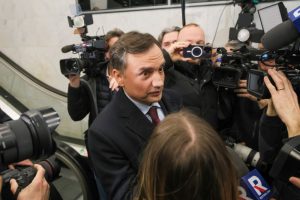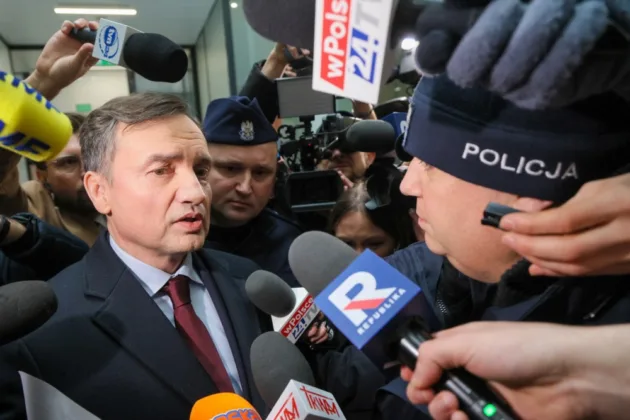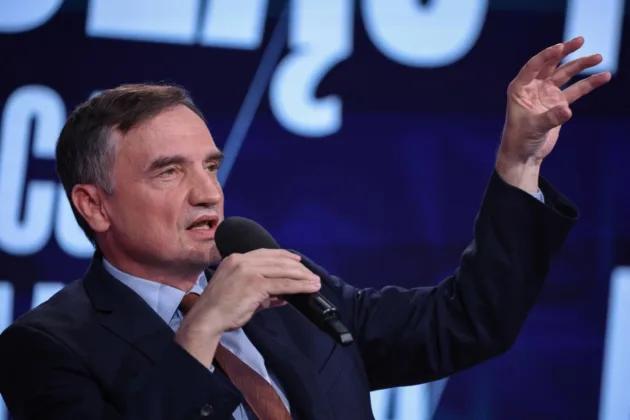











US President Donald Trump’s pardon envoy Ed Martin has told Polish media that action against the former justice minister in the last Conservative (PiS) government taken by the centre-left government led by Prime Minister Donald Tusk represented “lawfare” weaponised to fight political opponents.
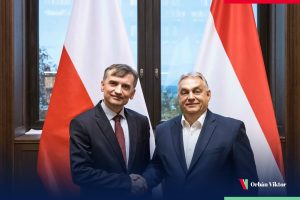
Ziobro has been granted an entry visit to the US following his being granted asylum by the last Hungarian government led by PM Viktor Orbán, but then threatened with being sent back to Poland by the new head of the Hungarian government, Péter Magyar.
The PiS ex-minister has been indicted by the prosecution service controlled by the Tusk government on charges of abuse of power during his time as justice minister (2007-2015), his parliamentary immunity lifted and arrest warrant issued. However, no European Arrest Warrant has as yet been applied for via the Polish courts.
He has not been accused of having personally benefitted from any of the financial decisions taken during this time at the ministry but of abusing the Justice Fund administered by his officials to fund political causes and to, allegedly illegally, purchase spyware that was used for surveillance against the then liberal opposition.
Ziobro denies the charges, saying that all the appropriate procedures relating to managing the Justice Fund, designed to help prevent crime and help the victims of crime, were followed to the letter and that the use of the Pegasus spyware was authorized by the courts for hundreds of cases, only a few of which involved opposition politicians.
According to Ed Martin the treatment handed out to Ziobro by the Tusk government is partisan and vindictive.
“Things that every other Minister of Justice did are now being called crimes – it’s hard to even talk about it. The Soviets were on your land not so long ago, and this looks like Soviet communism, a return of the globalists,” said Ed Martin in an interview with Poland’s most popular current affairs broadcaster TV Republika.
Martin, who has been involved in providing legal assistance to individuals affected by “lawfare” including those charged after January 6, 2021, when the attack on the Capitol took place, pointed out that communists in Poland used state power in a similar way against citizens to what happened then.
“In America, we thought we had a system that respects the rule of law, but instead we became the target of lawfare. So when I became a partner in President Trump’s legal team, he said: Find the people, the victims of lawfare, who were targeted by prosecutors, and help them especially. That’s why we understand very well what we are seeing in Poland , whether in the case of Minister Ziobro or journalists. We realise they did it to Trump, they did it to his family, and this poses a huge threat to our shared way of life, to freedom,” argued Martin.
He was alluding to the fact that a number of journalists in Poland have faced discrimination in access to government press conferences and also in facing legal action because of their activities.
But he concentrated on the Ziobro case emphasising that it was making an impression on Americans because of the high office which Ziobro held.
“For an American, the Minister of Justice is a very important role, in a sense the highest office after the president, and to see him being attacked by the media, by the judicial system, and by Tusk seems impossible. It seems impossible, but we have seen them do exactly the same to Trump,” he said.
Martin also said that one element of “lawfare” is that the process itself serves as a vindictive sort of punishment.
“When they do this to someone, they are: ‘We will come for you’. Their families worry, their wives worry, they change jobs, they have to spend money on lawyers. Going through the process of lawfare is meant to exhaust people, it is meant to harm them,” he said.
“If they can do this to Ziobro, if they can do this to Trump, they will certainly do it to you and your neighbour. Well, they will do it to you, but they will also do it to your neighbours and ordinary people. They will try, and you must stop it,” he added.
The US official urged the Polish opposition to resist.
“You have to stand up to this, you have to win elections, you have to talk about it, you have to watch programmes that show you the truth. You must understand that mainstream media will lie about what happened, trying to twist the situation to their advantage.”
He also claimed that the EU is not protecting opponents it does not approve of and instead joins in the process of “lawfare”.
“The European Union does this more than anyone else. This is how globalists try to steer their propaganda.”
The Polish government has expressed irritation with the Trump administration over Ziobro being granted an entry visa into the USA with foreign minister Radosław Sikorski claiming that it had been obtained “under false pretences”.
Ziobro was reported to have been granted a journalist visa to work as commentator for TV Republika in the USA and Polish prosecutors have actually interviewed the broadcaster’s CEO Tomasz Sakiewic on suspicion that he had “aided and abetted the flight of a fugitive from Polish justice”.
However, in fact Ziobro had left Poland without any assistance from the broadcaster when he travelled to Hungary last year. He left Hungary on a document granted to him by the Hungarians to which all people who have been granted asylum are entitled to, therefore his departure from Europe and entry to the USA were legal.
The Polish government has asked the visa granted to Ziobro to be revoked by the US authorities but this is most unlikely, especially given remarks such as those made by Martin.
The Poles have submitted detailed documentation to the US authorities with regard to the charges Ziobro is facing back at home but the highly charged political climate over these makes it that much easier for Ziobro’s defence lawyers to argue that he would not be able to face a fair trial back in his home country.
It was the suspicion that Ziobro would not face a fair trial which led the Hungarians to grant the ex-minister political asylum last year.
Ziobro’s defence lawyers are also likely to use the fact that Poland has been criticised by international organisations, including the European Commission, for extensive use of pre-trial detention.
It was that threat of pre-trail detention which was a key factor in persuading Ziobro, a man who is recovering from cancer of the oesophagus, to leave Poland.
The authorities pursued his pre-trial detention despite the fact that they claimed they possessed all the evidence to prosecute him while any flight risk could have been mitigated by the demand of bail, removal of passport and even electronic restrictions on movement.
Ziobro knew how civil servants who had worked for him and Father Michał Olszewski had been put in pre-trial detention for several months. The priest was subjected to being paraded in handcuffs in public and in the initial stages of detention had his sleep patterns disrupted and was even denied food and water for hours in the first 24 hours of his imprisonment, events which led to an intervention from Poland’s Ombudsman Marcin Wiącek.
Father Olszewski’s foundation had benefitted from grants from the Justice Fund which the present government deemed to have been misappropriation of public funds.
Ziobro is one of many former PiS state officials pursued by the authorities for alleged abuse of power. None of the cases thus far involved any claims of the individuals concerned having personally benefitted financially from the alleged abuses.
Among those being pursued are the former PiS PM Materusz Morawiecki, ex-defence minister Mariusz Błaszczak and past PiS minister of the interior Mariusz Kamiński.
One of the key promises of the Tusk government was that they would hold former PiS officials to account and that promise has been pursued with great determination and extensive media coverage, though without much legal success. No PiS ex-minister has as yet been convicted for alleged offences pertaining to the last period of PiS rule (2015-2023).