

With the Polish parliamentary elections beckoning in the autumn of 2027, the centre-left government led by Prime Minister Donald Tusk has announced measures to put money in the pockets of middle-class voters who have been the electoral base for his Civic Coalition (KO) in a bid to improve its poll ratings.
While Tusk’s party leads in the opinion polls, the poor ratings of his coalition partners mean that the government’s bloc trails behind the parties of the Polish right that could form the next government under the patronage of the right’s champion President Karol Nawrocki.
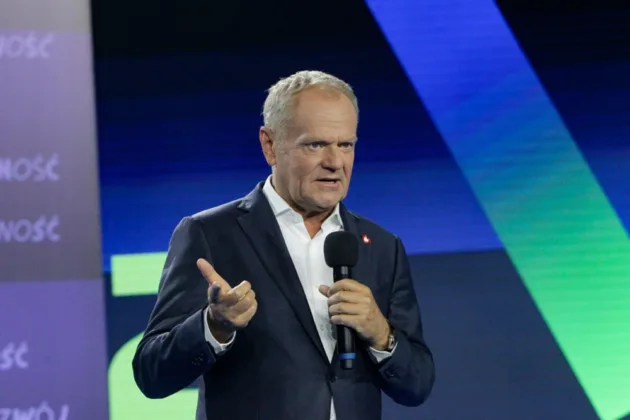
Speaking at a press conference on August 19, Tusk said that together with finance minister Andrzej Domański, he had prepared a package of tax changes that would come into force in 2027 benefitting 3.5 million taxpayers with annual savings of up to 3,600 zł (€830) per taxpayer.
The government has proposed raising the higher-rate income tax threshold from 120,000 zł (€27,700) to 130,000 zł (€30,000), creating a new tax band of 24 per cent for earnings between 130,000 zł and 150,000 zł (€34,700) with all earnings above that level taxed at 32 per cent.
The current income tax set-up consists of just two tax bands of 12 and 32 per cent. For earnings between 30,000 zł (€6,900) and 120,000 zł individuals pay 12 per cent in tax and are taxed at 32 per cent for all earnings above 120,000 zł.
Tusk noted that, since his government took office, pay has increased by around 30 per cent, bringing increasing numbers of people into the higher tax bracket.
According to figures from the Polish statistics agency GUS, in June average gross monthly earnings at companies employing more than nine people were 9,401.58 zł (€2,170), or some 113,000 zł (€26,100) per year.
“We’re not talking about millionaires here; we’re talking about a growing middle class on whose shoulders the financing of state security, defence spending rests to a large extent,” said finance minister Domański.
“We want to change this so that those who work hard to earn their average wage can clearly feel the relief and we want this to be financed by the wealthiest companies and the wealthiest individuals, who have the lowest tax burden,” added Tusk.
In order to finance the proposals the government has proposed to increase corporate income tax (CIT) for larger companies with revenues exceeding €50 million from 19 to 22 per cent.
Other proposals to generate revenue include increasing the solidarity levy for individuals earning more than 1 million zł (€231,000) per annum to 5 per cent, up by 1 percentage point, and restoring the previous revenue limit for self-employed taxpayers to €250,000 from the current level of €2 million.
In order for the Tusk government’s proposal to come into force legislation will have to be approved by parliament and then signed by President Nawrocki.
The President’s senior aide Paweł Szefernaker reacted to the government’s proposal with scepticism.
“We already have a complicated tax system which the government wants to complicate further. Instead of raising the tax-free allowance as they promised in the election campaign they are proposing a new tax band and higher corporate income tax for some companies,” said Szefernaker.
According to Szefernaker, Nawrocki has already proposed legislation that would simplify the tax system for everyone by raising the ceiling on the first tax band to 140,000 zł (€32,400) and parliament should consider that idea.
The President has already vetoed 41 government bills and Szefernaker’s remarks suggest that more could be on their way, even though the government’s proposal could lower taxes for a significant proportion of the population.
The Prime Minister and his party are keen to offset the fact that they have not delivered on one of their flagship election promises from 2023, the doubling of the tax-free allowance from 30,000 zł to 60,000 zł (€13,900), a promise they will not be able to deliver in the course of the present parliament.
But they are also keen to show sensitivity to the rising cost of living and therefore on August 13 the Tusk government announced the reintroduction of measures used earlier in the year to lower petrol prices.
The package which will cover the period until the end of August reduces value added tax (VAT) on fuel from 23 to 8 per cent and reintroduces retail consumer price caps on fuel which are set daily by the energy minister.
As a result of the change petrol prices have fallen by around 1 zł (€0.23) on a litre of petrol.
When similar measures (which also then included cuts in excise duty on fuels) were in place between the end of March and end of June, they cost the state just over €1 billion.
That measure brought fuel prices in Poland down to being among the lowest in the EU and since they were withdrawn in June prices at the pump have risen rapidly.
Economists at PKO BP, a major state-owned bank, said on July 31 that higher fuel prices in July, which stemmed from the expiry of price support and an increase in global oil prices, were the main drivers of inflation accelerating from 2.5 per cent in June to 3 per cent in July.
Tusk on August 13 also criticised Poland’s right-wing opposition allied President Karol Nawrocki for having blocked a windfall tax on fuel companies’ excess profits by referring it to the Constitutional Tribunal, claiming that the 4 billion zł (€920 million) proceeds could have been used to subsidise fuel prices.
Nawrocki’s chancellery has argued that fuel companies would simply have passed on the costs of tax increases onto customers and criticised the government for a belated response to rising fuel prices.
Though the government and the President have agreed on legislation which has just created Personal Investment Accounts (OKI) which will allow individual Poles to invest up to 100,000 zł (€23,100) without paying capital gains tax, currently at the level of 19 per cent.
The Polish stock market on which people are being encouraged to invest is dominated by giant state enterprises. The creation of the investment accounts is aimed at increasing the amount invested on the country’s stock exchange so that more capital is available for promising private companies to grow. This is why the amount which may be deposited in government bonds as part of the tax-free investment account will be limited to just a quarter of that 100,000 zł.
Poland’s economy is still growing at an impressive pace, with the European Commission forecasting expansion of 3.5 per cent in 2026. With the exception of the pandemic contraction in 2020, the economy has grown every year since 1992.
But Poland has also ranked among the European Union countries with the largest year-on-year increase in public debt relative to gross domestic product (GDP). This is according to the latest data published by Eurostat.
The latest Eurostat figures show that at the end of the first quarter of 2026, Poland was among the EU member states where the ratio of public debt to GDP increased the fastest compared with the same period a year earlier.
The budget for 2027 will be closely watched given that Poland’s fiscal situation has led the country to be placed under the EU’s excessive deficit procedure in 2024 and despite that fact the deficit rose from 6.4 per cent of GDP in 2024 to 7.3 per cent in 2025, the second highest level in the EU. This year Polish public debt actually exceeded the EU’s limit of 60 per cent of GDP.
As a result of the rising debt two of the big three rating agencies, Fitch and Moody’s, have moved Poland’s credit outlook to negative.
Since Poland is entering the year of a general election in which the current Tusk government will want to defeat the parties of the right that support President Nawrocki it is most unlikely that the country will tackle its growing budget deficit and escalating public debt.
The latest measures to cut tax and fuel prices indicate what the direction of travel is to be. Tusk and his government will at every turn attempt to show that the population at large rather than just large companies are benefitting from the years of impressive economic growth.
Tusk is also pressing his coalition partners to stand on one joint election slate in the coming election. He believes that with the right conflicted and fragmented a joint list for the ruling centre and left parties could make the difference between winning and losing.
On the face of it his coalition partners on the Left and the centre-right Polish People’s Party (PSL) are not that keen. But the Left party suggesting it wants to ally with the “Together” party that stopped supporting the Tusk government in 2024 and the PSL saying it wants to rebuild a centre-right coalition with the divided “Poland 2050” centrist grouping are showing that they actually may have little choice.
The Together party has shown no sign of wanting to ally with the pro-Tusk left and “Poland 2050” and PSL are polling very poorly and would find it difficult to cross the 5 per cent electoral threshold. Allying with the bigger Civic Coalition (KO) which leads in the polls would at least guarantee both the PSL and the Left party representation in the next parliament.
Their hand may also be forced by the fact that the right may in the end avoid being divided into four electoral lists.
Currently the right is divided into the largest Law and Justice (PiS), the breakaway (from PiS) Rozwój Plus led by former PiS Prime Minister Mateusz Morawiecki, the libertarian nationalist Confederation Party and the right-wing nationalist Catholic Confederation of the Polish Crown party led by maverick MEP Grzegorz Braun.
Yet it is not inconceivable that under the influence of President Nawrocki, the only figure who is respected by all the parties of the right, they may in the end stand in two blocks with Morawiecki fielding a joint slate with PiS and Braun forming a joint slate with his former colleagues from the Confederation Party.
It is difficult to imagine right now, when the wounds of recent splits inside both right-wing camps are so fresh. Many commentators feel that even if the parties of the right were to get a majority in parliament they would find it hard to form a government as none of them thus far seems willing to include Braun’s party, despite the fact that without his support there is unlikely to be a majority in parliament to elect a right-wing government.
But the election is still a year away and if a week is a long time in politics then a year is almost eternity. The existence of the electoral threshold of 5 per cent, the lack of enthusiasm for a ‘Bulgarian’ scenario of gridlock leading to repeated early elections and the draw of ministerial cars and appointments to state bodies may all shift the dial towards compromise.
The Prime Minister is determined to be the face of Polish prosperity, stability and security in the coming election while portraying his right-wing opponents as dangerous radicals who want to pursue identity politics.
Yet identity politics polarising Poland between left and right on attitudes to migration, gender, climate change and national sovereignty is not going away and creates more traction than issues relating to economic development.
In the end, in the autumn of 2027, Tusk is likely to be the face of a Poland more closely integrated with the EU, more secular and socially liberal whereas the right will be the face of Poland wanting to retain its sovereignty and defence of conservative and Catholic values.