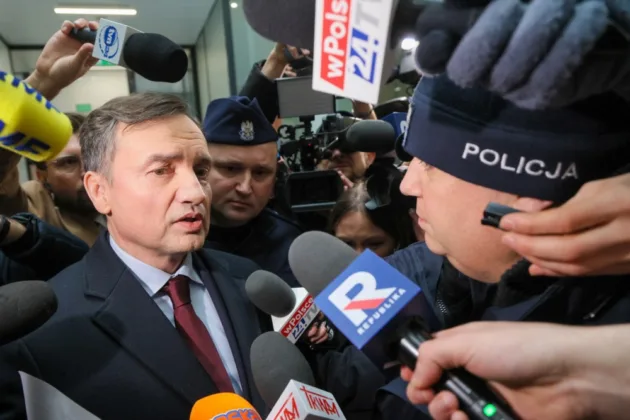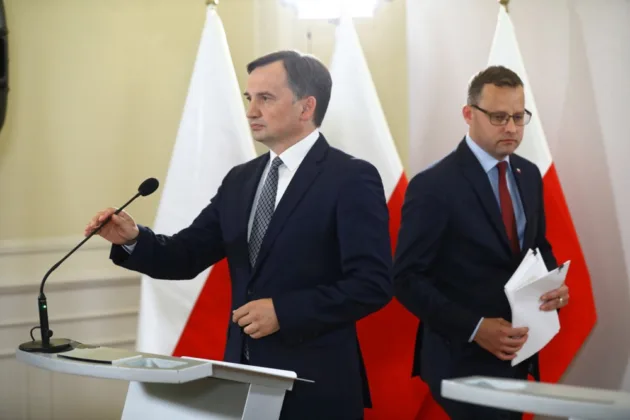











A court in Warsaw has rejected a request made by prosecutors working for the centre-left government led by Prime Minister Donald Tusk to issue a European Arrest Warrant (EAW) for Zbigniew Ziobro, the former Justice Minister in the last Conservative (PiS) government, who has been indicted for alleged abuse of power.
The court said that it had rejected the request for an EAW to be issued because the plaintiffs failed to demonstrate that Ziobro was actually staying within the EU or had any intention to travel to an EU country.
Since early May Ziobro has been staying in the USA where he is working as commentator for Polish conservative broadcaster TV Republika. He travelled to the US from Budapest where he had been granted asylum and travel documents by the last Hungarian government led by Prime Minister Viktor Orban.
Despite Ziobro’s presence in the US, Polish prosecutors were still seeking a European arrest warrant against him, arguing that such a warrant would be necessary to detain the former justice minister if he were to return to the EU.
The former justice minister reportedly flew to the US having received help from a State Department official despite Warsaw having previously warned Washington against assisting Ziobro, arguing that such a move would amount to “undue political interference.”
In February this year, following a Polish court’s decision to place him in pre-trial detention, a nationwide arrest warrant was issued for the former minister. Prosecutors subsequently applied to the court for a European Arrest Warrant which was denied on July 13.
The ex-justice minister had by then left Poland for Hungary, just before the Tusk supporting parliamentary majority voted to lift his immunity from prosecution and granting authority for his detention.
Ziobro left Hungary because of public statements made by Peter Magyar, the incoming Hungarian Prime Minister. Magyar made it clear that he would lift immunity on Ziobro and wanted to return him to Poland.
Magyar saw this move as a way of warming relations with the Tusk government which had actually withdrawn the Polish ambassador from Budapest in retaliation at the Orban administration’s decision to grant the ex-minister asylum.
In late June the Magyar administration kept their word and removed Hungarian protection from Ziobro, invalidating the former PiS minister’s travel documents on which he had managed to obtain a US visa to work for TV Republika.
Poland’s current justice minister, Waldemar Żurek, told state news agency PAP that the justice ministry would “use all legal means to bring the fugitives to justice in Poland.”
Żurek said in a social media post on Thursday that Warsaw would reach out to Washington to ask “whether individuals deprived of valid travel documents may continue to stay on US territory.”
The Tusk government has delivered thousands of pages of evidence against Ziobro for the Americans to examine but its case for deporting the ex-minister will not have been helped by the Polish court’s refusal to file for the EAW. The US is not well known for easily granting deportation orders against people its government has granted shelter for.
Poland has expressed its displeasure with President Donald Trump administration’s decision to help Ziobro.
However, they could not have been surprised by it, since the Polish opposition PiS is closely aligned with the Trump administration.
Nor will they have been surprised by the fact that the PiS aligned Polish President Karol Nawrocki had no intention of helping them lobby the US administration which views PM Donald Tusk as persona no grata because of his remarks about Trump being a Russian asset.
Nawrocki, who has made it a priority to stay on the right side of Trump, has in the past said that he would not have chosen to leave Poland as Ziobro had, but he also made clear that he felt the case being pursued against Ziobro was politically vindictive and that “there was little likelihood Ziobro would get a fair trial in Poland.
Ziobro’ colleagues in PiS have acknowledged that Ziobro leaving was “not a good look” as it was interpreted as an admission of guilt by their opponents, but have reminded that Ziobro is currently recovering from cancer of the esophagus.
They also argued that the government was determined to put Ziobro in pre-trial detention not because the investigation against Ziobro warranted it, but because it wanted to “feed their electoral base” that wanted to see Ziobro jailed, even if on a temporary basis.
Zbigniew Ziobro, who was one of the most influential figures in the previous PiS administration, is accused of committing 26 offences relating to the misuse of public funds and abuse of power.
Polish prosecutors accuse Ziobro of establishing and leading an “organized criminal group” that misused around 35 million Euro from the Justice Fund, a state program created to help victims of crime and to fund crime prevention.
Prosecutors say the funds were instead channeled into projects linked to his political allies and used to purchase the controversial Israeli Pegasus spyware, later allegedly used to monitor PiS’s political rivals.
Politicians from Tusk’s camp have also pointed to the fact the existence of correspondence between Ziobro and PiS leader Jarosław Kaczyński before the 2019 parliamentary election in which the latter warned the justice minister not to use resources from the Justice Fund for electoral purposes.
The justice minister was at the time the leader of a separate party called “Solidarity Poland” which was in an electoral alliance with PiS and keen to ensure his supporters were returned to Parliament, while Kaczyński preferred that the candidates backed by PiS itself won these seats.
It was reported at the time that Ziobro’s grouping wasn’t receiving any share of the public funding PiS was receiving as part of the state funding of political parties and compensation for incurred electoral expenses during the 2015 election.
Ziobro denies the charges levied against him by the Tusk administration and, like other senior PiS figures who have also been pursued by the Tusk administration, and claims the investigation is politically motivated.
None of the charges made against Ziobro relate to him having benefitted personally from any of the questioned spending of public funds.
Ziobro has defended himself by arguing that he had followed the regulations governing the allocation and disbursements from the Justice Fund and that the purchase of the Pegasus spyware was used in hundreds of surveillance cases, all of which were authorised by a judge and only a handful of which involved the then liberal opposition’s politicians.
He also maintains that there is nothing unusual about governments choosing to fund organizations that are sympathetic to its policies and that all governments and local mayors do this the world over.
The ex-justice minister says that it is the politicians from Tusk’s camp who face much more serious allegations of paid protection, extorting bribes and money laundering.
Most of those investigations Ziobro mentions have been closed down by the Tusk controlled prosecutors while former PiS state officials have been pursued relentlessly on accusation of irregularities in the allocation of public funds. None of them have been charged with benefitting financially from the practices for which they have been indicted.
The Tusk government’s offensive against officials from the last PiS administration has not yielded any actual court convictions thus far.
The only exception was the action brought against ex-interior minister Mariusz Kamiński and his ex-deputy Maciej Wąsik who were convicted of abuse of power when they managed a sting operation by the anti-corruption agency (CBA) during the time of a previous PiS government that ruled Poland between 2005 and 2007.
Both of them were eventually pardoned by President Andrzej Duda before being elected to the European Parliament in 2024.
The power of pardon, which now lies in the hands of President Nawrocki, is a strong insurance policy for former PiS ministers which is more than likely to be used in the eventuality of the indictments leading to any court convictions.
Tusk’s officials have no such insurance policy in place should PiS return to power after the parliamentary elections due in autumn of 2027.
The PiS leader Jarosław Kaczyński has warned that any government in which PiS may be involved will want to punish prosecutors and politicians involved in what he sees as a witch hunt against the last PiS administration.
As the election draws near prosecutors may not be so willing to get involved in cases involving politicians for fear of their jobs.
Judges are also increasingly reluctant to grant government ministers carte blanche, as the decision refusing the issuing of the ENA for Ziobro demonstrates.
In the meantime PiS politicians are feeling gleeful at the discomfort experienced by the Tusk administration with regard to difficulties it is finding with its vendetta against them.
They feel that the Tusk government has been humiliated by the ease with which Ziobro was able to enter the USA.
This gives Ziobro at least some hope of making a political comeback that not all within PiS would welcome.
The former PiS Prime Minister Mateusz Morawiecki has consistently gone on the record criticizing Ziobro for leaving Poland and has said he would not wish to see him in any future PiS administration.
The two clashed regularly during the lifetime of the last PiS government with Morawiecki believing that Ziobro’s pursuit of judicial reforms which were controversial both at home and with the EU made his job of getting EU funds and support impossible.
Ziobro on the other hand criticized Morawiecki for being too accommodating to Brussels on issues such as the Green Deal and for allowing the conditionality mechanism linking EU funds to rule of law observance to be put in place.
However, while the more right leaning and Euroskeptical parts of the Polish right, both within PiS and from the Confederation Party and Grzegorz Braun MEP’s Polish Crown break-way movement, may side with Ziobro on issue relating to the EU they are more skeptical about his time at the justice ministry (2007-2015).
The Confederation party were on the record consistently criticizing Ziobro for failing to reform the judiciary from the bottom up in favour of a politicized top-down approach which changed the personnel of the top courts but, in their view, failed to actually change the system.
However, all parts of the Polish right agree that the Tusk government has made things worse by challenging the status of thousands of judges appointed during the lifetime of the last PiS government and by a refusal to recognize the constitutional court and many decisions of the Supreme Court.
Polls have for months been consistently showing that PiS has no chance of forming a government on its own but that the three parties of the right should have a majority in the next parliament.
This means that the key man in the forming of the next right wing coalition is not likely to be the veteran PiS leader Jarosław Kaczyński, but President Karol Nawrocki.
Given Nawrocki’s and the Confederation party’s lack of enthusiasm for Ziobro and the reforms that he introduced when last in office, a glorious return for Ziobro to the ministry of justice seems an unlikely prospect.