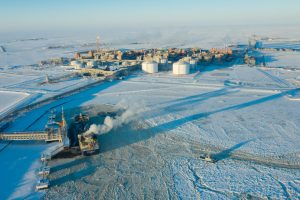


The European Commission is attempting to free itself from an energy trap of its own making. Having taken note of the embarrassing fact that after four and a half years of war European fossil fuel purchases are still bankrolling Moscow, it resolved to embargo sales of Russian liquefied natural gas (LNG) as of January 1, 2027. This deadline has spurred European gas distributors to gobble up as much Russian LNG as they can manage before winter demand begins to draw down stocks. In the first six months of this year, Europe has landed almost 10 million tonnes across 136 tanker cargoes from the Yamal LNG consortium, resulting in nearly €6 billion remitted to Russia, according to an analysis of Kpler shipping data by the campaign group Urgewald.
So far so good: Ending this trade will (finally) align the EU’s stated support for Ukraine with its actual fossil fuel purchases. But its search for alternative supplies of LNG is limited to a handful of suppliers. Algeria is close to European consumers, but has little gas in excess of domestic demand. Qatar’s supplies are currently trapped on the wrong side of the Strait of Hormuz. Iranian strikes on March 18 and 19, 2026 disabled two of Qatar’s 14 liquefaction trains, removing about 17 per cent of its export capacity for an estimated three to five years, so even when the strait opens, Qatar will have a constrained capacity to meet European demands.
Only the US and Nigeria have substantial exportable surpluses of gas and the infrastructure needed to liquefy and ship vast quantities to Europe. Nigeria exported 14.78 million tonnes of LNG in 2025, more than half of it to Europe, according to the International Gas Union, while the US shipped 72 million tonnes to Europe in 2025. Both have the capacity to backfill the loss of 16 million tonnes of Russian LNG, but both also have the option of exporting to major users in Asia bidding against Europe. While long-term contracts can serve as a hedge against price competition, Europe has traditionally relied on volatile spot markets for roughly half of its LNG purchases. Tankers can easily change course mid-ocean when a higher bid for their cargoes emerges. China can put the full weight of State funding behind its quest for stable gas supplies and is unlikely to be outbid by European firms.
Even if Europe can afford spot market prices for LNG, it will face importers reluctant to navigate new EU regulations. All LNG exporters to the EU are facing onerous new requirements designed to monitor methane, the primary component of natural gas, and limit its leakage into the atmosphere. The EU Methane Regulation (Regulation (EU) 2024/1787, in force since August 4, 2024) requires LNG importers to provide information on their efforts to measure, report and abate methane emissions, as well as the origin and transportation pathways of the gas they deliver to Europe. They must employ methods of “Monitoring, Reporting and Verification” comparable to European standards. The Commission’s questions-and-answers guidance for importers blithely asserts that importers and exporters “need to make sure that the required information is passed down to them”.
Consider for a moment the Henry Hub in Louisiana, where the LNG destined for Europe is collected and priced. It sits at the intersection of 13 pipelines each of which draw from a web of smaller pipelines connecting thousands of gas wells. Texas alone has over 83,000 active gas wells reporting production, according to the Railroad Commission of Texas, operated by over 1,500 companies, ranging from behemoths like XTO Energy to minnows like Whiskey River Oil and Gas. Tracing the gas arriving for export at Henry Hub back upstream to any of 1,500 operators, and then extracting reports on methane emissions from thousands of wells is an impossible administrative task. Can you imagine explaining to the real-life equivalent of Landman‘s Billy Bob Thornton that he must hire staff and assemble reports written to European standards on the off chance that some of his gas ends up in a cargo headed for Europe? The temptation to provide pretty paperwork rather than accurate documentation will be hard to resist for any Texas gas producers willing to hide among 83,000 wells. Nigerian producers are already highly skilled at evading government oversight and will likely provide the EU any nice representations they demand. Inducing non-compliance is the inevitable product of a poorly designed regulation.
The methane rule also leaves final judgment of its implementation “[ … ] subject to assessment of EU member state competent authority”, which raises the possibility of separate enforcement standards at different LNG terminals. What importer would risk 20 per cent of annual turnover on a difference in rule interpretation between GNL Adriatico, off the coast near Venice in northern Italy, and Wilhelmshaven, northern Germany? An EU regulation that doesn’t yet provide a common standard for member states charged with implementation creates at best uncertainty and at worst regulatory arbitrage as LNG importers seek the most lenient jurisdiction to land their cargoes.
The methane regulation comes with a strong recommendation to establish new independent verification organisations to monitor and eventually enforce EU rules at gas wellheads worldwide. This extra-territorial proviso seems designed to create jobs for otherwise unemployable eco-grifters intent on harassing fossil fuel companies into bankruptcy. NGOs wielding EU rules to cream off a portion of company revenues are perhaps the most successful jobs programme the EU has created. Monitoring methane compliance promises lucrative careers for activists, as well as a reliable lobbying bloc for further regulation. None of these new NGOs will help cure Europe’s energy deficits, but will usefully serve as global branch offices for the self-proclaimed regulatory superpower in Brussels.
The threat posed to European LNG supplies by these new rules has already prompted a vigorous pushback by the very importers the EU is counting on to backfill the loss of Russian gas. The energy ministers of Qatar, Algeria, Nigeria and the US sent an open letter to EU leaders on June 23, 2026, finding there was “no viable path to compliance” with the methane regulation, and warning of “significant supply and price impacts”. This is a polite way of asking the EU: “Do you want our LNG or not, and if you do, expect to see higher than market prices and disrupted supplies while we figure out how to comply with your bonkers rules.” US environmental rule-making comes in for criticism in Europe because of the influence of industry on the process. But the EU Methane Rule shows the danger of such rule-making without significant input from the companies bearing the compliance cost. A quick field trip to the Henry Hub and the gas fields of the Permian Basin, or perhaps more sportingly to the swamps of the Niger River Basin would have revealed to the boffins in the Berlaymont the impracticality of their regulation. A partial climbdown by the Commission, recommended on July 20, 2026, will delay penalties under the law until 2030, but leaves in place the reporting requirements.
One obvious solution to the loss of Russian gas is the exploitation of Europe’s own resources. Europe is sitting on 14 trillion cubic metres of technically recoverable shale gas reserves, on European Parliamentary Research Service estimates. Modern recovery techniques have granted the US energy autonomy, and could do much the same for Europe, were it willing to accept techniques common in Pennsylvania. But orthodox environmentalism remains a state religion among Europe’s governing elites, no matter the economic cost. In this case, it compels extreme dependence on the United States and benighted Texas roughnecks for its energy supplies. Europe is moving towards greater strategic autonomy in defence just as it sacrifices energy autonomy to the US, Qatar and Nigeria.
Cheap and reliable energy is the basis of economic prosperity. The EU Methane Regulation and Carbon Border Adjustment Mechanism are both part of Europe’s attempt to impose the same crippling constraints on global prosperity the EU inflicts on itself. The rest of the world will decline to kneecap itself in deference to the monarchical edicts of the Commission. Much as capital flees high taxation, so will LNG supplies seek markets unburdened by onerous regulation. Europe can expect to pay a premium on its imported gas as the price of its misconceived rules. Prosperity will migrate elsewhere: Hot air cannot substitute for cheap gas.