



The Christian Democratic Union (CDU) parliamentary group in the Saxony-Anhalt Landtag, the state parliament of a federal state in eastern Germany, has agreed that its 15 members will leave the chamber during the planned December election of a minister-president if an Alternative for Germany (AfD) candidate stands.
The move, confirmed on October 13 after a roughly three-hour group meeting in Magdeburg, is intended to remove any possibility that CDU votes could be cast for the AfD in a secret ballot.
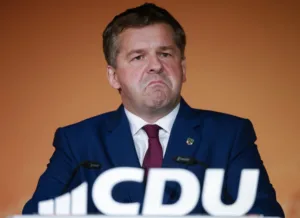
Group leader and acting minister-president Sven Schulze said the group had “agreed to do this”.
Fourteen members backed the proposal from the group leadership; former group leader Guido Heuer abstained, citing the need for legal advice on implications for any subsequent ballots.
The decision covers the first and second ballots; the approach to a possible third ballot was left open.
Schulze described the step as sending a clear signal that there would be no support from the CDU for an AfD head of government.
The decision follows the October 6 election of AfD member Tobias Rausch as Landtag president, the first time a representative of a party classified by the Saxony-Anhalt state office for the protection of the constitution as “confirmed right-wing extremist” has presided over a German state parliament. The office has applied that classification to the party’s state branch since 2023.
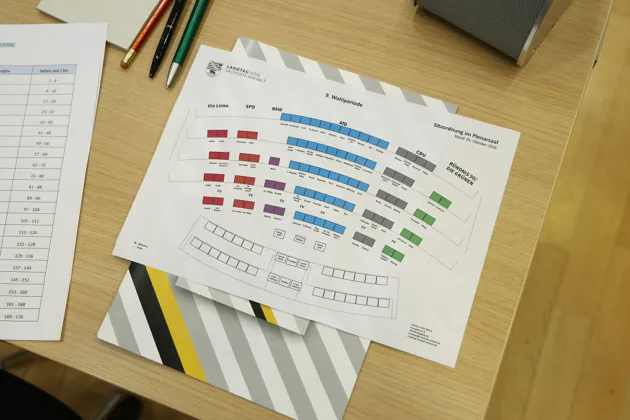
Rausch received 48 of 82 votes cast. The AfD has 39 seats and the Sahra Wagenknecht Alliance (BSW) five, or 44 certain votes.
There were only five abstentions in total, despite the CDU leadership having recommended that its members abstain (one CDU member was absent).
Other parties had indicated they would vote against. Because the ballot was secret, the source of the additional votes cannot be established with certainty, but the numbers prompted widespread speculation that some came from the CDU.
Public broadcaster ZDF asked the 14 CDU members present how they had voted. Nine said they had abstained, against a recorded total of five abstentions across all groups.
In the September 6 state election the AfD, led by Ulrich Siegmund, took 43.8 per cent of the vote and 39 of 83 seats, more than double its previous result, while the CDU fell to 17.2 per cent and 15 seats. Turnout was 76.9 per cent, against 60.3 per cent five years earlier.
Siegmund has said he will stand for minister-president in December and only in the first ballot.
The Landtag election of a minister-president is by secret ballot without debate.
Under the state constitution the first and second ballots require an absolute majority of all members (42 votes).
With the BSW indicating it will abstain, Siegmund would need three votes from elsewhere.
A third ballot, if required, is decided by a majority of votes cast.
Political scientist Marcel Lewandowsky has said Siegmund could stay in the contest to a third round despite his announcement, in which case an empty CDU bench would lower the number of votes he needs rather than raise it.
Siegmund himself called the plan a strange idea and said it showed disrespect towards the will of the voters.
AfD co-leader Alice Weidel responded that Siegmund would become minister-president “whether in the first, second or third ballot” and described the CDU plan as “kindergarten of the first order”.
BSW group leader Thomas Schulze called the walkout “maximally cowardly” and unparliamentary.
The Social Democratic Party (SPD) said it would participate and vote against; the Left and Greens criticised the move as a capitulation or failure to confront the AfD directly by casting a clear “no”. Left group leader Eva von Angern said the decision laid bare the depth of the mistrust inside the CDU.
The episode has intensified internal CDU tensions in the state.
Several members have spoken of possible exits from the group or the formation of a separate parliamentary group.
Long-serving member and former education minister Marco Tullner has said he is seriously considering leaving.
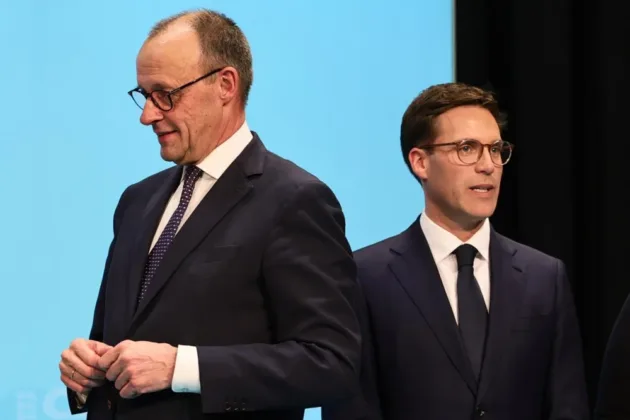
CDU federal chairman and German Chancellor Friedrich Merz has stated that votes for an AfD candidate for such an office are incompatible with CDU values, while Christian Social Union (CSU) leader Markus Söder has said anyone who votes for the AfD has “not much of a future” in the Union. Söder, speaking on public television, also told any dissenters who wanted to go elsewhere to say so and leave.
Schulze, who became group leader after a narrow 8-7 internal vote and remains acting minister-president until a successor is elected, said after the latest meeting that the group had “moved a good bit closer together” and that members wanted to look forward as the strongest opposition force.
He plans to step down as state party chairman; a party congress in early December is expected to choose a successor.
An animal-rescue group has refused to let a Lower Saxony AfD deputy adopt a setter from Italy, telling her the decision was based on her party membership. https://t.co/xYT8rVz0Ht
— Brussels Signal (@brusselssignal) October 2, 2026