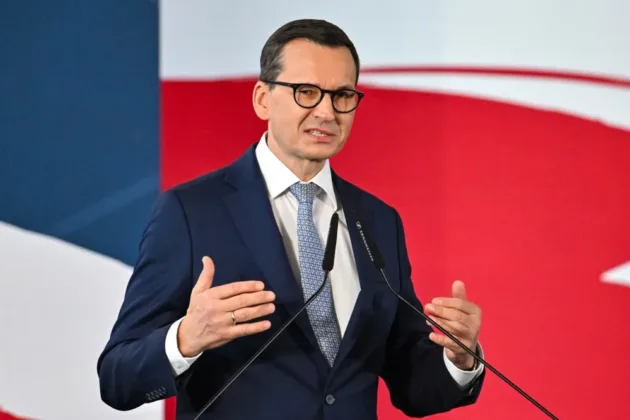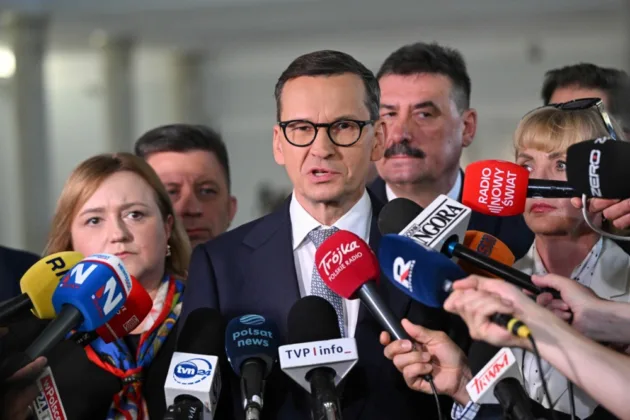
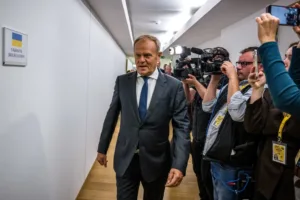





Poland’s populist conservatives continue to politically splinter, as Law and Justice (PiS) head Jarosław Kaczyński moves to expel party dissidents led by former prime minister Mateusz Morawiecki. That move would weaken PiS but could strengthen the opposition to Prime Minister Donald Tusk, especially if Morawiecki can form common cause with disaffected centrist parties unhappy with Tusk’s government.
Kaczyński has long been at odds with Morawiecki over PiS’ future. Kaczyński, who co-founded the party in 2001 and has led it since 2003, wants PiS to move rightward to compete with two populist parties to PiS’ right, Confederation and the Confederation of the Polish Crown (KKP). In March he named Przemysław Czarnek, a hardline former education minister, as the party’s candidate for prime minister.
Morawiecki wants the party to move toward the centre-right to compete with voters attracted to Tusk’s Civic Coalition (KO). Morawiecki’s decision to form an association, Development Plus (Rozwój Plus, RP+), sparked Kaczyński’s decision as he viewed the group as potentially forming the basis for internal opposition or even creating a new party.
Expelling the members of Morawiecki’s group, said to contain as many as 44 parliamentarians, for their refusal to sign a loyalty pledge effectively forces Morawiecki’s hand. PiS passed a resolution on July 15 requiring its parliamentarians to renounce membership of outside associations, with a deadline of midnight on July 23.
While Kaczyński has pulled back, referring expulsions to the party’s disciplinary officer to examine each MP’s case separately, Morawiecki says he believes he has been constructively expelled. As a result, he resigned on July 28 as president of the European Conservatives and Reformists (ECR) Party, the European political party to which PiS belongs. Carlo Fidanza of Brothers of Italy has taken over his duties.
Morawiecki stands on firm ground if the latest polls are to be believed. Three recent polls put RP+ above the 5 per cent needed to win seats in the 2027 election to the parliament’s more powerful lower house, the Sejm, with the group scoring between 6.2 and 7.5 per cent. Those polls all show PiS losing vote share to RP+, indicating that the expulsion would hurt Kaczyński too.
More notable, though, is the fact those polls also show Civic Coalition losing vote share too. RP+ thus seems to take votes primarily from the right, but also, as Morawiecki has believed, from Tusk. That expands the share of votes available to replace Tusk’s government even as it weakens PiS’ ability to dominate any replacement government.
Morawiecki’s hand would be even further strengthened if he could reach agreement with one or both of the two centrist parties that ran together as the Third Way in the last parliamentary election, held on October 15, 2023. The urban-based Poland 2050 seems to be a spent force, as it now usually receives under 2 per cent in polls.
But the rural-based Polish People’s Party (PSL) still has a base of support, regularly receiving around 3 per cent. An alliance between RP+ and PSL could conceivably top 10 per cent of the vote, potentially making it the kingmaker after the next election.
That alliance would also put Tusk in a severe bind. His current government’s majority rests on support from Poland 2050 and PSL, and polls show it is highly unlikely to be re-elected without support from one or both of those parties.
If Morawiecki’s group and PSL teamed up, Tusk could only win with support from a united left. That two-party coalition, Lewica (the Left), has also broken up since the last contest and the breakaway group, Razem (Together), struggles to hit the 5 per cent threshold.
Morawiecki has so far rejected an alliance with PSL, saying that the party’s continued support for Tusk disqualifies them from being potential partners. But that could simply be a bargaining chip. PSL’s leadership can read polls as well as anyone.
They know they are at risk of not entering parliament for the first time since Poland’s first fully free parliamentary election in 1991. Tusk’s ongoing wooing of the left, especially on cultural issues like abortion that are opposed to the views of PSL voters, makes continued alliance with him very problematic.
PSL will also be wary of joining Civic Coalition’s ticket, as other parties have done in the past, out of fear that this would lead to its demise. They will see what happened to a centre-right party, Modern (Nowoczesna), which tried that approach.
Modern ran as a separate party in 2015, winning nearly 8 per cent of the vote. It then joined with Civic Coalition’s prior incarnation, Civic Platform, to run on a joint ticket in the 2019 and 2023 campaigns. It sunk to a mere 1.7 per cent and won fewer than 10 seats each time. In October 2025, it surrendered to the inevitable and merged into KO. PSL will not want to follow Modern’s course.
Kaczyński surely wants a return to the old days when PiS was the only party that mattered on the Polish right, but those days are gone. The question he ought to be answering is how to build the largest possible coalition to unseat Tusk. Having chosen to push PiS to the right to regain vote share from Confederation and KKP, Kaczyński has decided to forfeit PiS’ chance to lead that push in a vain effort to summon the past.
Morawiecki’s expulsion, then, revitalises the chance for a broad rightist opposition to emerge that can consign Tusk and his leftist allies to the political sidelines. He should realise that he has now crossed the Rubicon and needs to find new allies that can further his goal and expand the centre-right. That means pushing PSL to choose between subservience and ultimate submission to Tusk’s KO and an alliance of dignity with RP+. Such an alliance, if formed, can be the basis for an enduring coalition of the right that can move Poland into a conservative future for years to come.