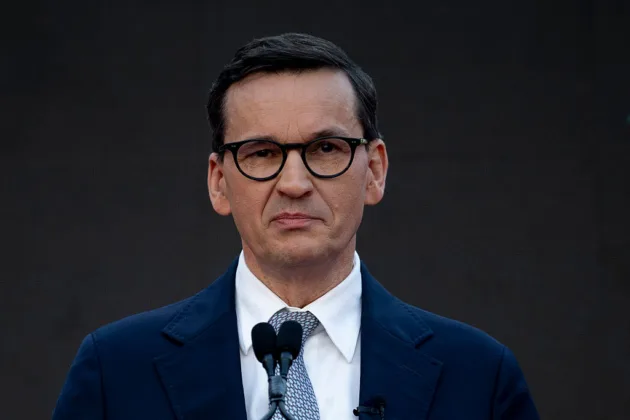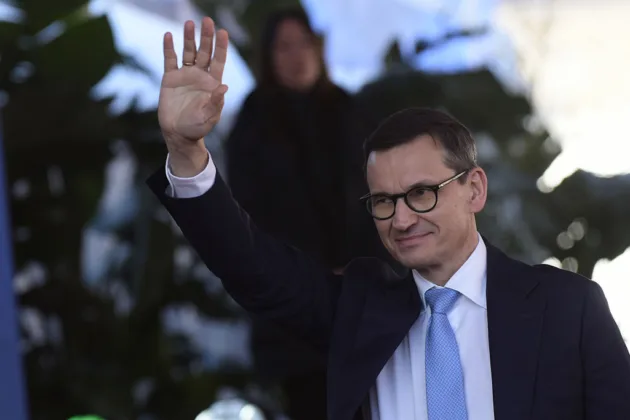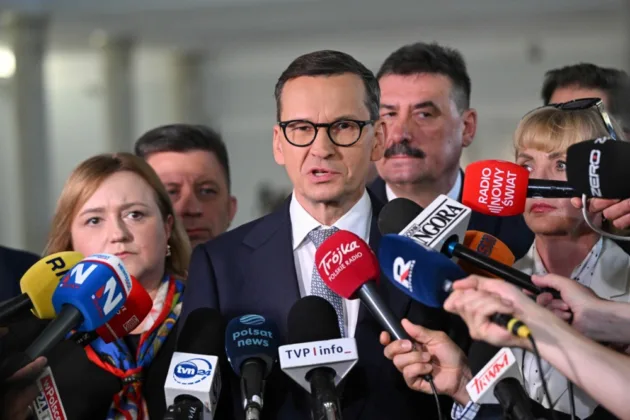







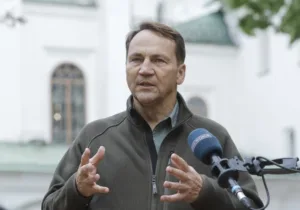

Former Polish Prime Minister Mateusz Morawiecki has said he will formally register a new political party by October 15 at the latest, after Law and Justice (PiS), Poland’s main opposition party, deemed his and his allies’ membership effectively over.
Morawiecki’s move marks the most serious internal challenge to PiS, which ruled Poland from 2015 to 2023, and follows months of tension between his allies and a party leadership that wants to concentrate on recovering support lost to the Confederation and the Confederation of the Polish Crown in the aftermath of the presidential election of 2025.
The dispute began after Morawiecki founded the association Development Plus (Rozwój Plus) on April 15, presenting it as a centre-right platform intended to complement PiS with a pro-development agenda rather than rival it.
PiS leader Jarosław Kaczyński demanded its dissolution and ordered members to sign a loyalty pledge disavowing “external” groupings. A party resolution of July 15 required PiS parliamentarians to renounce membership of outside associations by midnight on July 23.
Critics within PiS viewed the association as an attempt by Morawiecki to build an alternative power base that could eventually evolve into a separate party ahead of the 2027 parliamentary election.
The move by Kaczyński was intended to reduce the size of Morawiecki’s breakaway but 40 members of the Sejm, the lower house of the Polish parliament, three MEPs and one senator stuck with Morawiecki. Two of those who had backed the association, MEP Daniel Obajtek and MP Anita Czerwińska, later filed the declaration demanded by the leadership.
The 44 parliamentarians named by the PiS political committee on July 28 were referred to the disciplinary officer rather than being expelled outright.
Morawiecki’s allies registered their own parliamentary caucus on July 30. With 40 MPs it is the third largest in the Sejm, behind Civic Coalition (KO) on 156 seats and PiS on 147.
On August 3 the party’s disciplinary officer, MEP Karol Karski, said the PiS membership of those who had set up their own entity was “dead” in practice, although they formally remained party members until a final decision was rubber-stamped by the party’s national executive.
According to Morawiecki, Karski’s remarks confirmed that the PiS leadership had “wanted to push us out from the very beginning”, adding: “Now that our membership is dead, meaning we have been completely removed from Law and Justice, I can say we will indeed found a party by October 15 at the latest.”
The date coincides with a convention-style event already announced by Development Plus, timed to mark the third anniversary of Poland’s 2023 parliamentary election.
The former prime minister said he and his allies wanted to focus on challenging Prime Minister Donald Tusk’s government rather than becoming embroiled in internal disputes within PiS.
“In recent times, we have witnessed very strange party games that are completely unnecessary,” Morawiecki said, accusing unnamed “plotters and splitters” within PiS of trying to divert attention towards internal party affairs.
“We do not want to engage in these party squabbles,” he said. “We want to direct the focus of our attack towards Donald Tusk’s very bad government.”
He argued that voters were more concerned with issues such as economic growth, jobs, housing and national security than with internal party disputes.
“Our task is to show what mistakes, irregularities and missed opportunities this government is responsible for,” Morawiecki said. “We are very well prepared to do that.”
Morawiecki and his allies in Development Plus have argued that PiS should combine its traditional conservative base with a more moderate, pro-growth platform capable of attracting younger voters and entrepreneurs.
Others argued the party must become more hardline in rhetoric and strategy to avoid losing ground to groupings further to the right.
This second camp is centred on former education minister Przemysław Czarnek, an ally of Kaczyński and the party’s candidate for prime minister.
Morawiecki’s departure is a personal blow to Kaczyński and a sign that the 77-year-old PiS leader is losing his grip over his own party and the Polish Right as a whole.
In a post on social media platform X on July 28, Morawiecki set out “10 pillars” that signalled the new party’s electoral platform for the 2027 parliamentary election.
They commit the grouping to opposing the Migration and Asylum Pact and to scrapping the Green Deal and the Emissions Trading System (ETS) in its current and extended forms, which the text says damage industry, agriculture and household budgets.
It also promises faster construction of nuclear plants and small modular reactors, a higher second income tax threshold and permanent US bases in Poland. Its second pillar is respect for the President elected by the nation, with Morawiecki calling President Karol Nawrocki the most important institutional counterweight to a weak government.
Morawiecki resigned on July 28 as president of the European Conservatives and Reformists (ECR) Party, the European political party to which PiS belongs and which he had led since January 2025. His three allied MEPs are expected to remain in the ECR group in the European Parliament.
The former PiS prime minister appealed to entrepreneurs but aimed his messaging primarily at right-wing voters, territory currently dominated by PiS, the libertarian nationalist Confederation and the orthodox Catholic conservative nationalist Confederation of the Polish Crown led by MEP Grzegorz Braun.
At a Development Plus gathering in Warsaw on July 31 he said Christian faith had to be defended “even if some of us are non-believers”.
Morawiecki and his allies will also be aiming to attract centrist voters who supported the Third Way alliance, which polled 14.4 per cent at the 2023 parliamentary election and joined the coalition led by Tusk.
That alliance, made up of the agrarian Polish People’s Party (PSL) and the centrist Poland 2050, fell apart in June 2025 after Szymon Hołownia took 4.99 per cent in the first round of the 2025 presidential election, won by the PiS-backed Nawrocki. Many of its voters appear disillusioned with the Tusk government.
Polling by the publicly funded research centre CBOS shows that the proportion of Poles declaring themselves opponents of the government rose to 48 per cent in July, its highest reading since July 2025, while 29 per cent declared their support.
Morawiecki hopes that the disillusionment with the government among those voters, combined with PiS’s shift away from the centre ground, gives him an opening.
The potential impact of the rupture on PiS at the ballot box emerged in a United Surveys by IBRiS poll for news portal Wirtualna Polska, carried out on July 24-25.
Asked to choose from a list that included Development Plus, respondents put the new grouping on 7.5 per cent, clearing the 5 per cent threshold required to enter parliament, while PiS fell to 15.9 per cent from 21.5 per cent in the variant without it. KO stood at 28.5 per cent, the Confederation at 13.5 per cent and the Confederation of the Polish Crown at 12 per cent.
Such a result would mean a majority for the parties of the Right, and a parallel IBRiS poll for Rzeczpospolita over the same two days gave the four groupings 253 of the 460 seats in the Sejm. But the lack of any dominant force among them could pose problems in the formation of a government, since they disagree on the EU, Ukraine and economic policy.
The four seem much further apart than were the three parties that in 2023 made up the coalition that took power from PiS. The Confederation and Confederation of the Polish Crown regularly attack PiS and it is not clear that the Confederation would be willing to form a coalition government with PiS, while Kaczyński has ruled out working with the pro-Russian and anti-American party led by Braun.
The infighting within PiS which led to Morawiecki’s departure was carried out in public and puts into doubt how the two might work together in a future coalition.
In such a situation, the role of Nawrocki is likely to be key, since he is the only political figure who can reach all four of these parties and extract the concessions required during the process of forming a government.
It is the President who decides who gets the opportunity to try to form a government after an election. That role would be of particular significance if, as is possible, Tusk’s Civic Coalition emerges as the biggest individual party but the right-wing opposition together is able to form a parliamentary majority.
Morawiecki, son of Kornel Morawiecki, founder of the underground Fighting Solidarity movement, was the longest serving PiS prime minister, having held the job for six years between 2017 and 2023. Before entering politics in November 2015 as deputy prime minister and development minister, he had been chief executive of Bank Zachodni WBK.
He made no secret of his desire to succeed Kaczyński when the latter retired as leader of PiS and of wanting to be prime minister again after the 2027 parliamentary election. But Kaczyński was not willing to retire from leading the party he had founded in 2001 together with his brother, later President Lech Kaczyński, who perished in the Smolensk air disaster in 2010.
Seen by many within PiS as an alien body because of his past in a banking sector dominated in Poland by liberals, he has over the past three years built a following among parliamentarians and former ministers in his government which gave him the leverage to stake out his own political ground.