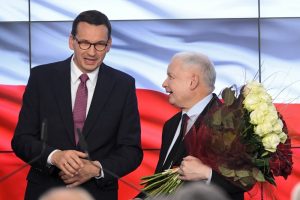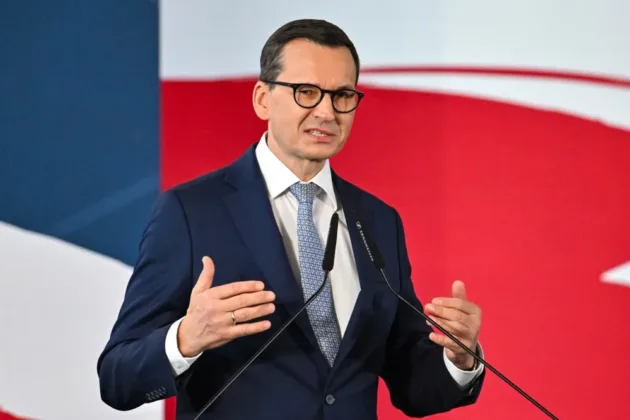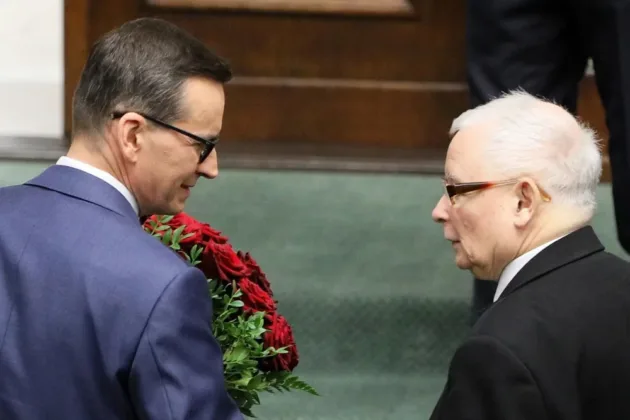


As the leader of the main opposition Law and Justice (PiS) party Jarosław Kaczyński has announced that former prime minister Mateusz Morawiecki and his allies were deemed to have left the party, the State-owned Polish television TVP Info, controlled by the centre-left government led by Prime Minister Donald Tusk, showed a split screen with Kaczyński in one half and, in the other, Civic Coalition (KO) senator Krzysztof Kwiatkowski and MP Adam Gomoła eating popcorn in the Sejm, the lower house of parliament. The commercial channel Polsat News broadcast the same scene.
TVP info podczas konferencji Kaczyńskiego podzieliło ekran i w rogu na żywo transmitowało jak poseł Gomoła i senator Kwiatkowski… jedzą popcorn XD
Może byłoby to zabawne w prywatnej stacji. Ale to jest telewizja publiczna, na którą się wszyscy składamy. pic.twitter.com/tYyMvBqo4I
— chrzanik (@chrzanikx) July 24, 2026
After weeks of internal arguments within PiS the announcement was made on July 24 that the failure of Morawiecki and his supporters to sign a declaration of loyalty that they would not be forming any political association outside of the structures of the party was deemed by the leader and the national executive of the party to mean that the former prime minister and his allies were no longer members of PiS.
The declaration had been demanded in a resolution passed by the PiS political committee on July 15, with a deadline of midnight on July 23. The committee is due to confirm the departures at a meeting on July 28.
Morawiecki had been prime minister in the PiS government for six years between December 2017 and December 2023. In his time in office the party had won a parliamentary majority in 2019, the European Parliament elections in the same year and the presidential election in 2020.
The pre-pandemic period (2017-2020) was marked by Poland balancing its budget, recording consistently high economic growth while at the same time increasing levels of pay and social spending.
But the pandemic and its aftermath led to a bout of inflation, which peaked at 18.4 per cent in February 2023 according to the Central Statistical Office (GUS), the highest reading since December 1996. That reduced people’s sense of well-being and the ruling party became embroiled in a dispute over the tightening of the already strict abortion legislation, which followed a Constitutional Tribunal ruling in October 2020, and tax reform the losers in which were more vociferous than winners.
The government enjoyed a boost to its popularity in the wake of the Russian invasion of Ukraine on February 24, 2022 and Poland’s response to it, but within months tensions appeared over imports of Ukrainian goods and competition from the Ukrainian road haulage industry.
In the parliamentary elections of October 15, 2023 PiS still topped the poll with 35.4 per cent of the vote, but it failed to win a majority whereas Tusk’s Civic Coalition, which polled 30.7 per cent, was able to secure a parliamentary majority in coalition with the centrists from Third Way and the Left party.
Kaczyński stepped in firmly after the loss of power to prevent any post-mortems on the election and the way PiS governed. He did so because the party was facing all out local government elections on April 7, 2024 and European Parliament elections on June 9 of the same year.
The party performed well in both, polling 34 per cent in the local government elections and 36.2 per cent in the European elections, in which it was beaten into second place by KO on 37.1 per cent. This made it feel it had a chance to win the presidential election due in 2025.
That election was won by the candidate it backed, Karol Nawrocki, and it looked as if PiS was on its way back to power.
But the party, as it turned in on itself over what would be its platform and prime ministerial candidate in 2027, had forgotten that it was no longer as dominant on the right as it had been in the past.
This was because of the growth in the vote of the Confederation Party, which polled 12.1 per cent in the European elections and then 14.8 per cent in the first round of the presidential election, and the arrival of the breakaway Confederation of the Polish Crown, whose founder and leader Grzegorz Braun MEP had managed to poll 6.3 per cent in the same round. Braun’s party had been part of the Confederation umbrella since 2019 and was expelled in January 2025 after he announced a presidential run against Confederation’s own candidate.
As PiS and the two other right-wing parties started to attack each other, jockeying for position ahead of the parliamentary election PiS’s poll ratings declined from around 35 per cent to 25 per cent.
At the same time, as a result of the collapse of the centrist Third Way Tusk’s Civic Coalition increased its support to around 30 per cent and established a clear poll lead over PiS, running at about seven points in surveys published in July.
That increased tensions within PiS as former prime minister Morawiecki argued that the party needed to concentrate on economic rather than identity issues while his opponents argued that the party needed to move to the right to stop leaking support to Confederation and Braun’s Confederation of the Polish Crown.
Morawiecki saw that strategy as both electorally risky and politically short-sighted. For him the problem was not that PiS is insufficiently radical, but that it was narrowing its appeal at a time when it needed to rebuild a broader coalition.
The ex-prime minister made no secret of the fact he wanted to be party leader and began to organise a faction around himself in the party. That led his opponents to mobilise against him.
Kaczyński, who co-founded the party in 2001 and has led it since 2003, is 77 years old but had no intention of surrendering the leadership of the party he views as his creation, therefore he began to see Morawiecki as a threat which had to be dealt with.
He attempted to persuade the former prime minister to accept that the party needed to attract support from its right-wing competitors and that this was why it had to select a more right-wing candidate for prime minister in the shape of the former education minister Przemysław Czarnek.
Morawiecki found that very hard to accept and kept on hinting that this was the wrong course of action and that the party needed a different direction and formed his own political association, Rozwój Plus (Development Plus), which he said was to give added value to PiS but which Kaczyński and people to the right of the former prime minister saw as being the stalking horse for a new political party.
The conflict came to a head in mid-July when Kaczyński reluctantly decided that he would not allow members of his party to be members of any political associations and ordered all parliamentarians to sign a declaration of loyalty.
Morawiecki and his allies refused and therefore Kaczyński argued that he had no alternative but to deem those who did not sign to have decided to leave PiS. The PiS leader said that “thirty-something” MPs had given up their membership. Morawiecki put the number at 40 MPs, one senator and three MEPs. The PiS parliamentary caucus had 186 members before the split.
Morawiecki has argued that he and his supporters wanted to remain in PiS and that the association was no threat to it, rather that it was those who succeeded in pushing him out of the party who were splitting it.
But the former prime minister accepts the parting of the ways and is now anxious to state that this does not rule out future cooperation between different parties of the right.
“There is no hegemon on the Polish right. We have to learn to cooperate,” said Morawiecki, who described the quarrels on the right as arguments within a family.
His claim to be the right candidate to be prime minister again is hotly disputed by PiS and the two remaining parties of the right, which accuse Morawiecki of having been too accommodating to the EU and the Green Deal, too liberal with regard to migration and too ready to introduce new taxes when in office.
Morawiecki has also claimed that he and his allies had not decided on setting up a separate party at this stage as that was not their intention when forming his association. A new parliamentary club, which under Sejm rules requires a minimum of 15 MPs, is expected to be registered during the last sitting before the summer recess.
Though his association is planning a large-scale summer event in Warsaw on July 31 with both a barbecue and discussion panels that is widely seen as an overture to a future creation and announcement of a new political force on Poland’s right.
Speaking on conservative news channel TV Republika Morawiecki was at pains to deny that he was attempting to reach an agreement with the two centrist parties that formed the Third Way coalition, the Polish People’s Party (PSL) and Poland 2050.
The former prime minister’s enemies have accused him of planning to make a deal with parts of the Tusk coalition. He categorically denies this.
“Not only am I not in agreement with them, I have not held such talks at all and do not intend to. Anyone who props up this government is not any kind of partner for talks for me,” declared Morawiecki, who added that he would not shy away from talking to anyone opposed to Tusk.
But in order for his breakaway to make any sense he has to look not only to PiS voters who are not convinced by the party’s current tilt to the right on the EU, migration and pursuit of identity politics, but also towards what is left of the 14.4 per cent Third Way vote from back in 2023.
Admittedly the centre in Polish politics has hollowed out following the break-up of the Third Way with the parties that used to form it now accounting for around 5 per cent of the electorate with Tusk’s KO absorbing much of that electorate.
This raises the question about the chances of survival of Morawiecki’s breakaway.
According to leading Polish political scientist Rafał Chwedoruk, Morawiecki is taking a “gigantic experiment” by gambling on his own party and is chasing voters who backed PiS but, in his words, “did not applaud”. He feels that although the move will weaken PiS the party still has the strongest political organisation on the right with structures, financial resources and media allied with it.
Chwedoruk also believes that it will be a challenge for Morawiecki to convince voters he once represented that he is offering something different and that the former prime minister will be continually challenged over the decisions he took in the latter stages of his premiership.
Another issue the new Morawiecki party will face will be how to approach its relations with PiS.
The break-up has so far been acrimonious with both PiS loyalists and Morawiecki supporters attacking each other on social media accusing each other of splitting the party and giving succour to Tusk and his party.
But it will not be in Morawiecki’s interest to attack PiS if he wants to take over some of its voters and to make himself attractive to undecided electors who do not like infighting between parties.
For Tusk and his supporters the fragmentation on the right seems like a godsend at a time when his government and party became embroiled in scandals over cronyism and mismanagement of Poland’s ailing public healthcare system.
But to govern Tusk and his allies in the centre and the Left need a parliamentary majority which is not secured on 30 per cent of the vote. Tusk either needs to mop up the Left and centrist voters in order to reach over 40 per cent of the vote or to have the PSL and the Left Party clearing the electoral threshold of 5 per cent to make up the majority in the next parliament.
Eating popcorn to demonstrate pleasure at PiS’s troubles may therefore be premature, just as PiS’s conviction that it was headed for victory after Nawrocki’s victory in the presidential election of June 1, 2025 was proved to have been counting chickens before they hatched.
Before the split in PiS polls were indicating that it was the parties of the right which would have a majority in parliament, but Morawiecki’s intervention now needs to be factored in and measured in the polls.
Initial polling has put the potential for a party led by Morawiecki over a wide range, depending on the agency conducting the survey and the questions put. A Pollster survey published on July 3 gave the Rozwój Plus association 2.05 per cent, a United Surveys poll for Wirtualna Polska put it at 5.1 per cent, while figures circulating in the former prime minister’s camp run to between 6 and 7 per cent.
It is only when the Morawiecki party becomes real rather than hypothetical that we will discover what the level of support may actually be and whether there is demand for a party that will argue for EU integration and reform together with economic modernisation rather than leaving or defying the EU and concentrating on issues of national and religious identity.