




Ever since the Korean war boom launched the Wirtschaftswunder, Germany has regarded her gargantuan export surpluses as a national patrimony. The combination of technical prowess and a highly productive workforce appeared to give German firms an unassailable competitive position. Suppression of domestic consumer demand and a usefully undervalued euro kept Germany competitive despite growing regulatory burdens and archaic labour practices. Profits reaped from foreign markets sustained a growing social welfare state and underwrote the transformation of the European project from customs union to quasi-federal entity.
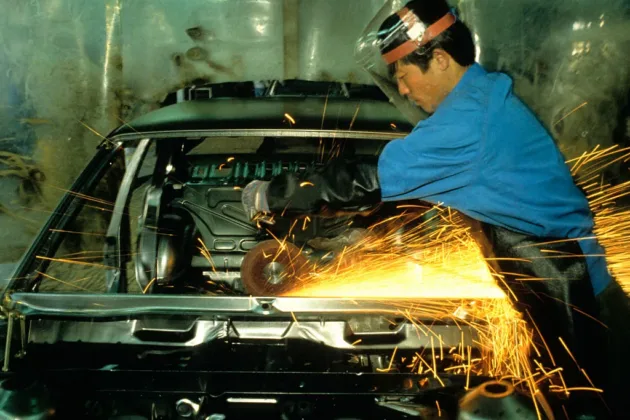
Yet now the German export machine finds itself besieged by Chinese competition. Volkswagen is the latest casualty, facing plant closures and job redundancies as Chinese firms reclaim their domestic markets and invade Europe’s. German machine tools and electrical equipment are being displaced by Chinese competitors offering comparable quality at lower prices. Chinese demand for German cars is in dramatic decline, and the US market is now protected by high tariffs. The search for new export markets resembles a global game of musical chairs, with Germany struggling to find a seat as the music slows.
Rather than embrace the brutal downsizing that revived American car makers, Germany is appealing to Brussels for relief from the Chinese onslaught. The European Union has developed a handy means of determining whether China’s exports constitute an unfair distortion of world trade. The “Capacity Expansion Gap” purports to show an excess in productive capacity over domestic demand. This surplus is dumped on world markets, beggaring European manufacturers. In response, the EU is considering a range of trade restrictions, ranging from tariffs to demands for joint ventures and technology transfers from Chinese partners.
But how is the Capacity Expansion Gap any different from the investment patterns demonstrated by any export-oriented economy? South Korea, Taiwan and Japan all grew wealthy by exporting far more than their domestic demand alone would warrant. These countries followed the path pioneered by Germany in the 1950s. Each of these success stories required a substantial mismatch between productive capacity and domestic demand in order to exploit global markets. The value of German goods exports is comparable to that of the United States, which is to say far in excess of the consumer demand generated by 82 million Germans.
Beijing has not been hesitant to point out the EU’s historical hypocrisy. Like China, Germany suppressed domestic demand and used an undervalued currency to stimulate export growth. Volkswagen is partly owned by the Niedersachsen government, which imposes political objectives on corporate management. Both Germany and France steer banking capital to industrial champions. Export surpluses and capacity expansion gaps never troubled the EU as long as they benefited Europe. Only now that China uses them to prise open European markets do they emerge as a concern in Brussels. The self-proclaimed champion of a rules-based international order wishes to change those rules once it begins to lose.
Of course, trade and the need to guard national prosperity are not a morality play. The EU is not obliged to stand by while China ransacks its industrial base, and it hasn’t. Steel imports are now subject to quotas, with swingeing tariffs applied to any excess. Chinese electric vehicles face a fat 35.3 per cent levy on top of the standard 10 per cent tariff on car imports. It is too late to protect domestic makers of solar panels and batteries: Both sectors are now dominated by Chinese firms, who are feasting on the EU’s Net Zero rules. Extracting Chinese technology and investment in European production may be the best that EU regulators can manage for European firms.
For 75 years, Germany thrived as an export steroid case, generating surpluses far in excess of any conceivable “Capacity Expansion Gap.” Whereas exports as a percentage of GDP total 21 per cent in China, they constitute an astonishing 42 per cent of German GDP. Now Germany faces a future where foreign demand is insufficient to sustain its workforce and industrial base. Debt-financed military spending will take some of the burden, but not nearly enough to soak up 100,000 redundant Volkswagen workers. There is no replacement for the Chinese or US market in sight: India, South America and Indonesia purchase a combined 7.7 million cars annually, compared to 16 million units in the US and 30 million in China. Retreat to Europe would lock German automakers in a brutal struggle over a mature market with Stellantis and Renault. European sales of low margin VW Polos cannot replace the fat foreign profits once earned by Audi and Porsche.
Economists have long urged China to reduce its dependence on exports by stimulating domestic consumer demand. China is not only the world’s biggest exporter, but its second largest creditor nation. Growing domestic demand and a free-floating yuan would rebalance the global economy by sucking in imports from the rest of the world. The same principle applies to Germany, the world’s third largest exporter and biggest net creditor. Growing German demand for imports could remedy trade imbalances within the EU and help reduce the chronic US trade deficits that have fuelled German industry for decades.
This won’t happen. Two and a half generations of Germans have devoted themselves to running huge trade surpluses as a symbol of national industrial prowess. That China is using the same strategy to claim the export markets Germany considered its birthright won’t prompt any introspection among policymakers in Berlin, who prefer to go howling for relief to the guardians of the Single Market in Brussels. But for German industrialists, the music is already stopping. Energy costs, excessive regulation and Net Zero mandates are driving investment out of Germany. BASF is pouring capital into its Chinese chemical complex; VW will exploit low wages at its factory in Bratislava. The great German export machine is living on borrowed time.