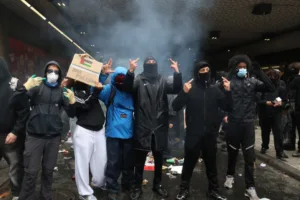


Sixteen minors arrested during violence on the margins of a national trade-union demonstration in Brussels on October 9 have been released because no places were available in public youth protection institutions (IPPJ), the Brussels public prosecutor’s office said on October 11.
Prosecutors had sought placement in a closed institution for eight of the youths, citing the seriousness of the alleged offences.
In several cases a youth judge had examined the files and ordered placement.
The orders could not be carried out, though, for want of a place.
Among those released was a 16-year-old already known to the youth court who was stopped with seven ready-to-use Molotov cocktails he intended to take to the protest.
Another 16-year-old was identified on camera allegedly throwing electric scooters onto a burning barricade. A 14-year-old was arrested after repeatedly throwing stones and pyrotechnic devices at police.
🚨 BREAKING: Brussels
Masked rioters smashed windows and set fire to STIB buses near Gare du Midi during Friday’s anti-austerity protest. Passengers were evacuated safely — no injuries reported.
Police seized Molotovs, used water cannons and tear gas, and made over 100 arrests… pic.twitter.com/Xl8HlHLxAL
— WasAcop (@WasAcop) October 10, 2026
The prosecutor’s office said alternative measures were also saturated.
Mobile accompaniment teams and educational supervision schemes had 44 young people waiting for support.
Judicial supervision by the youth protection service could not start for several days or weeks in a number of cases.
Across the French-speaking system, 283 youths are currently on a waiting list for a place in a closed IPPJ regime. The six institutions run by the Wallonia-Brussels Federation hold 245 places, of which 102 are closed. Brussels has no IPPJ of its own, though about half the places are taken by young people from the capital.
In a statement carried by VRT NWS, the prosecutor’s office said a placement decision that cannot be executed “deprives society, the victims and the minor themselves of the educational, protective and structuring measure that the judge deemed necessary.”
It warned that the situation risks creating a sense of impunity and omnipotence among some minors “since the State proves incapable of imposing clear limits,” and that “in this way justice loses its credibility.”
The office called on politicians to restore the credibility of youth justice.
The releases form part of a longer-standing capacity crisis in Belgium’s youth detention system.
Brussels public prosecutor Julien Moinil said in April that 162 French-speaking youths were then waiting for a closed place, a figure that has since risen by three-quarters. Youth welfare minister Valérie Lescrenier has said a former boarding school in Forest, southern Brussels, is due to open as a 30-place semi-open IPPJ by the end of 2028.
Adult prisons are also heavily overcrowded. Emergency measures in force since October 1 provide for automatic electronic tagging of inmates serving up to 18 months, faster deportation of foreign convicts and an extension of early release, though justice minister Annelies Verlinden did not secure the wider release scheme she had sought.
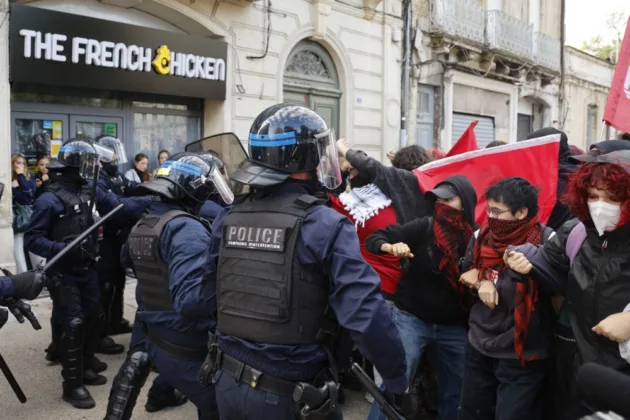
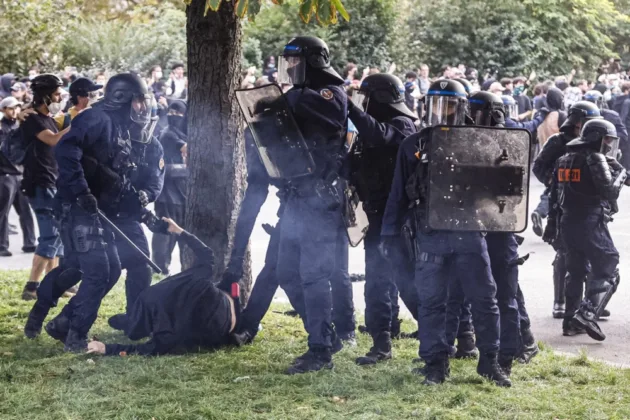
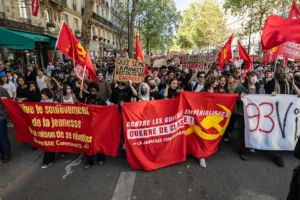
The October 9 demonstration itself saw clashes near Brussels-Midi station.
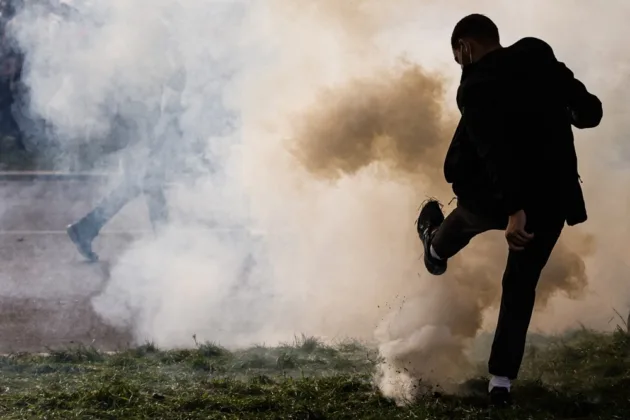
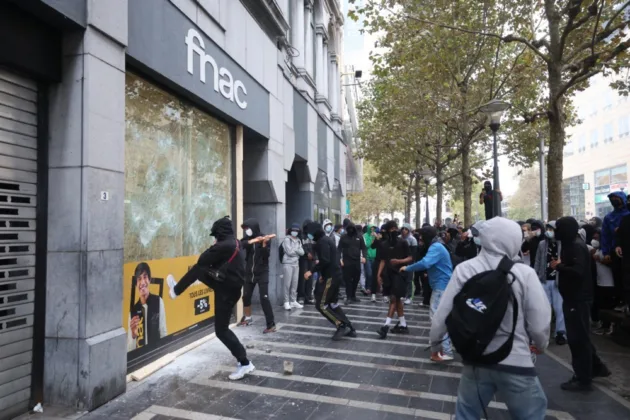
Police made multiple arrests amid reports of barricades, thrown projectiles and damage. The march, called by the socialist trade union ABVV-FGTB against the federal government’s budget cuts, drew 30,000 people according to police and 50,000 according to organisers. Prosecutors said 21 people, 17 of them minors, were held over arson, violence, vandalism and threats. Water cannon and tear gas were used as bicycles, scooters and bins were set alight and public transport buses were attacked.
The prosecutor’s office has emphasised that the releases do not end the investigations and that further proceedings remain possible once capacity or alternative measures become available.
Een stukje uit de reportage van @terzaketv over de betoging in Brussel, de hoofdstad van de Europese Unie.
Ze weten niet waarom ze betogen, maar ze gaan alles kapot slaan.
De EU en onze overheden hebben West-Europa vernietigd. pic.twitter.com/L2UyWR6LSn
— Frank Peeters (@FrankPeeters4) October 10, 2026
Police unions criticised the decision.
“The public prosecutor’s office may not be to blame, but the justice system – in the broad sense – and the politicians are abandoning both the police and the citizens,” Joery Dehaes of the police union NSPV told journalists of news group Mediahuis.
“I would like to remind everyone once again that the riots in Liège and Brussels left 50 colleagues injured and that citizens saw their property destroyed, for the umpteenth time. Does that mean absolutely nothing to those in authority? Those released ‘boys’ are home just in time to make new Molotov cocktails for Monday, at the next demonstration. Pathetic. We are getting very disappointed reactions from the police officers.”
Belgian interior minister Bernard Quintin said it was “unbelievable” and impossible to explain. He had said on October 9 that the State never allowed itself to be intimidated and that the response of police and justice would be proportionate to the damage caused.