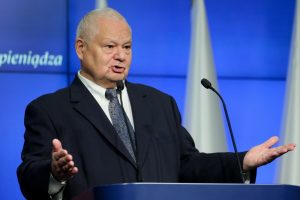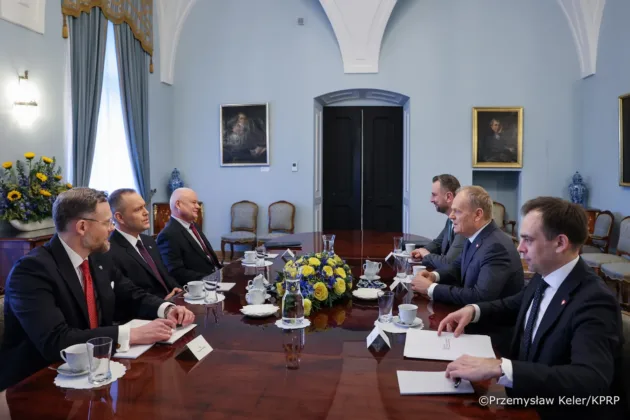
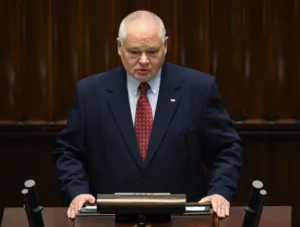



Poland’s parliament has moved to bring the chief of the country’s central bank the National Bank of Poland (NBP) Adam Glapiński before the Tribunal of State over alleged constitutional and legal violations.
The Tribunal of State is elected by parliament and is the only body which has, according to the Polish constitution, the power to try state officials over breaches of the constitution. Its chairman is the first president of the Supreme Court, while the two deputy chairmen and 16 members are chosen by parliament from outside its own ranks.
It may even try an incumbent head of state, though that requires the National Assembly to vote an indictment by a two-thirds majority of its statutory membership – at least 374 of its 560 members – after which the President is suspended from office while the case is heard.
Prime Minister Donald Tusk pledged to dismiss the NBP governor during the 2023 election campaign and in March 2024 a group of MPs from the governing coalition submitted a preliminary motion to bring Glapiński before the Tribunal of State.
Proceedings against NBP head Glapiński have been ongoing for over two years and concern accusations over the constitutionality of his actions and allegations that he violated the principle of political neutrality while in office.
The Parliamentary Committee for Constitutional Responsibility’s backing of a long-awaited report on October 9 recommending that Glapiński be charged in front of the Tribunal of State forms part of a broader push by Tusk’s coalition government to call to account public figures it accuses of wrongdoing under the previous Law and Justice (PiS) government which has led to a raft of indictments, even some arrests, but no convictions in a court of law.
The 148-page report upholds all eight charges in the original motion. They run from the purchase of zł144 billion (€32.9 billion) of government bonds in 2020 and 2021 to currency interventions in March 2022 taken without a board resolution, and to a forecast of a zł6 billion (€1.4 billion) profit transfer given to the finance ministry before the bank posted a loss of zł20.8 billion (€4.7 billion).
This means that a full parliamentary session will consider that report and recommendation. Under the law on the Tribunal of State, the speaker of the Sejm Włodzimierz Czarzasty must let at least 21 days pass before the motion is put to a vote. Since the move is backed by the ruling coalition which has a majority in parliament it is highly likely that Glapiński will have to face the Tribunal of State and that, for the period that this body considers the indictment, he will be suspended from his duties.
Parliament may adopt a resolution to bring the NBP head before the Tribunal of State by an absolute majority of votes, provided that at least half of the statutory number of MPs – 230 members – are present. That threshold is itself contested, as in January 2024 the Constitutional Tribunal struck down the provisions setting the absolute-majority rule and the automatic suspension of the NBP president, and lawyers differ over what remains in their place.
Glapiński is a professor of economics at the Warsaw School of Economics who served as minister for construction and spatial planning in 1991 and then as minister for foreign economic co-operation in the Solidarity-rooted government of Jan Olszewski in 1991-92, and has for decades been a close ally of PiS leader Jarosław Kaczyński.
He was supported by PiS for election as President of the NBP in 2016 and then for a second six-year term in 2022 after being proposed on both occasions by the PiS-aligned then-president Andrzej Duda.
Heads of the NBP in Poland are nominated by the head of state with that nomination having to be approved by parliament.
The liberal opposition criticised Glapiński for allegedly stacking the NBP with political appointees linked to PiS and for taking actions in support of that government, such as the lowering of interest rates before the 2023 parliamentary election, despite the fact that Poland was still suffering from a bout of inflation.
After coming into office in 2023 the Tusk government accused him of allegedly illegal purchase of government bonds during the Covid pandemic to finance the budget deficit.
Such ways of financing budgetary deficits during the Covid pandemic were used by central banks across Europe in order to increase the money supply and keep their national economies out of recession.
The relations between the Tusk government and Glapiński have remained strained, despite Glapiński’s successes in markedly increasing Poland’s gold and foreign currency reserves – the NBP held 594 tonnes of gold at the end of April, about 29.7 per cent of its reserves, with a target of 700 tonnes – and the fact that the monetary policy of the NBP has led to Polish inflation being reduced to levels close to the euro area average. Polish consumer prices rose by 4 per cent in the year to September, against 3.8 per cent in the euro area.
Glapiński irritated the government on March 4, 2026, when he stood shoulder to shoulder with President Karol Nawrocki and the PiS opposition and proposed that the NBP could finance Poland’s rearmament programme through monetising the profits from gold reserves rather than the EU’s Security Action for Europe (SAFE) loans programme which the Tusk administration opted for.
Poland is the largest beneficiary of SAFE, with €43.7 billion of the €150 billion on offer, and in May became the first member state to sign its loan agreement. In August the European Central Bank came out against the Polish alternative, arguing that it would amount to the monetary financing banned by Article 123 of the EU treaties.
For the Tusk administration Glapiński’s intervention on SAFE was evidence that the present head of the NBP is working with the opposition against the government.
Glapiński’s defenders have accused Tusk’s Civic Coalition of a political witch hunt and argued that prosecuting the head of the central bank will reduce Poland’s financial ratings and cause an international controversy.
PiS MP Iwona Arent who is a member of parliament’s constitutional accountability committee went further arguing the Tusk government wanted to replace the Polish currency the zloty with the euro.
“In effect, this is an attempt to paralyse the National Bank of Poland. The aim is to seize control of the Polish złoty and introduce the euro. They also want the gold held by the NBP to be shipped to Germany and taken over by other countries,” said Arent.
The Polish constitution, though, makes the zloty the country’s currency and that provision would require a two-thirds majority in parliament which no single party or ruling coalition has ever had since the replacement of communism with democracy in 1989.
The present government has said that it will not be proposing the adoption of the euro within the lifetime of the present government but there are advocates of the eventual adoption of the single European currency who argued that there will not be a need to alter the constitution as being part of the eurozone is already legislated for in Poland’s accession treaty to the EU, a point of view which has been rejected by all parties of the political Right.
The NBP itself considers the allegations against Glapiński entirely unfounded and believes that the proceedings could paralyse the work of the central bank. Glapiński has stated that the NBP will not participate in the procedure and that any decisions made by the committee are irrelevant to the bank, citing a 2024 Constitutional Tribunal (TK) ruling that suspending the head of the NBP was unconstitutional.
The Tusk government, though, considers the current composition of the TK to be illegitimate and has therefore refused to publish its rulings and is reported planning to use the security forces to install members it believes have been legitimately elected.
This means that should parliament decide to put Glapiński before the Tribunal of State the government will no longer consider him to be in office.
If Glapiński is suspended by being put before the Tribunal of State it will be his deputy at the NBP Adam Lipiński who would have to deputise for him. Lipiński’s own term runs out in November.
But sources close to the government indicate that since the present management board of the NBP does not have the statutory number of members, after PM Tusk refused to countersign candidates proposed by President Nawrocki – among them Marta Kightley, whose term as a deputy president of the bank expired in March – the court may appoint someone with the power of attorney to manage the institution in Glapiński’s absence.
The person who would then be nominated would likely be a candidate linked to the Tusk government, raising the prospect of a dispute over whether the government has violated the law and the constitution by an indirect takeover of the central bank.
Any such move by the Polish government would be certain to be challenged internationally. This is evident from the fact that the head of the European Central Bank Christine Lagarde in 2023 assured Glapiński that he would be protected by EU law if the then incoming government unlawfully suspended and prosecuted him.
In late 2023 just weeks after that year’s parliamentary elections and days before the Tusk administration arrived in office Glapiński wrote a letter to the ECB head outlining the new administration’s plans to bring him before the Tribunal of State.
While Poland is not part of the eurozone, it is a member of the European System of Central Banks (ESCB), an institution that comprises the ECB and the national central banks of all 27 EU member states.
Lagarde responded to Glapiński assuring him EU legislation would protect him.
“In case the members of the new majority were indeed to submit a preliminary motion to Parliament, any measure affecting your ability to perform your duties as head of NBP may, if not lawful, affect your independence and by extension the independence of the ECB’s General Council,” Lagarde wrote, adding that the statute of both the ECB and ESCB offers protection against actions by legislators and governments against the independence of any central bank.
She also wrote that should there be any attempt to suspend Glapiński he could “refer such a resolution to the European Court of Justice (ECJ) and ask for the assessment of its lawfulness.”
There can be little doubt that Glapiński, the opposition and its ally President Karol Nawrocki would fight any attempt to oust the present head of the NBP.