

Romania’s continuing inability to form a government is more than a serious problem for the heavily indebted nation. It’s yet another example to the anti-populist traditional parties that embracing a grand coalition to keep populists out of government causes more problems than it purportedly solves.
Romania is now into its third month under a caretaker government with no end in sight. The original four-party coalition, formed after last year’s presidential election, was a shotgun marriage of odd bedfellows from the start. Embracing all four non-populist parties in parliament, there were never any common governing themes to hold them together. Their inability to stay together, spurred by the Social Democrats’ (PSD) desire to spend more money than their coalition agreement allowed, should have surprised no one.
Indeed, the government’s collapse should have been foreseen from the outset since they had spent more than a decade fighting one another for power. That prospect did not deter President Nicușor Dan, though. He saw his mandate as one primarily geared towards keeping the “anti-European” populist Alliance for the Union of Romanians (AUR) and two smaller parties to its right from any participation in government.
That plan might have worked had that been the only item on the agenda. But governing requires, well, governing, and Romania’s huge annual deficit meant the government had to make tough, unpopular choices to reduce it. Doing so was a precondition for unlocking billions of euros in EU funds, while also increasing the chance that Romania could join its neighbour, Bulgaria, in the eurozone.
Doing that proved to be too painful for the PSD, leading to it allying with the supposedly uncoalitionable AUR and its allies in bringing down the National Liberal Party (PNL)-led government in May. Two months and two failed efforts to appoint a new prime minister later, Romania is still leaderless and fast approaching the August deadline to pass fiscal laws that would unlock €11 billion in EU funds.
Say what you will about the substance of the issues; politically, the PSD has played a masterful game. It fears that continued fiscal austerity would disproportionately harm its voters and likely cause a further deterioration in its political standing. Its only leverage was to blow up the government and force Dan and his centre-right allies to choose what they care more about: Fiscal stability or keeping AUR out.
This is inevitably what happens when populists are automatically excluded from serious power. One party that fears for its future has every incentive to force its partners to make unwelcome concessions even if they know the problems facing the nation will worsen. That’s what France’s Socialist Party has done in its informal anti-populist grand coalition, and that’s what PSD is doing here.
Dan clearly thinks that PSD will eventually come around despite all the evidence to the contrary. He is, against tradition, refusing to nominate a third candidate for prime minister, instead asking the parties to resolve their differences and present him with a candidate who can command a parliamentary majority. That’s likely because if a third nominee fails to obtain a parliamentary vote of confidence within 10 days of his or her appointment, Dan has the option of calling new elections to break the deadlock. Polls show that would radically increase AUR’s representation, making it harder to exclude it from meaningful responsibility.
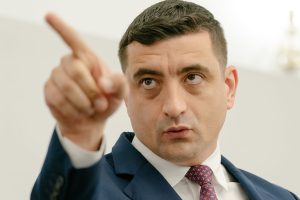
It’s not clear that AUR’s leader, George Simion, would accept such responsibility at this point. He knows that he’ll be in a much stronger position if the turmoil continues. Just as PSD has no incentive to reduce its demands so long as Dan will clearly not contemplate new elections, so too Simion has no reason to accept a smaller piece of the pie now rather than potentially get a much larger one in the future.
This could all have been avoided if Dan had been willing to swallow his pride at the outset of his term and offer to consider a government with AUR’s participation. That would have placed Simion in a political bind. He had finished a strong second to Dan in the election and clearly represented nearly a majority of Romanian voters. Refusing to moderate some of his policies in exchange for getting others his voters wanted might have cost him support, much as happened to Geert Wilders in the Netherlands when he proved unwilling to play normal politics as part of a four-party government.
Enticing populists with real power also tends to moderate them, as the Nordic example shows. Each of the four Nordic countries has included a conservative populist party in government in the past decade. In each case, the populists advance some of their agenda but can no longer credibly campaign as the untried alternative. It entrenches their position in politics, which many on the Left despise, but it keeps these nations from becoming ungovernable.
Perhaps Dan and PSD will persist in their political game of chicken, but that may work against them in the long run. Bulgaria’s traditional parties fought one another for five years earlier this decade, causing government crisis after crisis as no stable alternative could entrench itself. Bulgarians finally took matters into their own hands in the April 2026 snap election, giving an outright majority to former president Rumen Radev’s new, arguably pro-Russia Progressive Bulgaria party. The Socialists failed to enter parliament for the first time since democracy returned after 1989. Neither Dan nor PSD would like such a result in Romania.
Conservative populism continues to gain support across Europe because the cross-partisan Brussels elite parties continue to fail at governing. Eventually in democracies, the people will get their way. Perhaps it would be better for European democracy and health if the populist element of Europe were included sooner rather than later.