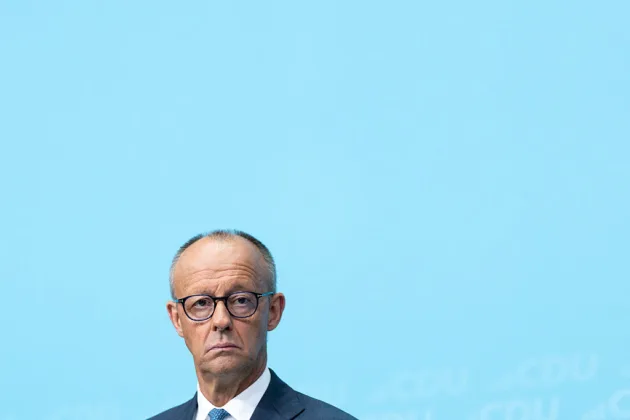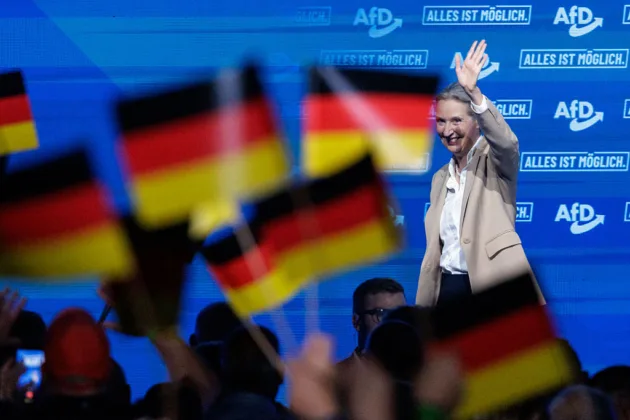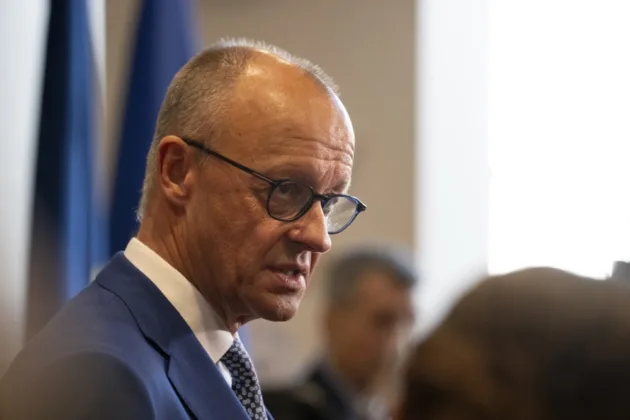








Saxony’s premier, Christian Democratic Union (CDU) politician Michael Kretschmer, started a firestorm on July 22 when he called for an end to the participation of the CDU and its Bavarian sister party, the Christian Social Union (CSU), in the Brandmauer (firewall) prohibiting cooperation with the Alternative for Germany (AfD). CDU German Chancellor Friedrich Merz rebuffed his ally’s call, but his continued insistence that the AfD cannot even be spoken with when discussing government shows he remains woefully out of touch with Germany’s conservative voters.
Kretschmer’s statement was clearly prompted by the political reality he and other Christian Democrats face in states in the former East Germany. Kretschmer leads a minority government that survives without AfD support only because of the tacit backing from one of three left-wing parties, two of which (Die Linke and Bündnis Sahra Wagenknecht, BSW) are lineal descendants of the former East German Communists. Since the September 2024 election, his CDU party has dropped by 11 points in the polls while the AfD has risen by the same amount to a commanding 42 per cent, according to an INSA survey published on May 21.
Kretschmer’s predicament is shared by other CDU leaders in the former East Germany, especially in the two states holding elections on September 6 and September 20. In Mecklenburg-Western Pomerania, in Germany’s northeast, where former chancellor Angela Merkel held her Bundestag seat, the AfD leads with 36 per cent with the CDU running a poor fourth on 9 per cent, according to an Infratest dimap poll for public broadcaster NDR published on July 9.
The situation in Saxony-Anhalt is even more dire for the CDU. Polls there show the CDU down 13 points from the last election in June 2021. The AfD leads with 41 per cent, a 20-point jump from 2021, in Infratest dimap’s survey for broadcasters MDR and WDR published on July 30. If it increases its share just a little, or if the Greens or Social Democrats (SPD) drop below the 5 per cent threshold to win seats, the AfD could win an outright majority.
Kretschmer sees what Merz will not: Depending on the Left for government pulls the CDU to the Left, causing conservative voters to flock to the AfD. He also sees that in East Germany, the CDU and SPD have become so weak that they can only rule by relying on Die Linke or the BSW. CDU party resolutions formally rule out coalition with Die Linke, but informal cooperation causes it problems too, as Kretschmer’s situation makes painfully clear.
It seems so obvious: If conservative voters are moving to the populist Right, perhaps cooperation with the populist Right is what an allegedly conservative government should pursue. Moreover, talking with the AfD has two obvious potentially positive outcomes for the CDU even if it doesn’t lead to a government. Simply saying the CDU is willing to talk with the AfD could lead some conservative voters to reconsider their allegiance. If that does not happen before the election, the AfD could be so unreasonable in coalition talks that conservative voters change their minds afterwards.
Merz has suffered the same losses in federal polls, although not to the same degree as the East German CDU. The AfD first moved ahead of the CDU in the ZDF Politbarometer in April and leads recent polls by a 28-21 per cent margin over the CDU, most recently in Forsa’s survey of August 4. That’s an 8-point drop for the CDU and a 7-point rise for the AfD since the February 2025 federal election. The migration of conservative voters to the Right is obvious, yet Merz remains steadfast in his refusal to countenance any discussion with the AfD.
The Chancellor is clearly banking on his coalition with the SPD being able to turn the German economy around, in part through investment in the military, before the next federal election is due by March 2029. That’s not wholly unreasonable given that the SPD’s continued fall in support makes it less likely to leave government and potentially trigger a new election. It does, however, mean the CDU’s state chapters are put in increasingly untenable positions given that their support is dropping on the backs of the general national movement away from the party.
Merz is thus in a very difficult position. State-level CDU politicians will not want to be kicked out of power for problems caused in Berlin and then be hamstrung by resolutions foisted upon them by Berlin from retaining some influence. Conservative voters will not want to see the CDU abandon its policy against formal cooperation with the former Communists simply to keep a party backed by many of their friends from government. Both groups, then, would have an incentive to undermine Merz’s position as party leader — something that is already rumoured to be happening after his poor handling of the recent dismissal of transport minister Patrick Schnieder.
The CDU faces the same challenge that all legacy centre-right parties are facing: Many of their voters no longer want what they are offering. Coupled with a similar movement on the Left, it is increasingly difficult for the old parties to form a coalition even if all the old rivals lock arms together. Unwilling to move to keep their voters, they are finding that their voters are equally unwilling to move their ideals to keep their party allegiance.
The September East German elections will pose a massive challenge to Merz and the Brandmauer if the results match current polling. The 2027 elections in five states in the former West Germany may be the breaking point. The CDU is strong in four of them, but polls all show the party down and the AfD substantially up compared to the prior election. West German CDU leaders, then, may have to drink from the same poisoned chalice as their East German brethren — deal with the AfD or Die Linke — if polls don’t improve. It’s hard to see how Merz survives this political Götterdämmerung.
Kretschmer sees the future and knows that in a democracy, the people ultimately rule. He understands that it is in Germany’s and the CDU’s interest to bend before voter anger forces a break. Merz should grasp this logic sooner rather than later and end the Brandmauer. The alternative will likely be much worse for him, his party, and his nation.