

Of the 12 players sent off so far at this World Cup, only one has had his suspension lifted. He is Folarin Balogun, the United States striker and the co-hosts’ top scorer at the tournament, whom FIFA has cleared, a day before the last-16 tie against Belgium and without explanation, of the ban he had been carrying since his sending-off in the previous round against Bosnia and Herzegovina. The difference between the American and the other 11, as far as is known, has been a telephone call from Donald Trump to Gianni Infantino.
The pardon, essentially a political one, has not been received as a sporting decision in Belgium, whose federation said it was “astonished” and announced it was studying every option. As far as is known, no official had previously pressed FIFA to let a player take part in a match. In the same way, no sent-off player had featured in his team’s next game since cards were introduced, in 1970.
Unlike Europeans, American supporters, who treat sport more as a pastime than a passion, struggled to grasp the controversy. In the event, the favour changed nothing.
With Balogun restored to the starting line-up, the United States were beaten 4-1 by Belgium in Seattle on July 6 and went out in the last 16. Charles De Ketelaere scored twice inside the first half, a goalkeeping error let in a third and Belgium added a fourth late on, with Malik Tillman’s free kick the hosts’ only reply.
Balogun, whose eligibility had filled a week of headlines, did not score. Belgium, the side that had protested his inclusion, went through to meet Spain in the quarter-finals.
FROM SOUTH KOREA TO THE UNITED STATES
FIFA’s indulgence of host nations is nothing new. It is hard to forget the 2002 World Cup, when South Korea, co-hosts with Japan, reached the semi-finals and knocked out two European giants amid refereeing as unforgettable as it was indefensible.
Italy fell first, in the last 16, when Ecuadorian referee Byron Moreno sent off Francesco Totti for supposedly diving to win a clear penalty and disallowed a valid goal in extra time. The official would later be arrested in New York for heroin trafficking.
Spain then suffered a similar episode in the quarter-finals at the hands of Egyptian official Gamal Al-Ghandour, who ruled out two goals for José Antonio Camacho’s side, beaten on penalties. Several players spoke of “a robbery” and Joseph Blatter, then at the head of FIFA, put what had happened down to human error.
The suspicion that the body’s ambitions in Asia had counted for more than football never faded and, in an act of “justice”, South Korea’s Ahn Jung-hwan was dismissed by his Italian club Perugia over the extra-time goal that eliminated the azzurri.
A WORLD CUP FRIENDSHIP
Unlike the Koreans, the Japanese and other past hosts, the principal host of 2026 has a president who picks up the telephone and does not hide it, any more than he has hidden his delight at the decision: “Thank you to FIFA for doing what was right, and reversing a great injustice.”
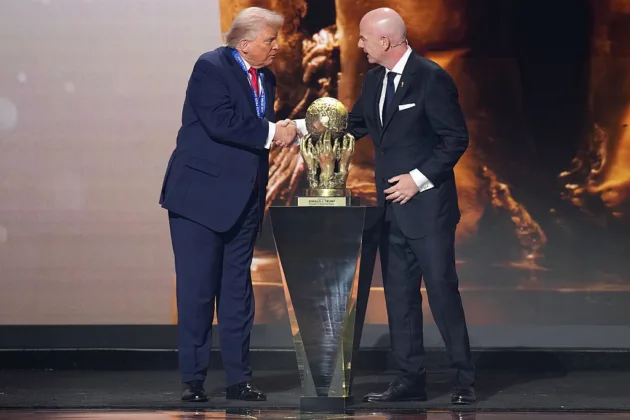
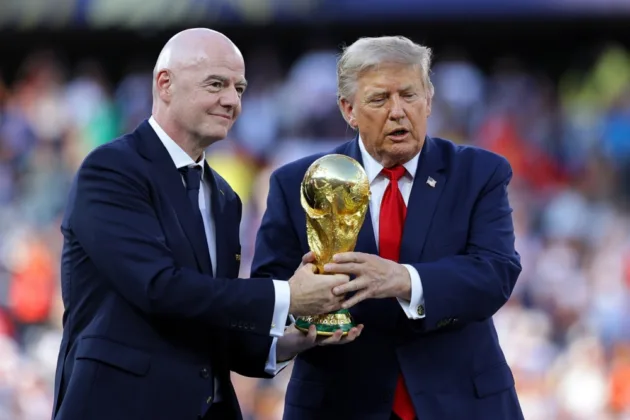
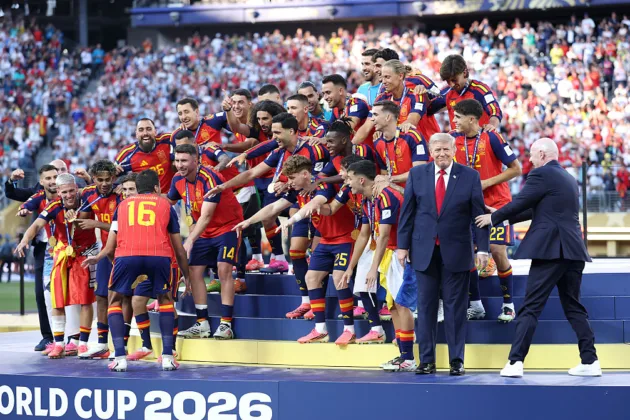
The relationship between the two is close. Few world leaders have spent as many hours alongside the American president. The FIFA chief, who has said the tournament could not have happened without his counterpart, has handed Trump a tailor-made, inaugural Peace Prize, opened an office in Trump Tower in New York and given him tickets worth $15,000 (€13,130).
The United States President, who has likened the World Cup to several Super Bowls at once, set up a White House task force to keep every detail in hand. Against that backdrop, the involvement of Commerce Secretary Howard Lutnick in the Balogun reprieve should come as little surprise.
FIFA AND ITS HOSTS
Bureaucracy also prevails over football in the choice of venues. The body took the 2022 World Cup to Qatar, a country smaller than the Spanish province of Cáceres, with the deaths of migrant workers during a decade of preparation and amid persistent allegations of bribery.
Then, with no logic beyond the deal between FIFA and its principal host, it went to the United States, Canada and Mexico, more than 20 million square kilometres between them.
In a few years the 2034 edition will be played in Saudi Arabia, thanks to an uncontested vote that FIFA engineered by spreading the 2030 tournament from Spain and Portugal to one country of the African confederation and three of the South American one, so that the following turn could fall only to Asia.
The Iberian World Cup, dreamed of for decades, will be an unworkable multicultural mosaic of six hosts in which the original bidders are pushed aside. The countries of the Peninsula are not even assured of staging the final, as FIFA has yet to award the venue, feeding suspicion that it will go to Casablanca’s vast Grand Stade Hassan II, and not the Santiago Bernabéu, for the distinctly unsporting reasons the body that governs football tends to weigh.