

A phone call from US President Donald Trump to FIFA President Gianni Infantino has triggered a major controversy at the 2026 World Cup, after FIFA reversed its decision to suspend American striker Folarin Balogun for a red card.
The move has drawn sharp criticism from other national teams, European football authorities, and fans worldwide.
According to multiple sources, Trump called Infantino shortly after Balogun received a red card during the United States’ Round of 32 win over Bosnia and Herzegovina on Wednesday.
The US forward was automatically handed a one-match ban that would have ruled him out of Monday’s last-16 clash against Belgium.
On Sunday, FIFA’s disciplinary committee surprisingly announced in an unprecedented move it was suspending the ban for a one-year probationary period, effectively clearing Balogun to play.
Trump publicly welcomed the decision on social media, writing: “Thank you to FIFA for doing what was right, and reversing a great injustice.”
UEFA issued a strongly worded statement on Monday, declaring that FIFA’s decision “crossed a red line.”
The European governing body argued that the automatic one-match suspension following a red card is a fundamental principle embedded in the regulations and cannot be subject to exceptions, especially mid-tournament, where several other players have been in the same situation and regularly served their suspension.
“When the certainty of rules is no longer guaranteed by its guardians, the integrity of the game is at stake and the credibility of a competition is undermined,” UEFA said.
“We express our disbelief at such an unprecedented, incomprehensible and unjustifiable decision.”
Belgium’s football federation had earlier reacted with fury, describing itself as “astonished” by FIFA’s move and accusing the governing body of acting in direct contravention of its own regulations.
It noted that article 10.5 of the FIFA World Cup 2026 Competitions rules and regulations explicitly says that “If a player or team official is sent off as a result of a direct or indirect red card (second caution), they will automatically be suspended from their team’s subsequent match. In addition, further sanctions may be imposed.”
Furthermore, the automatic nature of a suspension was explicitly reiterated in the specific FIFA World Cup 2026 Circular No. 16, which was sent to all participating nations on 12 May 2026.
The rule is also reiterated at every “Match Coordination Meeting” prior to each FIFA World Cup 2026 match, as well as in all FIFA World Cup 2026 workshop presentations.
Belgian Foreign Minister Maxime Prévot called FIFA’s decision “incomprehensible”. He said it was undermining the most fundamental rules of football and sport
Most commentators world wide sided with Belgium over the issue.
Ex-FIFA boss Sepp Blatter posted on X, stating: “Red cards are not overturned by political phone calls.”
“Football must never become a playground for political power”, he noted.
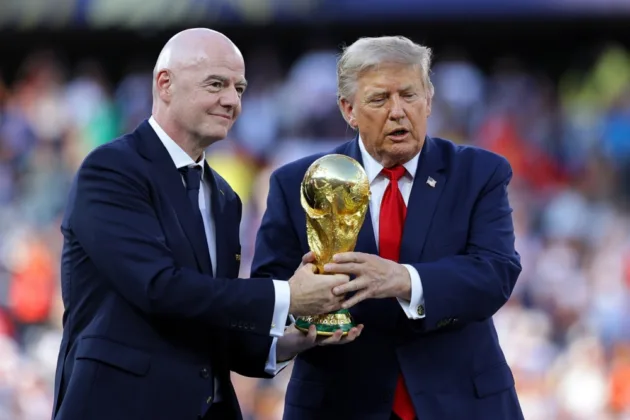
The episode has fuelled accusations that the close personal relationship between Trump and Infantino, who has previously awarded Trump FIFA’s inaugural Peace Prize, influenced the outcome of what should have been an independent disciplinary process.
Most critics argue that allowing a head of state to directly intervene in disciplinary matters undermines FIFA’s credibility and the principle of fair play, especially during a World Cup co-hosted by the United States.
FIFA has stated that the decision followed an “independent review,” but has not directly addressed the reported role of Trump’s call.
Infantino and Trump have spoken multiple times in recent days, with the US president reportedly telling Infantino after the reversal that it was “the right decision.”
USA’s game against Belgium is now expected to be one of the most watched matches of the tournament.
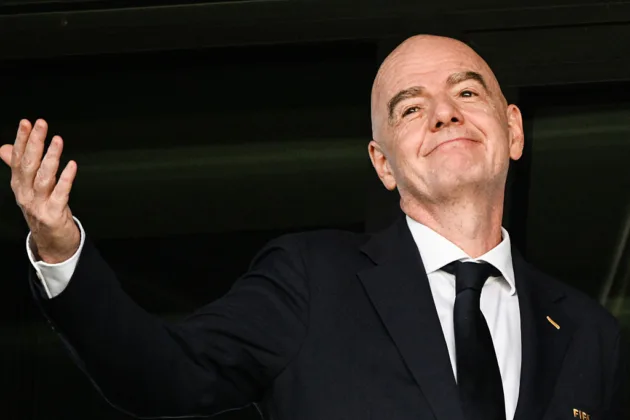
FIFA President Gianni Infantino has faced criticism over the years due to his perceived greed and lavish spending.
Detractors point to his substantial salary increases, the awarding of lucrative broadcasting and sponsorship deals, and a lifestyle that includes private jets and high-profile events.
Ethics concerns have mounted over transparency in hosting decisions and commercial partnerships.
The controversy carries added irony given President Trump’s long-standing opposition to birthright citizenship.
Folarin Balogun, the player at the centre of the dispute, was born in New York City to Nigerian parents and qualifies as an American under the 14th Amendment.
Had Trump’s past policy positions been enacted, Balogun might not have been eligible to represent the United States at all.
Balogun grew up in the UK and came through the England youth setup. It was only in 2023 that he opted to represent the United States, where the level of competition is considerably lower than it would have been with the higher-rated and more prestigious English senior team.