


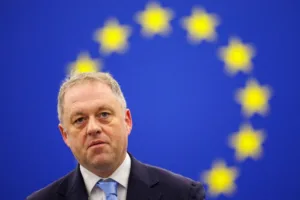



The head of Poland’s Supreme Court Zbigniew Kapiński is being pursued by the public prosecutors under the control of the centre-left government headed by Prime Minister Donald Tusk for allegedly abusing his power as a Supreme Court judge, before his recent appointment as chief justice.
Kapiński, who was appointed by the opposition Conservatives (PiS) aligned President Karol Nawrocki has said that the government prosecutors move is part of a “coordinated political action” against him.
The Supreme Court in Poland is the top court with regard to all matters concerning criminal, civil, family and labour law. However, there are two more top courts, one for adjudicating the constitutionality of laws and another for administrative law.
The Tusk government disputes the way Supreme Court constitutional court and common court judges were appointed during the time of the last PiS government, which has opened up a serious crisis within the Polish judiciary as the status of thousands of judges up and down the land has been questioned by members of the government and fellow judges alike.
The European Court of Justice (ECJ) and the European Commission (EC) have sided with the Tusk government whereas they sanctioned the previous PiS administration over alleged rule of law violations.
However, the Tusk government has not been able to pass legislation which would resolve the dispute over the status of judges because both the previous President Andrzej Duda and his successor Karol Nawrocki- both PiS supporters- maintain that as heads of state the constitution gave them the sole and exclusive power to nominate judges.
The dispute over the status of judges dates back to the way PiS reformed the way the National Council for the Judiciary (KRS), the body which makes recommendations on judicial appointments to the head of state is selected.
Before 2017 the KRS was elected by senior judges, but PiS changed that to a system in which most of the members of that body are elected by Parliament.
The opposition accused the PiS government of acting unconstitutionally and the ECJ and the EC ruled that the KRS was no longer an independent body because it was elected by Parliament.
However, PiS pointed to the fact that the Polish constitution does not specify the method of election of the KRS and that bodies which perform similar functions in major EU member states such as Germany and Spain are also elected by parliaments.
Despite the European institutions critical view of the KRS when pressed to declare all its recommendations and the judicial appointments based on them to be invalid the ECJ has ruled that every judicial appointments has to be examined independently and that there could be no automatic categorizing of all judges appointed on recommendation of the KRS as being unfit to hold the office.
However, the Polish government continues to maintain that the judges appointments since 2017 are not valid and has called them “ne–judges” in order to accentuate their allegedly illegitimate status.
Zbigniew Kapiński who was appointed by President Nawrocki recently to be chief justice of the Supreme Court is one such so-called “neo-judge”, having been recommended as a Supreme Court judge in 2022 by the KRS.
Accusing Kapiński of being under political influence of PiS is questionable since PiS actually protested his appointment because the chief justice over two decades ago presided over a case which cleared the former President Lech Wałęsa of suspicions of having cooperated with the communist secret police.
Kapiński argues that as a judge he had to follow the law and that at that stage there was no conclusive evidence of Wałęsa having been an informer. That evidence emerged in later years.
But Kapiński has also ben criticized by PiS for the fact that he has decided to allow the new KRS elected recently by Parliament on the recommendation of judges, with the exclusion of the views of the so-called neo-judges, to go function by calling its first meeting.
PiS maintains that the parliamentary procedure was not followed and the constitutional court has also questioned the validity of that election. Kapiński however maintains that parliament had the right to consult who it liked, including the exclusion of certain judges.
Despite Kapiński taking an independent stance in the way he is proceeding with his job the Tusk government still questions his appointment and now its prosecutors are investigating whether he abused his power between May 2024 and May 2026 while serving as head of the Supreme Court’s criminal chamber by blocking motions to exclude other “neo-judges” from cases due to doubts over their legal status.
In a statement announcing the launching of proceedings, the National Prosecutor’s Office said that the case had begun with a notification against Kapiński by unnamed fellow Supreme Court judges on May just three days Nawrocki’s nomination in a process a process boycotted by many “old” judges appointed before the overhaul of the KRS.
Prosecutors claim that, after examination of preliminary evidence including witness statements and documents, there is “reasonable suspicion of a crime having been committed therefore an investigation will proceed.
If Kapiński is found guilty of the abuse of power, he could face a prison sentence of up to three years, but as chief justice he is protected by immunity from prosecution. That immunity can only be removed by the State Tribunal, a body that the Supreme Court Justice actually presides over.
That immunity had already protected Kapiński’s predecessor Małgorzata Manowska who clashed regularly with the government from facing charges of abuse of power.
Kapiński has told Polish media that “the claims and threats being made against me are part of coordinated political campaign.”
He explained that, when heading the criminal chamber of the Supreme Court, he had issued the order to reject motions to exclude judges based on how they were appointed because such efforts were often intended to “prolong proceedings for months or even years”, adding that he “cared only about the efficiency of proceedings”.
Kapiński also noted that, on the same day he was informed about the prosecutors’ decision to open proceedings, he was told by the Supreme Court’s disciplinary commissioner that a separate case against him had been sent to a Supreme Court body that reviews judges’ alleged misconduct.
He said that the disciplinary case relates to proceedings involving former PiS government ministers Maciej Wąsik and Mariusz Kamiński who were both convicted in a case concerning abuse of power when authorising a sting operation but who were later pardoned by President Duda.
Those pardons were challenged in the Supreme Court because they had been issued before the full completion of the legal process, even though the Polish constitution does not limit the head of state’s power of mercy just to those who have been convicted.
Following that Supreme Court ruling an appeals court upheld the convictions against Kamiński and Wąsik with the government seizing on this and ordering their arrest.
The arrest, which took place in the presidential palace, where they were the guests of the President, was swiftly followed by a hunger strike by both men leading to the President pardoning them again and them being released.
However, before they were detained the two, both MPs, continued to attend and vote in parliamentary sessions. It is that parliamentary attendance that was challenged by the ruling majority with the case brought before the Supreme Court with the prosecutors claiming the two had forfeited their mandates.
Justice Kapiński stopped their case being heard by the Labour law chamber and referred it to the Supervisory chamber, a body created during the time of the last PiS government which has been contested by both the government and EU institutions.
Kapiński, rejects claims by the justice minister Waldemar Żurek that he is politically biased pointing to the Wałęsa case and the KRS decision and that he has adjudicated in several cases involving politicians from different parties.
However, the fact that the Tusk government is continuing its campaign of undermining all judicial appointments made by PiS presidents shows that the state of gridlock with regard to judicial reform is unlikely to be resolved between now and next autumn’s parliamentary election.
That gridlock over the status of almost 3,000 judges is causing problems in everyday court cases. There have been several judgements which were ruled as invalid on appeal with the questioned status of the judge being given as the reason for the overturning of the conviction.
The government has proposed legislation that would have broken up the 3,000 so-called neo-judges into categories, with some being allowed to remain while some were transferred to their previous jobs and others removed from being allowed to adjudicate.
However, such a reform has proved unacceptable to both the last and the current President as both argued that it undermines their power of judicial appointments enshrined in Poland’s constitution.
President Nawrocki has proposed a reform that would actually make it an offence for judges to question the status of other judges, but that in turn is totally unacceptable to the Tusk administration.
The EU institutions which were highly active in challenging the PiS reforms today remain silent on the judicial disputes in Poland, saying that they are an internal matter for Poland.
Tusk is a prominent member of the EU’s ruling European People’s Party (EPP) who between 2014 and 2019 was President of the European Council and later actual leader of the EPP (2020-2023).
He holds steadfast to the view that European law is supreme in all matters whereas PiS believes that according to Poland’s constitution European law cannot override the Polish constitution.