
Europeans have become accustomed to one of the greatest achievements of the post-war era: food simply being there. We enter a supermarket expecting not merely potatoes, but several varieties.
We expect bread, beef, chicken, milk and vegetables every day of the year. If Europe does not produce enough, we assume something will arrive from Ukraine, Brazil, Argentina or somewhere else. But what happens when it does not?
With drought affecting much of the continent, Europe risks discovering that food abundance was never automatic.
In the 1950s, food could absorb 40 to 50 per cent of household income in southern Europe and around 30 to 35 per cent in northern Europe. By 2024, food and non-alcoholic beverages accounted for 13.2 per cent of EU household consumption expenditure, according to Eurostat.
That decline liberated enormous purchasing power. Money previous generations needed simply to feed themselves became available for housing, cars, education, holidays and everything associated with mass prosperity.
The Common Agricultural Policy emerged from a Europe that remembered war scarcity. Europe created abundance so successfully that it eventually forgot why producing food mattered.
Farmers even became targets of resentment, supposedly bathing in EU subsidies. Yet agricultural support declined substantially relative to the European economy. Common Agricultural Policy spending fell from 0.54 per cent of EU GDP in the 1990s to 0.36 per cent in 2023, according to the Commission’s own figures.
Environmental protection is not the problem. Farmers have an obvious interest in fertile soil, reliable water and a functioning natural environment.
The problem begins when environmental ambitions become detached from producing food, or become entangled with a degrowth philosophy in which producing less is itself treated as progress.
The European Commission’s own researchers warned where this could lead. In 2021, Joint Research Centre modelling of the “Farm to Fork” and Biodiversity strategies projected output reductions across most crops and animal products: Around 15 per cent for cereals and oilseeds, 12 per cent for fruit, vegetables and permanent crops, 13 per cent for beef and 10 per cent for raw milk.
Yet Europe cannot demand more expensive production, accept lower output and assume consumers will never notice.
The apparent escape route is imports, with Mercosur being the obvious example. European farmers face stringent rules on pesticides, animal husbandry and environmental impacts while competing with imported products produced under different conditions.
If imports are cheaper, consumers understandably buy them. After a while, European production even becomes uneconomic.
The EU does not make the environmental consequences disappear by moving production abroad to less productive agricultures, eg in South America. It merely relocates part of its carbon footprint, while transport can add further emissions.
Europe’s trade statistics also create a misleading impression of self-sufficiency. The EU is a major agricultural exporter by value, selling French wine, Italian cheese and Spanish ham around the world.
But measured in nutrition rather than euros, Europe remains dependent on imports. Three-quarters of the high-protein animal feed used in the EU is brought in from outside, and in 2025 a quarter of the protein from oilseeds and protein crops was sourced within the bloc.
That dependence matters when supply chains stop behaving as expected.
Covid demonstrated how quickly apparently permanent supply chains could fracture. Russia’s invasion of Ukraine in 2022 then forced Europe to rediscover strategic dependence: first energy, then fertiliser and food.
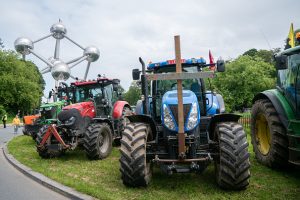
Farmers’ protests added political urgency. After smelling burning tyres outside meetings of EU agriculture ministers, Brussels began changing its language.
The Commission’s Vision for Agriculture and Food, published on February 19, 2025, puts competitiveness, farm incomes and Europe’s capacity to produce food back at the centre of policy.
The reversal is clearest in livestock. Meat and dairy had been prime targets of environmentalist demands for Europeans to consume less.
Yet on May 27, 2025, launching a dedicated workstream on the sector, the Commission declared that livestock “is, and will always be, an essential part of EU agriculture, competitiveness, and cohesion”.
It is too early to relax. The Green Deal has not disappeared. But the emphasis has shifted from accepting contraction towards preserving productive capacity.
That reconsideration comes as nature itself is making food production more difficult. In its crop monitoring bulletin of July 2026, the Joint Research Centre cut EU yield forecasts for every spring and summer crop, by 6 to 7 per cent for grain maize and sunflowers, and revised winter crop forecasts down by 1 to 4 per cent.
Hungary’s production forecast fell from 4 per cent below average in June to 17 per cent below in July, in what has been reported as the country’s worst drought since 1991.
Hungary illustrates why Europe cannot simply engineer its way out. Between 1.5 and 2.6 per cent of its agricultural land was irrigated between 2014 and 2023, and 5.1 per cent is equipped for irrigation at all.
Even with enormous investment, getting much beyond 10 per cent would be difficult because irrigation requires vast quantities of water and infrastructure. Farmers will have to adapt in different ways: different crops, different cultivation methods and, in some places, different uses for agricultural land.
But such long-term, investment-heavy adaptation requires farmers who still want to farm in the future. Farming needs to be a viable business, securing income for farming communities, so that they devote the labour and capital such transitions demand.
The EU created the Common Agricultural Policy because a generation that had experienced hunger understood that food production was a strategic necessity. Their successors inherited such abundance that they could afford to forget.
Covid, war and now drought are reminding Europe of the old maxim associated with Sicco Mansholt, the father of the Common Agricultural Policy: “Nooit meer honger” – never again hunger.
Brussels would do well to remember it before Europe has to learn the lesson the hard way.