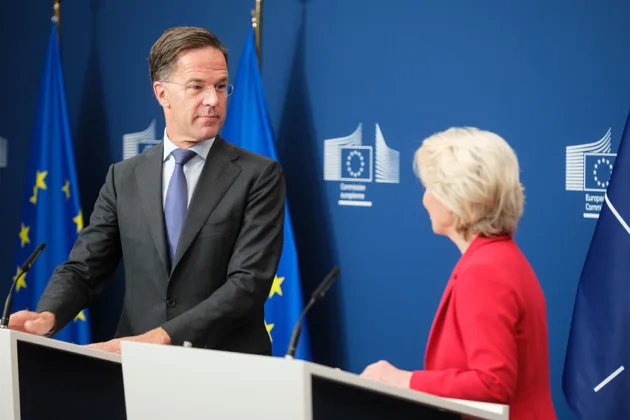
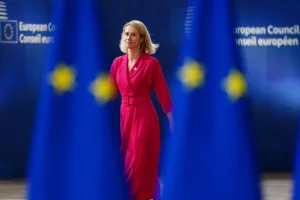


NATO has to become more European to reduce its long-standing reliance on the United States for security, European Commission President Ursula von der Leyen and NATO Secretary General Mark Rutte have said.
The pair spoke on July 7 as leaders of the 77-year-old alliance gathered in Ankara, Turkey, for its annual summit, which runs over two days.
“To stay transatlantic, we have to become more European,” Rutte said at a defence industry forum held ahead of the main talks. He called for a stronger Europe within a stronger NATO.
Von der Leyen appeared alongside him and stressed the value of close cooperation between the EU and the alliance. To make that work, she said, “what we need is interoperability”.
Rutte set out what he described as a clear division of labour between the two bodies. NATO oversees the command structure, capabilities and standards, while the EU handles industry, investment and regulation.
Twenty-three of the EU’s 27 member states are also NATO members, though the two organisations remain formally separate.
The summit has come after months of transatlantic tension, fuelled by the White House’s decision to strike Iran without consulting allies and by a gradual withdrawal of US military assets from Europe.
European governments are keen to show US President Donald Trump that they are increasing defence spending at pace, a shift some observers have called the “Europeanisation of NATO”.
Progress remains uneven. Poland, the Baltic states and the Nordic countries have raised military spending sharply towards a new target of 5 per cent of GDP, while Spain, Belgium, Luxembourg and the Czech Republic still lag behind.
At The Hague summit last year, allies agreed to reach that 5 per cent figure, covering defence and related security spending, by 2035.
Von der Leyen used the forum to promote the Commission’s own funding plans for home-grown defence. These include €150 billion under the SAFE loan programme and a provisional €135 billion set aside in the next EU budget.
Trump, who has repeatedly criticised the alliance and threatened to pull the United States out, is among the leaders attending. His administration wants European members to take primary responsibility for the continent’s conventional defence.