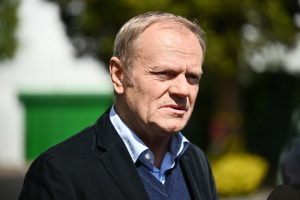






Donald Tusk, the Polish Prime Minister at the head of a centre-left coalition government which promised to “restore the rule of law” in Poland has confirmed that he is backing his minister who departed the government on August 11 to take up a seat on the country’s Constitutional Tribunal (Trybunał Konstytucyjny, TK).
Maciej Berek was until August 11 the member of the cabinet responsible for coordinating and overseeing the implementation of the Tusk government’s legislative programme. He also chaired the Standing Committee of the Council of Ministers and ran the government’s deregulation drive. His duties have passed to Joanna Knapińska, head of the Government Legislation Centre.
Tusk’s proposal is being questioned by his coalition allies and by most judicial circles because when in opposition Tusk had argued that politicians should not become judges on the TK for at least four years after they have left politics.
Justifying his move at a press conference on August 13, Tusk said that Berek was exceptionally well qualified to help repair the institution despite having served in government.
“I don’t know anyone better prepared than Maciej Berek” for the task, Tusk said, describing him as “one of Poland’s most outstanding practising lawyers”, and calling him an “apolitical and non-partisan figure”.
Tusk accused the last Law and Justice (PiS) government of having severely damaged the institution and said the current situation required exceptional measures.
“We do not have a normal election to a normal Constitutional Court today,” he said.
The government previously proposed legislation that would prevent members of the government from becoming TK judges for four years after leaving office. The Sejm, the lower house of parliament, passed that bill and its implementing act on September 13, 2024. The package also required a three-fifths majority for the election of tribunal judges.
The Prime Minister acknowledged that backing a former minister appeared to conflict with his own position that Constitutional Tribunal judges should be free of political connections.
Asked about the apparent contradiction, Tusk said the legislation had not been signed by the president and therefore was not in force. Then-president Andrzej Duda referred both laws to the TK for preventive review on October 7, 2024, which stopped them entering into force.
“I understand that principle, and I believe in it myself,” Tusk said. “But what matters most today is the work of people who are as competent and courageous as possible.”
“Since methods that are unconstitutional are being used from the other side, I must also demonstrate my determination and that we won’t give in to such methods,” added Tusk, referring to the refusal of the PiS-aligned Presidents Andrzej Duda and Karol Nawrocki to swear in judges elected by Tusk’s coalition.
“We have no interest in this matter other than to repair the Constitutional Tribunal so that it is not a tool and is not under the thumb of the president or PiS, but rather that it performs its work as objectively as possible,” said Tusk.
He maintained that politicians should generally have no role in the TK, but said restoring its functioning was now the government’s priority.
Tusk also rejected suggestions that Berek was his personal or party candidate, saying he had merely agreed to allow him to leave the government and seek nomination.
The TK, whose 15 judges are elected by the Sejm for single, non-renewable terms of nine years, reviews whether legislation complies with the Polish constitution. Its status has been at the centre of a long-running dispute over the rule of law following changes introduced during the 2015-2023 governments led by PiS.
These were condemned by the then liberal opposition which is currently in power as having put the constitutional court and the judiciary as a whole under direct party political control by PiS.
Even before the dispute that has been going on since 2015, though, politicians have often become members of the constitutional court immediately on ending their elected or government posts. PiS placed two of its own former MPs, Krystyna Pawłowicz and Stanisław Piotrowicz, on the bench in December 2019.
In October 2015 the then liberal government majority of Tusk’s Civic Platform (PO) and the Polish People’s Party (PSL) decided to take the step of appointing two additional constitutional court judges ahead of the date on which vacancies were to actually arise. Tusk had by then left Warsaw to chair the European Council and Ewa Kopacz was prime minister.
It had been the customary process for constitutional court judges to be elected only when vacancies were about to arise and not well in advance.
PiS won both the presidential and then parliamentary elections in 2015 and on coming into office decided to overturn the election not only of the “additional” judges elected ahead of schedule but also three who had been elected at the appropriate moment in time but had not been sworn in by the new PiS-aligned President Andrzej Duda.
The move was greeted with fury by the liberal opposition and criticised by the European Commission as political interference in the judicial process. The Commission opened its rule of law framework dialogue with Warsaw in January 2016, the first time it had used the mechanism against a member state.
Tusk’s party, Civic Platform, which now leads the Civic Coalition (KO) alliance, has ever since then consistently argued that the whole court, composed of 15 judges, lacks legitimacy, despite the fact the remaining 12 judges were elected in accordance with the law.
Their view was backed by both the European Commission and the Court of Justice of the European Union (CJEU) and during the rule of law dispute with the 2015-2023 PiS government Polish post-pandemic and structural funds were withheld. The Commission adopted the two legal acts releasing up to €137 billion on February 29, 2024, weeks after Tusk returned to office.
When coming into office Tusk and his government decided it would not publish any of the decisions taken by the court and for over two years its parliamentary majority blocked any election for constitutional court judges when vacancies arose.
They changed their minds this year, by which point enough terms were due to expire for the coalition to hold a majority on the court by the beginning of 2027.
As a result they decided to elect six judges to the court on March 13, 2026. Nawrocki, elected in 2025, took the oath from two of them, Magdalena Bentkowska and Dariusz Szostek, on April 1 but withheld it from the other four. His chancellery argued that only two seats had fallen vacant during his term and that the Sejm should have filled them individually rather than in a single batch.
The ruling majority held a swearing-in ceremony in the Sejm on April 9 for the four judges, before Speaker Włodzimierz Czarzasty, despite the fact that legally it has no force. Bentkowska and Szostek repeated their oaths at the same event. They argue that the President had no right to refuse the four justices from taking their oath of office. Nawrocki has since asked the TK to settle a competence dispute, which his office says suspends the four cases by operation of law.
But they are now proceeding with elections of more judges of the court individually, as vacancies on the court actually arise. The next falls on September 18, when the term of Justyn Piskorski expires, one of the two remaining judges the ruling majority itself regards as improperly seated. That is the seat for which Tusk’s “right-hand man”, as he has called him, is to stand. The Sejm is due to sit on September 2-4.
Tusk has said that Berek’s candidature has yet to be discussed with his coalition partners and initial reactions from those parties were not favourable.
Anna Maria Żukowska, the head of The Left’s (Lewica) parliamentary caucus, declared on X on August 11 that, if rumours of Berek’s nomination were true, “he won’t get votes from The Left because we promised our voters that politicians wouldn’t end up on the TK”. Another Left deputy, Andrzej Szejna, said he would vote in favour, calling Berek an outstanding lawyer.
The Speaker of the Sejm and leader of New Left (Nowa Lewica) Włodzimierz Czarzasty as well as Władysław Kosiniak-Kamysz, the deputy Prime Minister and defence minister who leads the agrarian Polish People’s Party (PSL), have stayed silent on the matter.
Given that the government has only a majority of nine in the 460-seat parliament it would only require a small number of MPs from Tusk’s coalition to oppose Berek’s nomination for him to fail to be elected.
But Tusk has said that he would sit down with the whole coalition to look for solutions, and he has plenty of patronage at his disposal to sweeten the pill for his allies. Moreover, with a parliamentary election due in 2027 and with Tusk’s party being in the lead in the opinion polls while his coalition partners are struggling to clear the 5 per cent electoral threshold, he also has the potential of offering them an electoral coalition that would see them safely elected back into parliament. An IBRiS poll for Polsat News published on August 3 put KO on 27.5 per cent, PSL on 4 per cent and Poland 2050 on 1.4 per cent.
Even if Berek is approved by parliament, the law states that new TK judges must swear an oath “before the President” and it also stipulates the requirements a candidate must meet for his election to be valid.
President Nawrocki’s chief of staff Zbigniew Bogucki said on August 13 that the head of state had “one vector of decision” on tribunal oaths. “If procedures are respected, the President accepts the oath,” he said, adding that on that basis Berek’s election “may be valid”. Nawrocki took the oath from Sławomir Patyra on July 28 after the Sejm elected him in June to a single, individually identified seat.
Since the President does not recognise four of the seven justices elected by Tusk’s parliamentary majority the PM will not have a majority on the court unless he gives the green light to his justice minister Waldemar Żurek to use the police and security forces to take over the constitutional court by installing the four judges whom the government insist have been legitimately elected.
But any such move would be likely to lead to a further conflict in which there are two individuals claiming to be chief justice of the court, the incumbent, Bogdan Święczkowski, and a new candidate elected by judges whom the government accepts as legitimate members of the court.
The European Commission has accepted Tusk’s version of events with regard to the judicial disputes in Poland, including his government’s claims that thousands of judges appointed within the lifetime of the last PiS government and the body which recommended them, the National Council of the Judiciary (KRS), were illegitimate. Tusk and his party are key members of the European People’s Party (EPP), the largest group in the European Parliament, which Tusk himself led from 2019 to 2022.
European institutions have felt that the Polish judiciary was being subjected to party political control by PiS but the actual reforms which were pursued made the process of electing the KRS by parliament similar to the way such bodies are elected in Germany and Spain. The Polish constitution, on the basis of which Poland joined the EU, gives the President the sole power of appointing judges.
The government has attempted not only to have the KRS elected by judges again, but also to nullify the 3,000 or so judicial appointments made during the lifetime of the last PiS government and the PiS-allied President Duda.
As a result of the gridlock between the President and government no actual legislation on reforming the judiciary has been passed in this term of parliament, therefore the plan for the restoration of the rule of law Tusk presented to Brussels on February 20, 2024 has not been implemented.