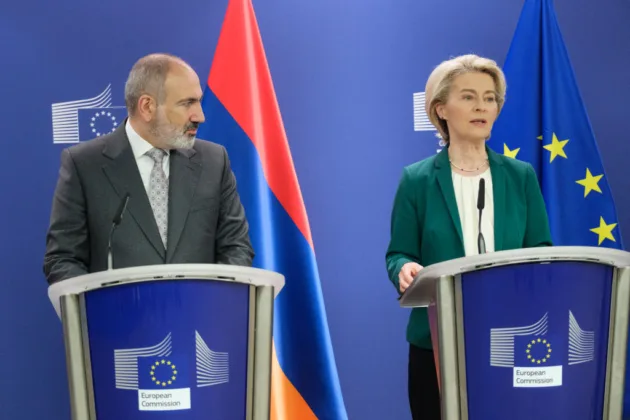
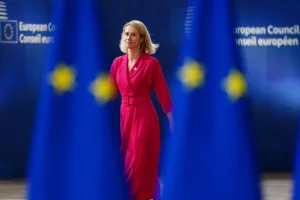

European Commission President Ursula von der Leyen used a visit to Yerevan on 2 July to announce that the European Union will eliminate tariffs on nearly 80 per cent of Armenian exports, the clearest signal yet that Brussels intends to anchor Armenia more firmly in the European economic sphere while reducing its dependence on Russia.
The proposed Autonomous Trade Measures, which still require approval by the European Parliament and the Council, are accompanied by an additional €18 million in answer to recent Russian trade restrictions on the country.
Both Brussels and Moscow are explicitly linking their trade measures on Armenia as political tools, presenting them as part of a broader strategies to exercise influence on the country within a wider geopolitical contest opposing the EU and the Kremlin.
Since Russia’s full-scale invasion of Ukraine in February 2022, the EU has sought to strengthen ties with post-Soviet countries willing to reduce their dependence on the Kremlin.
Armenia, under Prime Minister Nikol Pashinyan, has increasingly emerged as one of Brussels’ key partners in the South Caucasus.
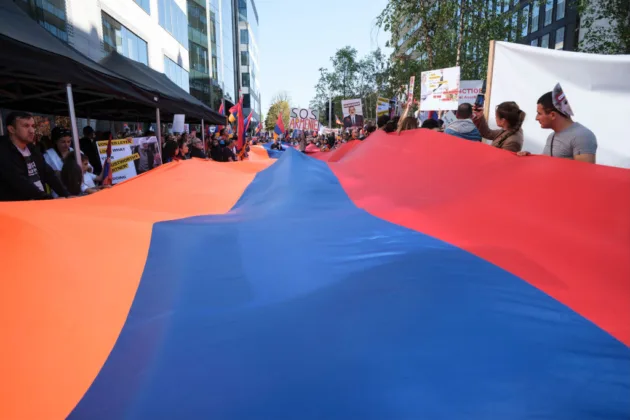
For decades, Armenia was one of Russia’s closest allies. It hosts a Russian military base, belongs to the Moscow-led Eurasian Economic Union and traditionally relied on the Kremlin for security, energy and trade. That relationship reached a turning point in September 2023, when Azerbaijan retook Nagorno-Karabakh.
Russian peacekeepers deployed in the region failed to stop the Azerbaijani offensive or prevent the subsequent exodus of more than 100,000 ethnic Armenians, fuelling unprecedented criticism of Moscow inside Armenia.
Since then, Pashinyan’s government has accelerated its political and economic rapprochement with the European Union. On 5 May 2026, Armenia hosted its first EU-Armenia Summit, where Brussels pledged to deepen cooperation on trade, connectivity, energy and reforms, while reaffirming its support for Armenia being more independent from Russia.
Relations with Moscow deteriorated further in June 2026, when Russia imposed restrictions on imports of Armenian agricultural products, flowers, fish and alcoholic beverages. The European Commission described the measures as economic coercion intended to pressure Yerevan over its increasingly pro-Western orientation.
Brussels responded within days. On 4 June, von der Leyen announced a €52 million emergency support package. On 19 June, the Commission released the first €34 million to help Armenian exporters affected by the Russian restrictions.
The tariff package announced in Yerevan on 2 July represents the next phase of that strategy. By opening the EU market to most Armenian exports and helping local companies comply with European standards, Brussels is offering Yerevan a concrete alternative to Russian markets and supply chains.
The initiative also fits into the EU’s Global Gateway strategy, which seeks to expand European influence through trade, investment and infrastructure rather than military commitments.
In Armenia, Brussels is deploying its strongest geopolitical asset—access to the world’s largest single market—to strengthen a government that has increasingly distanced itself from Moscow.