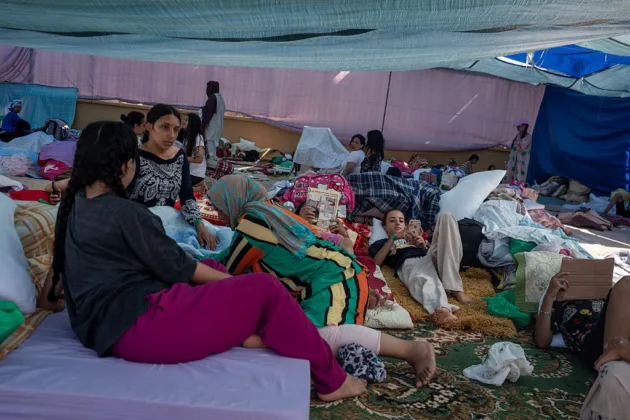






The European Commission has said that all migrants staying illegally in the Spanish exclave of Ceuta should be sent back to Morocco, including the unaccompanied children who crossed into the autonomous city in late July.
Commission home affairs spokesman Markus Lammert told reporters in Brussels on August 18 that the expectation remained that everyone illegally present in Ceuta would be returned.
Asked whether that also covered minors, despite the additional protection European Union law affords them, Lammert said the matter was regulated by EU law. He said the Return Regulation agreed in June set out provisions for the removal of irregular migrants, and that children were ‘also covered by EU law’.
Spanish and Moroccan authorities were expected to work together so that the returns were carried out effectively, he said. Brussels had offered to facilitate and support the process, he added, after Morocco signalled its willingness to take back all unaccompanied minors.
Rabat has attached a condition to that offer. A Moroccan diplomatic source told EFE on August 6 that the kingdom would receive every Moroccan child now in Spain if Madrid lifted the judicial and administrative obstacles that, in its view, blocked such returns.
The Commission has pressed for speed since the first days of the crisis. European Commission President Ursula von der Leyen demanded on July 31 that those entering illegally be sent back without delay and that returns be swift, as EU rules allowed.
Lammert welcomed statements by the Spanish Government that nobody staying illegally in Ceuta would be transferred to the Iberian peninsula. He also welcomed Madrid’s announcement that it would expand reception capacity to address the humanitarian situation.
The Return Regulation replaces the 2008 Return Directive and was agreed by negotiators on June 1 before the European Parliament approved it on June 17 by 418 votes to 218. It bars the transfer of unaccompanied minors to return hubs in third countries, though it does not prevent their removal to a country of origin.
Some 72,000 people crossed into Ceuta on July 30 and 31, according to Spain’s interior ministry, in the largest influx recorded at the EU’s only land border with Africa. Morocco has given a lower figure of about 40,000.
Most of those who entered went back within days. Spanish authorities have confirmed 72 deaths and Morocco has reported 11 more, 10 of them drownings, while the NGO Caminando Fronteras has counted 141.
The Ceuta government said on August 5 that it was caring for about 1,100 unaccompanied minors, against a statutory figure of 90 for the city under the mechanism that covers migratory contingencies. Ceuta has been formally in that category since August 2025.
Spain’s youth ministry registered 1,342 children two days later, and NGOs working in the exclave say the real figure is higher. The local administration has added 664 places and two schools have been handed over for temporary use.
Minister for Youth and Children Sira Rego said on August 7 that the first transfers to the mainland would begin within weeks. She was relying on a 2025 reform of article 35 of the immigration law, which obliges the State to redistribute children from territories whose reception systems are overwhelmed.
The procedure gives the sending region 10 days to notify a transfer proposal to the rest and five more to move the child. Rego has also announced €25 million in extraordinary funding and sent a permanent technical team to Ceuta on August 16.
The Supreme Court has already ruled against a faster route. In January 2024 it found that the return of a group of unaccompanied children from Ceuta to Morocco in August 2021, after the mass crossings of that May, had been unlawful.
The court did not bar returns to Morocco as such. It held that each case required an individual administrative file, a hearing for the child and an assessment of his or her circumstances, and that the 2007 bilateral agreement with Rabat on unaccompanied minors could not on its own justify removal.
Judges described the operation as a collective expulsion, which the European Convention on Human Rights prohibits, and said the children’s rights to physical and moral integrity had been breached.
The same court found on July 8 this year that migrants intercepted while swimming towards Ceuta and Melilla could not be handed straight back to Moroccan officers, because open water does not amount to the physical containment a border fence provides. Police associations warned at the time that the judgment would act as a pull factor.
Vox has asked the Congress of Deputies to order the return of every unaccompanied minor who entered on July 30 and 31 and to suspend transfers to the mainland until age tests and the corresponding files are complete. The party argues that the 2007 agreement provides for assisted returns to families or to guardianship institutions in the country of origin.
The Popular Party, which governs Ceuta under Juan Jesús Vivas, has said its regional administrations will comply with the law while pressing for it to be changed.
Two weeks after the crossings, about 5,000 people were still in the city and the interior ministry had identified 1,898 migrant children.
Ceuta lies outside the Schengen area, a point the Spanish Government put to the emergency meeting of EU interior ministers on August 4.