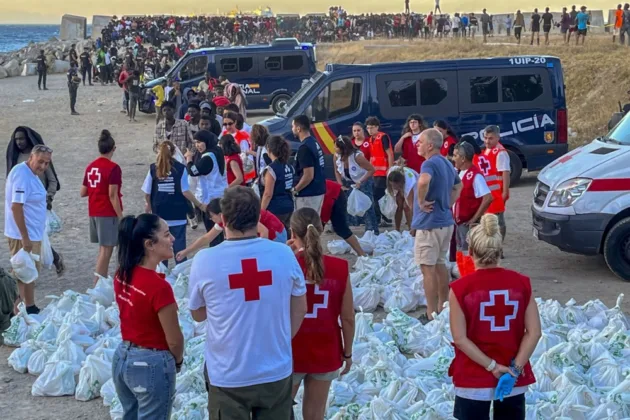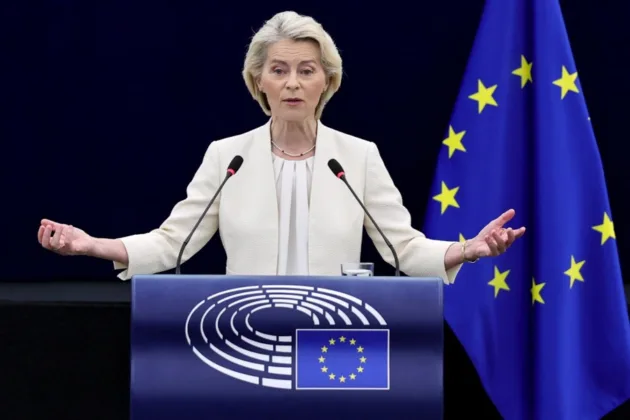






European Commission President Ursula von der Leyen has called the mass crossings into the Spanish enclave of Ceuta unacceptable and demanded that those entering illegally be sent back to Morocco without delay.
In her first public comments on the crisis, made on July 31, she said nobody could enter the European Union without abiding by its rules. “The images coming from Ceuta are unacceptable,” she said.
She called for dangerous crossings to stop immediately and for smuggling networks to be dismantled, adding that returns had to be swift, as EU rules allowed.
Von der Leyen said she had tasked two Commissioners with helping Spain bring the situation under control. Magnus Brunner, the Commissioner for Internal Affairs and Migration, was working closely with Madrid and was ready to travel to critical points, she said.
Brunner would seek further operational support for Spain, including through Frontex, the European Border and Coast Guard Agency. He offered Interior Minister Fernando Grande-Marlaska an urgent deployment of Frontex officers to Ceuta on July 30, though the Spanish Government has yet to submit a formal request.
Dubravka Šuica, the Commissioner for the Mediterranean, was in contact with her Moroccan counterpart. Von der Leyen made no criticism of Rabat, saying she was confident the partnership with Morocco would deliver concrete results.
Spain’s Interior Ministry estimated that more than 40,000 people had crossed into Ceuta by land and sea in the 24 hours to July 31. Juan Jesús Vivas, the president of the autonomous city, put the total for recent days at around 60,000, more than half the local population.
Vivas said at least 34 people had died, many of them drowning as they swam around the border fence or crushed in a surge at the El Tarajal breakwater. The Interior Ministry said some 25,000 people had been returned to Morocco by July 31.
Prime Minister Pedro Sánchez travelled to Ceuta on July 31 and described the crossings as a violation of Spanish territorial integrity. His Government has blamed a Supreme Court ruling of July 8 that barred the summary return of migrants intercepted at sea off Ceuta and Melilla.
The intervention from Brussels came after Italy and Finland called for Spain to be suspended from the Schengen area, France tightened checks on its Spanish border and the Netherlands told Madrid to protect the EU external frontier.
Ceuta and Melilla form the only land borders the EU has with Africa. Local authorities had asked for a national emergency declaration before Madrid sent the Armed Forces to support the Civil Guard.