










Poland is in talks with Washington over establishing “several” and not just one permanent military base in the country but seems in two minds over whether to actually have nuclear weapons on its soil.
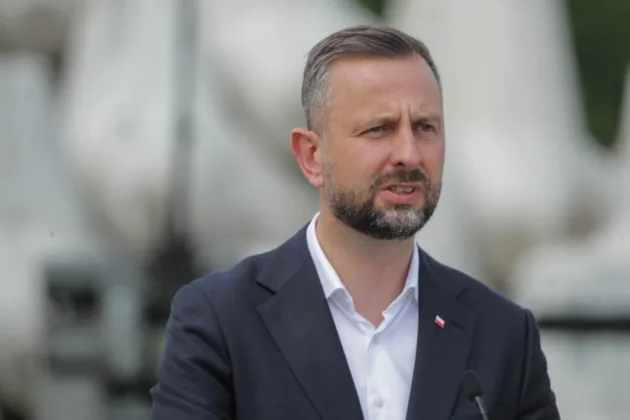
Deputy defence minister Paweł Zalewski met US Under Secretary of War for Policy Elbridge Colby on August 27 at NATO’s headquarters in Brussels and revealed that an official from Colby’s office will soon be visiting Poland to review locations proposed by the country’s government.
Zalewski told reporters that the plans did not have to involve just one base. “In fact, we are talking about several bases, several locations where American soldiers would be permanently stationed in Poland,” he said, though he confirmed that no specific locations of deployments had as yet been agreed.
The Polish deputy defence minister said Poland was seeking not only a larger permanent US troop presence but also access to military capabilities it currently lacks, citing reconnaissance and command systems as examples.
He added that he hoped for progress around the time the Pentagon completes its six-month review of the US military posture in Europe, announced in June, but added that he did not want to become “a hostage to any deadline”.
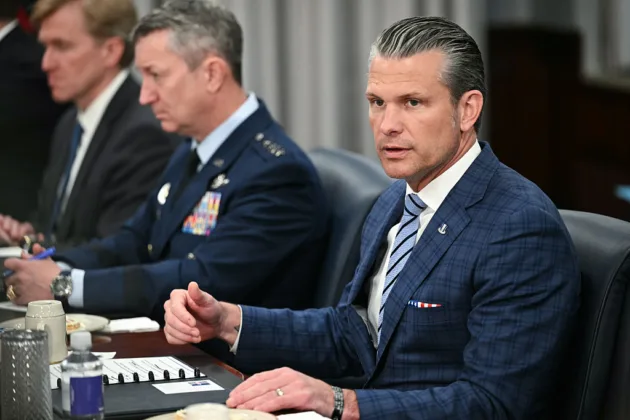
Pentagon chief Pete Hegseth unveiled the review at a NATO defence ministerial in Brussels on June 18 and Colby formally launched it on July 27.
The review is examining the future deployment of roughly 80,000 US troops across the continent, nearly half of them in Germany. NATO allies have expressed concern that it could lead to further American reductions but Poland has been positioning itself as the key country on the eastern flank of NATO in which US military presence should be strengthened.
This week’s talks followed a Polish proposal floated in May after the Pentagon cancelled a planned rotational deployment of about 4,000 troops to the country as part of a broader review of the US military footprint in Europe.
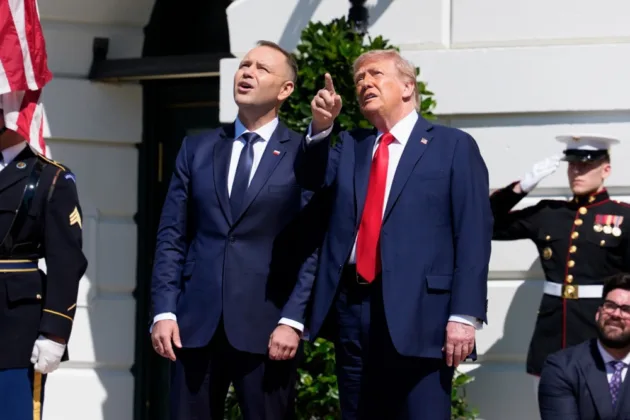
After interventions from both Poland’s right-wing opposition allied President Karol Nawrocki and Republican lawmakers US President Donald Trump later reassured Warsaw that his country did not intend to reduce US military capabilities in Poland. On May 21 he went further, announcing on Truth Social that Washington would send an additional 5,000 troops, a decision he attributed to Nawrocki’s election and to “our relationship” with the Polish President.
While Prime Minister Donald Tusk has had a strained relationship with Trump’s administration because of his past remarks accusing the US President of being a Russian asset, made at a campaign meeting in the region of Silesia in March 2023 and later denied by the Prime Minister, Nawrocki is regarded as Trump’s closest ally in Europe.
Poland has enjoyed close relations with the US since the collapse of communism in 1989 and participated significantly in both the NATO mission in Afghanistan and with troops sent to support the US in Iraq.
In June, Poland’s defence minister Władysław Kosiniak-Kamysz said Pentagon chief Pete Hegseth had welcomed the Polish proposal for a permanent US base, although the two sides did not reach a final agreement.
Poland currently hosts around 10,000 US troops, one of the largest American contingents in Europe and the biggest on the alliance’s eastern flank, though most are stationed on a rotational rather than permanent basis.
For Warsaw, securing a permanent presence would help shield Poland from any broader troop reductions. Congress has written a floor of 76,000 US troops in Europe into the National Defense Authorization Act.
Zalewski said the US military presence in Poland also serves Washington’s strategic interests. “The Americans have such important interests in Poland that they want to be here permanently,” he said.
The Polish deputy defence minister’s meeting with Colby also covered the Pentagon’s “NATO 3.0” approach, under which European allies would take primary responsibility for conventional defence while the US retains a supporting role.
“Poland supports this way of thinking,” Zalewski said.
Colby praised Poland, Germany and the Netherlands for their “extraordinary investments” in defence and said Washington hoped other allies would follow their lead in increasing military spending.
Poland has invested heavily in US arms with major contracts for batteries of Patriot missiles, Black Hawk helicopters, Abrams tanks, F-16 and F-35 fighter planes and HIMARS rocket launchers.
The country spent 4.48 per cent of its economic output on defence in 2025, the highest share in NATO that year. Alliance estimates published on July 7 put it at 4.68 per cent for 2026, fourth behind Lithuania, Estonia and Latvia. Poland is still one of only three allies expected to spend at least half its defence budget on equipment.
Poland’s high spending on its defences is supported right across the country’s political spectrum as fears of possible attacks from the east have grown markedly since the onset of the war in Ukraine.
There have been incidents with stray Russian rockets and, on the night of September 9-10, 2025, Poland recorded 19 violations of its airspace by Russian drones during a mass attack on Ukraine. Three or four were shot down and Warsaw invoked Article 4 of the North Atlantic Treaty. There have also been hostile cyber and arson attacks allegedly inspired by Russian intelligence.
Tusk has been warning that Poland could be under some sort of attack from Russia within a few months and the visit by CIA director John Ratcliffe to Moscow on August 25 was interpreted in Warsaw as a potential sign that the US is increasingly concerned as to the imminent Russian threat on the eastern flank of NATO. The Wall Street Journal reported that the trip was intended to warn Russia against attacking NATO members, while Politico said the warning concerned the Baltic States. Trump described it as “semi-routine”.
President Trump has said that he did not think Russia would attack a NATO state but there have been no denials from the US administration with regard to intelligence warning of possible Russian actions against Eastern and Central Europe.
The Polish deputy minister, though, ruled out hosting US nuclear warheads in Poland as part of any future permanent presence.
“Poland does not want to have nuclear warheads on its territory,” he said.
“We want to participate in NATO nuclear deterrence which does not mean having nuclear warheads on our territory,” Zalewski said.
That is not the view of the present opposition backed President Karol Nawrocki nor his predecessor Andrzej Duda. They have both gone on the record stating that they wanted for Poland to be a part of NATO’s nuclear sharing programme and to host American nuclear weapons on its soil.
Zalewski’s remarks on nuclear weapons were also criticised by Gen Stanisław Koziej, who ran the National Security Bureau (BBN) under former President Bronisław Komorowski and previously served as a deputy defence minister. He called the public declaration “an incomprehensible strategic error in the field of deterrence”. Komorowski served as President between 2010-2015 and was supported by Tusk’s Civic Platform party.
“We do not have to have nuclear weapons here, but we should be able to have them, and that is precisely what Putin should know,” Koziej wrote on X.
President Nawrocki’s chief foreign policy aide Marcin Przydacz, the secretary of state who heads the President’s International Policy Bureau, also criticised Zalewski saying that the minister had spoken in contravention of long-term Polish goals since Poland has consistently supported strengthening deterrence on NATO’s eastern flank. Speaking to Polsat News on August 28, he went further, calling the remarks bizarre and absurd and saying Tusk and Kosiniak-Kamysz should reconsider Zalewski’s future in the government.
Polish defence minister in Tusk’s administration Władysław Kosiniak-Kamysz quickly stepped in on X to clarify that Poland wanted to be a full part of the nuclear sharing initiative and not just the DCA initiative which does not involve any storing of nuclear weapons on any specific territory and to which Poland has just negotiated access.
NATO’s Dual-Capable Aircraft (DCA) programme is a nuclear-sharing arrangement under which member states provide fighter jets capable of carrying both conventional weapons and nuclear bombs.
“To dispel any doubts: Poland remains steadfastly interested in participating in the NATO Nuclear Sharing program. We are also conducting talks regarding the proposal for participation in the European nuclear protective umbrella. Our government’s stance on these issues is unequivocal,” wrote Kosiniak-Kamysz.
Zalewski returned to the subject on X later the same evening, saying Poland had secured the possibility of joining the DCA programme, which he described as a prelude to nuclear sharing, and that storing nuclear weapons on Polish soil was “neither possible nor desirable”.
United States nuclear weapons, for delivery by fighter aircraft, are based in Belgium, Germany, Italy, the Netherlands and Turkey. B61-12 bombs were reported to have returned to RAF Lakenheath in eastern England in July 2025, a deployment that neither Washington nor London has confirmed. It would therefore seem strange if they could not be placed on the soil of a country which has US military bases as Poland intends to have.
As part of nuclear sharing, the participating countries carry out consultations and make common decisions on nuclear-weapons policy, training and deployment, and maintain technical equipment such as nuclear-capable aircraft that is required for the eventual delivery of nuclear weapons.
It is the addition of the “European nuclear protective umbrella” which is significant here signalling Poland’s declared readiness to see the French nuclear umbrella covering Poland, even though the French have thus far never placed nuclear weapons on foreign soil and seem only willing for their nuclear-capable aircraft to be involved in protecting the territories of other European states.
The Tusk government is keen to support European defence initiatives despite wanting to see the US expanding its military footprint on Polish soil.
This is why it enthusiastically embraced the EU’s Security Action for Europe (SAFE) loan programme and took out the largest loan from it among all EU member states, €43.7 billion (£38 billion, $51.6 billion) out of the instrument’s €150 billion ceiling. Poland was the first country to sign a SAFE agreement, in May.
It did so despite opposition from both President Nawrocki and the opposition parties of the right who argued for Poland funding its rearmament from profits on its central bank’s gold reserves. This, they argued, would be cheaper and give Poland more flexibility in terms of what weapons could be purchased.
The Tusk government pressed ahead with taking out the loan though the right-wing opposition believes it could in future be used against Poland, since the money could be stopped under the EU’s conditionality mechanism.
The previous Law and Justice (PiS) government had its post-pandemic funding blocked for alleged rule of law violations, money released in early 2024 after Tusk took office. Hungary’s request for €16.2 billion (£14.1 billion, $19.1 billion) under SAFE remains the only one still awaiting final approval, held up by European Commission concerns over public procurement transparency and conflicts of interest under Viktor Orbán, who left office on May 9 after losing April’s election to Péter Magyar’s Tisza party.