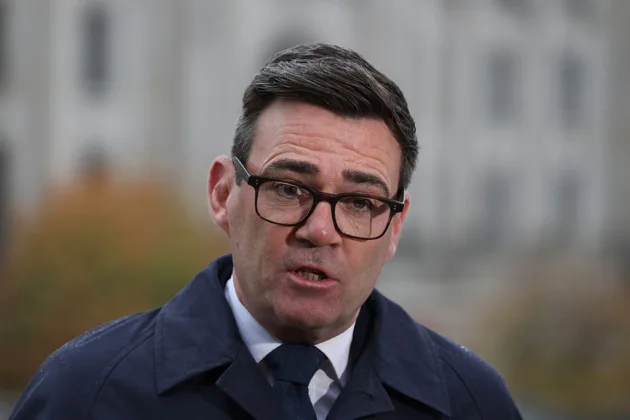




Andy Burnham’s announcement of a new National Centre for Information Defence warrants attention for reasons that go well beyond Russian bots and AI-generated deepfakes. In his first UN speech as Prime Minister, delivered on September 22, Burnham said Britain had suffered an “industrial-scale assault” on its “information environment” and tasked security chiefs with beginning work on a centre capable of detecting, attributing and disrupting hostile-state information attacks. He promised to strengthen the population’s “resilience”, noting that, faced with information warfare, “security starts in every home”.
There is an obvious security case for identifying forged websites, fake government accounts and covert foreign operations, especially during elections. The new centre is initially being run out of the Office for the Prime Minister and Cabinet. But the more interesting question concerns the conception of democracy that increasingly underpins this agenda.
Burnham’s language belongs to a much wider European political elite vocabulary. “If you’re struggling with the cost of living and your life is not improving [ … ] then you are going to be much more vulnerable to this kind of influence [misinformation]”, he said in his speech. The idea that ordinary citizens can no longer judge arguments, lies and propaganda for themselves, but are instead vulnerable inhabitants of an “information environment” requiring expert protection, is an elitist prejudice long entrenched in the EU.
To suggest that Burnham sounds like the EU’s Head of Communications for the European Democracy Shield is no exaggeration. His speech borrowed the European Democracy Shield’s language almost word for word. The European Commission says the Shield must safeguard the “integrity of the information space”, increase “societal resilience”, counter Foreign Information Manipulation and Interference (FIMI), and bring together governments, platforms, fact-checkers, researchers and civil society in a “whole-of-society” response. The European Centre for Democratic Resilience, the Shield’s flagship initiative, began work on February 24. The Shield itself was presented on November 12, 2025.
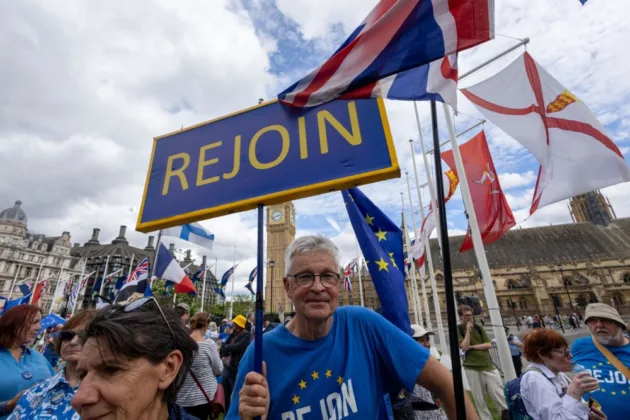
The similarity is no accident. It reveals what many have suspected but few have been able to prove: the growing public alignment between the EU and the British technocratic elite, despite Brexit. Indeed, Burnham’s new National Centre for Information Defence is straight out of the Commission’s censorship playbook. It shows how an elitist convergence around the dangers of free speech has already been consolidated between “Brexit Britain” and the Commission.
Just look at the House of Commons Science, Innovation and Technology Committee report, Social media, misinformation and harmful algorithms, published as the committee’s Second Report of Session 2024-25, which provides important policy groundwork for Burnham’s initiative. It explicitly recommends looking to the EU and to how its Digital Services Act extends regulation beyond illegal speech to “systemic risks”. Like the EU’s Democracy Shield, it recommends that platforms be compelled to algorithmically deprioritise not merely demonstrably false material but also content citing “unreliable sources”, even where that speech is lawful. It also proposes consolidating responsibility for “tracking and countering online narrative operations” in a single entity, suggesting the National Security Online Information Team as a candidate.
Contempt for democracy and the demos is a common thread. The committee report identifies one of the key elements of the EU’s censorship playbook – that misinformation behaves “like a virus” and that influential individuals act as “superspreaders”. Written evidence submitted to the inquiry by psychologist Sander van der Linden, director of the University of Cambridge’s Social Decision-Making Lab, with Jon Roozenbeek of King’s College London and Stephan Lewandowsky of the University of Bristol, advocates “prebunking and psychological inoculation”, in which citizens should be “vaccinated” in advance by exposing them to weakened versions of misinformation and teaching them its alleged techniques. The same submission called for a national educational curriculum to “inoculate future generations” against conspiracy theories and foreign propaganda.
Prebunking and the idea of inoculating the public against the epidemic of misinformation, disinformation and fake news are now core components of the EU’s Ministry of Truth. On March 31 the Commission awarded €5 million to a 30-month project led by the European Fact-Checking Standards Network (EFCSN), described without irony as Europe’s “independent” fact-checking network, under the Democracy Shield. The network also runs a separate project, Prebunking at Scale, which explicitly uses inoculation theory to intervene against claims and narratives before people encounter them. This embeds a bleak anthropology. Citizens are no longer reasoning subjects who weigh claims against experience, memory, values and argument, but merely vulnerable hosts on which contaminants land and leave marks. Pluralism and contestation are no longer the bread and butter of democracy; they have become an epidemiological risk in need of expert inoculation. Instead of asking why voters distrust institutions, oppose migration policies, reject political establishments or support populist parties, attention shifts to the information that supposedly made them think this way. This is censorship by pre-selection.
This contempt for democracy and the demos is not merely a shared assumption among the UK and Brussels elites. Brexit Britain is not merely standing on the sidelines, cheering on unelected Brussels bureaucrats who are implementing this shared enmity. A British NGO, Full Fact, which develops AI-powered fact-checking tools “for everyone”, along with Spain’s Maldita.es, is a financially and operationally integrated participant in the EFCSN. The network has more than 60 member organisations and is chaired by Clara Jiménez Cruz, co-founder of Maldita.es. Full Fact describes itself as using AI and collaborating with more than 40 European fact-checking organisations to identify emerging narratives early enough for fact-checkers to publish prebunks before those narratives “take root”. It is also a joint developer of the “Prebunking at Scale” project and participates in the EFCSN’s European election project. Full Fact chief executive Chris Morris sits on the EFCSN’s governance body, and Kate Wilkinson, a Full Fact senior product manager, is listed as the network’s tech and innovations lead.
Formally, Britain left the European Union. But institutionally, its information-governance establishment increasingly speaks the same language, reads the same literature, collaborates through the same organisations, and seeks the same solutions.
That is especially significant after Brexit. The referendum was the most spectacular rejection of Britain’s governing consensus in generations. Across Europe, support for anti-establishment parties has likewise forced institutions to confront electorates dissatisfied with the status quo.
Burnham’s promise to deepen Britain’s ties with the EU and to construct a new architecture to counter attacks on the information environment was not rhetorical. This will not reverse Brexit, but it does reveal how comfortably Britain’s emerging information policy fits the intellectual architecture that Brussels has spent years constructing.
The deeper European argument is therefore no longer simply Leave versus Remain. It concerns what democracy assumes about the people themselves. One tradition begins with moral independence: adults may encounter propaganda, lies, unpleasant opinions and foolish arguments and remain entitled to judge for themselves. The elitist “resilience model” increasingly begins with an infantilised view of the demos as vulnerable and seeks to manage the informational conditions in which judgement takes place.
On that question, Britain may have left the European Union, but its governing class has not abandoned the European technocratic consensus. What Burnham has exposed, though, is that the demos of Europe and the UK now have powerful grounds to unite and struggle to protect and extend free speech, if democracy is not to be destroyed by an elite with nothing but contempt for ordinary people.