









Bone fragments attributed to Saint Nicholas — the fourth-century Bishop of Myra and the historical inspiration for Santa Claus — have been stolen from a prominent basilica in northeastern France, before allegedly being burned and crushed by the perpetrator.
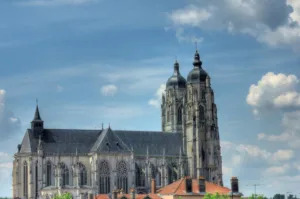
The desecration took place at the Basilica of Saint-Nicolas-de-Port in the Meurthe-et-Moselle department of Lorraine, located roughly 12 kilometres southeast of Nancy.
According to regional newspaper L’Est Républicain, the parish priest of the basilica filed an official complaint at the police station in nearby Dombasle-sur-Meurthe on November 2, reporting the theft of a reliquary containing precious bone fragments of the saint.
Following an investigation, police apprehended a suspect at his home. During questioning, the man reportedly confessed to acting spontaneously to smash the protective display case and steal the reliquary.
Rather than stealing the items for financial gain on the black market, the suspect admitted to burning the ancient bones and crushing the remains.
According to French Catholic media outlet Catholix, the suspect told investigators he acted out of a “desire to destroy” the relic, which he reportedly equated with “fetishism”.
The Association Connaissance et Renaissance de la Basilique, a heritage group devoted to the building, said on November 7 that the item destroyed was not the basilica’s principal relic, which is kept in an arm-shaped reliquary in the treasury.
It said the fragment had been placed beneath the statue of the saint in the patronal chapel in the early 2000s.
Catholix wrote that the profanation nonetheless “wipes out a piece of the religious history of Lorraine and of France”.
The destruction comes at a sensitive time for the region, just weeks before the December 6 Feast of Saint Nicholas, a major cultural and religious celebration across Lorraine, Belgium and northern Europe. The basilica’s traditional torchlight procession is due to take place on December 5.
Saint-Nicolas-de-Port has served as the heart of devotion to the saint in France for nearly a millennium.
In 1087, Italian sailors removed the skeleton of Saint Nicholas from Myra (in modern-day Turkey) and brought it to Bari, southern Italy.
Eleven years later, in 1098, the knight Aubert de Varangéville brought a bone relic — traditionally identified as the dextre bénissante (a phalanx from the saint’s right hand) — from Bari to Lorraine.
The arrival of the relic transformed the town into one of medieval Europe’s foremost pilgrimage destinations. Joan of Arc famously travelled to Saint-Nicolas-de-Port to pray before the saint’s relics in 1429 before setting out to meet the Dauphin at Chinon.
Following the Duchy of Lorraine’s victory over Charles the Bold at the Battle of Nancy in 1477, Duke René II declared Saint Nicholas the patron saint of Lorraine and commissioned the current flamboyant Gothic basilica to house his remains.
The building has survived the Thirty Years’ War, the French Revolution — during which the basilica was briefly converted into a “Temple of Reason” and had its gold reliquaries melted down — and both world wars.
The incident in Saint-Nicolas-de-Port is the latest in a string of high-profile thefts, vandalism and arson attacks targeting Christian heritage sites across France. On February 4, the same basilica was evacuated after a fire that the town’s mayor said could have been started deliberately.
French Interior Ministry figures have consistently recorded hundreds of anti-Christian acts each year, ranging from the toppling of rural wayside crosses and the smashing of Marian statues to the desecration of tabernacles and historic reliquaries.
The ministry recorded 843 anti-Christian acts in 2025, up 9 per cent on the previous year. Attacks on property accounted for 87 per cent of them.
Heritage advocates and clergy have repeatedly warned that rural and suburban churches, which remain open to the public during the day with minimal security or surveillance, have become soft targets for both organised art thieves and ideologically motivated vandals.