









An attempt at reaching a compromise solution over the stand-off at the Polish constitutional court between the ruling centre-left government led by Prime Minister Donald Tusk and opposition-allied President Karol Nawrocki, put forward by one of the PM’s junior coalition partners, has been effectively scuppered as a result of the behaviour of the government’s justice and interior ministers and the European Commission.
The centre-right Polish People’s Party (PSL), a junior government partner, on November 5 unveiled a proposal to amend Poland’s constitution that would end the mandates of all sitting constitutional court judges. It would allow parliament — the Sejm and Senate sitting jointly as the National Assembly — to elect 15 new members by a super majority of three-fifths.
The proposal is an attempt to defuse the current confrontation around the legitimacy of several of the constitutional court’s judges and restore legitimacy to the court, which with its current membership has been questioned by European courts.
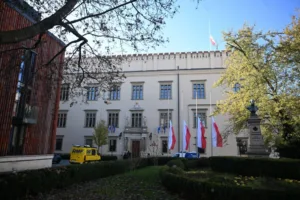
The reset idea has surfaced in response to events on October 30, when the police stormed the constitutional court building to install judges elected by the Tusk majority in Parliament. Most of them were not accepted by President Nawrocki because either their dates of election were out of kilter with the arising vacancies on the court or, in one case, the parliament’s nominee did not have the qualifications required by law to hold the post of justice of the constitutional court.
Nawrocki turned back his plane over Spain on course for a working visit to Senegal and went to the court in order to object to judges elected during the time of the previous conservative Law and Justice (PiS) government being prevented from entering the building. He said that the constitutional order had been violated and a constitutional body “seized by force”.
On November 3 the new judges, led by justice-elect Anna Korwin-Piotrowska, met and declared their meeting to be quorate. The President does not accept Korwin-Piotrowska as being a member of the court but, together with four other rejected justices-elect, she chose to take her oath of office in Parliament, despite the fact that no such procedure is envisaged by the constitution or in law.
The gathering adopted the court’s 2027 budget plan and drew lots for the panels that would rule on the cases of the existing chief and deputy chief justices of the court, Bogdan Święczkowski and Bartłomiej Sochański, whom Korwin-Piotrowska had suspended for a month on October 30.
That decision to declare the meeting of eight judges, five of whom are not accepted by the President, as quorate is viewed as being illegal by most constitutional lawyers. The quorum is two-thirds of the 15 members of the court, meaning that there must be 10 judges in attendance.
Korwin-Piotrowska ruled, though, that the two suspended justices, Święczkowski and Sochański, and Jarosław Wyrembak, another justice whose election was questioned by the ruling Tusk majority, did not count towards the quorum. Therefore the membership of the court was 12, meaning that eight was the required number for a quorum to take valid decisions.
Święczkowski has denounced the takeover as an illegal “coup d’état”. He has been backed by the court’s remaining six judges, who all refused to attend the session of the court called by Korwin-Piotrowska.
President Nawrocki at a meeting of the National Security Council on November 3 chastised PM Tusk publicly for the situation. Tusk later at a meeting with reporters said that he did not want to escalate the dispute and that he had offered the President a one-on-one meeting that week to discuss measures to reduce tension around the issue. Nawrocki’s chancellery has since set conditions for the talks.
Soon after, the PSL leader and defence minister in the Tusk government, Władysław Kosiniak-Kamysz, came forward with the reset proposal of electing all the judges afresh and granting the existing judges the status of retired constitutional court judges.
Unlike now, the new judges would not have to swear their oath before the President but before the National Assembly, though the names of the candidates put forward by the Sejm Speaker would require the prior consent of the head of state. The new judges would serve staggered terms of three, six and nine years.
To take effect, the measure would require amending Poland’s constitution, something that has happened only twice since the document was adopted in 1997 and which also requires a two-thirds majority in the Sejm and an absolute majority in the Senate.
The current method of choosing new constitutional court judges requires only the support of a majority in the Sejm. Judges must, though, then swear an oath “before the president”. That has been a bone of contention, with the government claiming the President must accept all candidates elected by Parliament and both Nawrocki and his predecessor Andrzej Duda arguing that they have to be certain the candidates have been elected in accordance with the law.
The PSL leader’s idea is supported by another junior coalition party, Poland 2050, as well as the right-wing Confederation, the left-wing Razem party and the breakaway from PiS Development Plus (Rozwój Plus) movement led by former PiS PM Mateusz Morawiecki. Both the main parties, PiS and Tusk’s Civic Coalition, as well as the Left party, though, remain sceptical about the reset idea.
The reset proposal is also backed by some NGOs and think tanks, which point to the fact that the current Tusk government had in 2024 proposed legislation that would have required new constitutional court judges to be approved by a three-fifths parliamentary majority.
Those plans were blocked, though, because they also proposed to remove judges elected during the lifetime of the last PiS government, a move that was unacceptable to Andrzej Duda, the PiS-allied president of the time. Duda referred the legislation to the constitutional court in October 2024.
Meanwhile the government’s actions since the PSL made its proposal have been confrontational. Justice minister and Prosecutor General Waldemar Żurek has sent the court six motions to lift the immunity of the current chief justice Bogdan Święczkowski, one of which also seeks consent for his detention and pre-trial arrest. The allegations include manipulation of the court during his time as chief justice. Korwin-Piotrowska has called a general assembly of judges for November 17 to rule on the requests.
The Tusk administration has also rejected the President’s call for the police to leave the constitutional court building and for the judges elected during the lifetime of the last PiS government, including Święczkowski and Sochański, to be allowed to enter the building to resume their duties.
The European Commission has said through its spokesperson Louise Bogey that it is for the Polish authorities to ensure the court can function in line with the Polish constitution and with the case law of the Court of Justice of the European Union (CJEU). She also recalled that the European Court of Human Rights (ECHR) ordered Poland on May 5, 2026, not to obstruct the judges elected by the Sejm in March 2026 from taking up their duties.
In the light of such declarations, the decision by European Commission President Ursula von der Leyen to avoid appearing at a press conference alongside President Nawrocki after a Visegrad Group summit in Trenčín, western Slovakia, on November 5 was seen by commentators as a decision to show solidarity with Tusk and in opposition to Nawrocki. The Commission’s chief spokesperson Paula Pinho said von der Leyen could not attend for scheduling reasons communicated well before the recent events in Poland.
Commenting on the matter, former PiS PM Beata Szydło MEP criticised von der Leyen on X.
“Ursula von der Leyen fled the press conference after the V4 summit in Slovakia because she did not want to appear alongside Polish President Karol Nawrocki. According to media reports, von der Leyen’s aides say this was intended as an ‘expression of support’ for Donald Tusk. This is a scandal. The European Commission president behaving like this? Perhaps von der Leyen thinks she is ‘reprimanding’ Poland’s president this way. In reality, she has only discredited herself—and revealed her intentions,” the former prime minister wrote.
Given the fact that Tusk has the backing of the EC, his own party, the Left and its leader and Sejm Speaker Włodzimierz Czarzasty, and that neither the PSL nor Poland 2050 has any intention to actually leave the government, the Polish PM appears in a strong position.
Even if PiS were to support a reset, the Speaker Włodzimierz Czarzasty, a close ally of Tusk, would be unlikely to submit the motion to Parliament. Even if he did, a constitutional majority of two-thirds cannot be found for the measure without Tusk’s party’s support. Czarzasty has said he does not believe the required majority can be gathered in the current parliament.
This is why most commentators do not feel Tusk is prepared for any compromises on the issue, unlike the compromise he seems to have made with regard to the central bank.
The Polish PM, whose party is to vote to put the present head of the central bank Adam Glapiński on trial in front of the Tribunal of State over alleged political bias and illegal financing of the state budget, has decided to allow the four board members Glapiński and Nawrocki wanted to be appointed. He countersigned the nominations on November 3.
Tusk decided against blocking those appointments so as not to make the management of the bank inoperable should the head of the central bank be put on trial and therefore suspended. The board also risked falling below its statutory minimum when deputy governor Adam Lipiński’s term ended on November 4.
Both his finance minister Andrzej Domański and the European Central Bank persuaded him that any crisis in Poland’s central bank would be detrimental for Poland’s economy and financial standing.
That financial standing is already under pressure thanks to moves which have been made by rating agencies.
On November 6 credit rating agency S&P revised Poland’s outlook to negative, from stable, saying that the country has seen “one of the most significant fiscal deteriorations globally” and that “political polarisation hinders fiscal consolidation”. It also lowered the country’s long- and short-term local currency ratings from A/A-1 to A-/A-2.
S&P’s move follows similar actions by the other members of the big three rating agencies, with Fitch already having Poland on negative outlook since last year. Moody’s cut the country’s credit rating in September this year from A2 to A3, its lowest level since 2002, because of ballooning budget deficits caused by defence and social spending.
The rating agency analysis estimates that general government net debt will exceed 70 per cent of GDP by 2029, up from 53 per cent in 2025. The agency also forecasts that the general government deficit will remain above 7 per cent of GDP through 2027. The deficit reached 7.3 per cent of GDP in 2025, the second highest in the EU.
Poland will hold parliamentary elections in 2027, which in S&P’s view makes “meaningful consolidation unlikely” before then. This, along with the power of veto being in the hands of opposition-aligned President Karol Nawrocki, means the government “faces constraints in advancing its legislative and fiscal consolidation agenda”.
S&P also warned that the crisis around the constitutional court meant “renewed institutional tensions could weigh on policy predictability”.
Tusk’s finance minister Andrzej Domański latched onto S&P’s remarks on gridlock between the President and the government to criticise the head of state, writing: “Despite the presidential vetoes, we will continue taking steps to strengthen the country’s finances.”
Nawrocki has argued, though, that the country’s budget deficits were ballooning before he came to office in August last year.