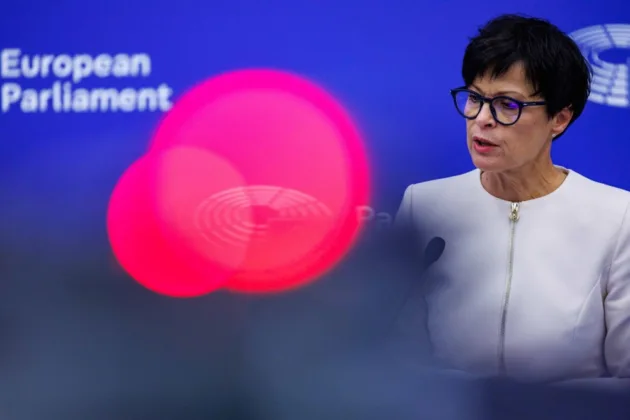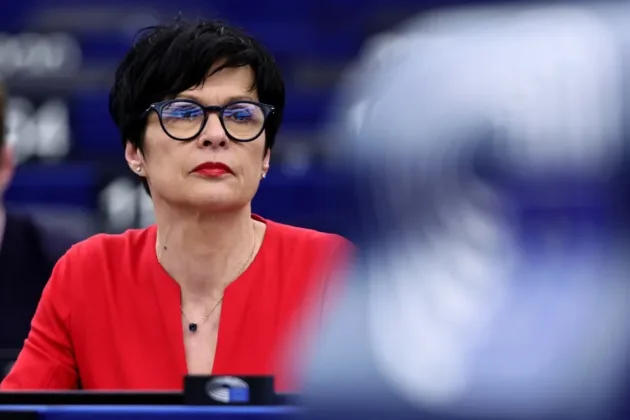

EU candidate countries should cut ties with the MAGA (Make America Great Again) movement and, more broadly, avoid strategic dependencies on political movements and figures that Brussels considers incompatible with its interests, EU Enlargement Commissioner Marta Kos has warned.
Kos, a former vice-president of Slovenia’s centre-left, social-liberal Freedom Movement, issued the warning on September 8 in Brussels, during an event organised by the Centre for European Policy Studies (CEPS), as reported by Euractiv.
The occasion was the launch of an International Monetary Fund (IMF) report on the economic gains of EU membership, presented by IMF managing director Kristalina Georgieva.
Speaking about the pressures facing the European Union and its future members, she warned that candidate countries should not build dependencies that run against the EU’s long-term interests.
“We should not risk our future members developing dependencies on others that would run counter to our long-term interests,” she said.
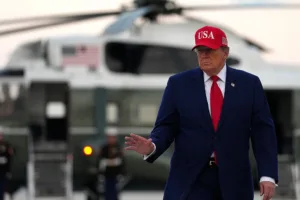
She explicitly pointed to pressure from the United States, describing it as “pressure from the West, from the MAGA ideologists”, who, she said, try to persuade Europeans “that our European civilization is in decline, that our economy is in decline”.
The intervention broadens the traditional framework of EU enlargement. Candidate countries have long been expected to meet political, economic and legal criteria before joining the bloc, including democratic standards, the rule of law, economic reforms and alignment with EU legislation.
Kos’ remarks add two further considerations: Strategic alignment with the European Union, and the need to avoid not only dependencies on foreign states, but also close political ties with movements within Western democracies whose positions are seen as incompatible with the EU’s political and strategic direction.
Her comments come at a strategically important moment for enlargement, which has regained momentum after years of stagnation.
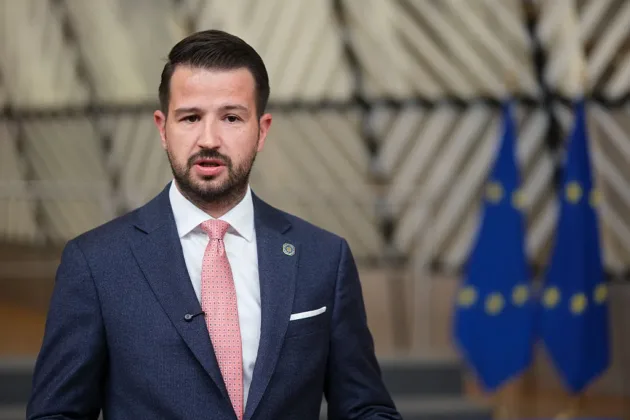
Montenegro is currently the frontrunner and aims to conclude accession negotiations by the end of 2026, potentially putting it on track to become the first new EU member of this enlargement wave. EU ambassadors approved the drafting of its accession treaty in April, work that began the following month, and Podgorica is preparing for membership in 2028 as the bloc’s 28th member state.
Albania is targeting the conclusion of negotiations by 2027, though Kos has pointed to 2029 as the more realistic date for Tirana.
Ukraine and Moldova are also moving forward, although their accession is expected to take longer. Both are working towards 2028 and each has so far opened only two of the six negotiating clusters.
The IMF report presented on the same day grouped Moldova with the Western Balkans and set Ukraine apart, citing its size and the war.
Serbia, North Macedonia, Bosnia and Herzegovina and Georgia remain at different stages of the process, with no firm timetable for membership.
On MAGA, Kos did not identify a specific candidate as being aligned with or dependent on the movement. Her warning was broader, concerning the possibility that future EU members could develop political or strategic relationships that Brussels considers contrary to the Union’s interests.
Alongside MAGA, Russia was another actor explicitly identified by Kos as an “adversary” in the enlargement process. “Clearly, Russia is one of them,” she said.
“For the first time in history, we have adversaries in the enlargement process,” she told the Brussels audience, accusing Moscow of seeking to keep candidates out of the bloc.
Belgrade continues to present EU membership as a strategic objective while maintaining close relations with Russia and China. Serbia’s reluctance to fully align with EU foreign policy towards Russia has become a major obstacle on its path towards membership.
China represents a more complicated case. According to Euractiv, Kos distinguished Beijing from Moscow, arguing that China is primarily seeking economic opportunities in candidate countries rather than pursuing the same type of disinformation activity attributed to Russia.
Beijing is “somehow nestling in our candidates”, she said, meaning Chinese companies would already be established inside the single market once those countries joined.
Kos did not announce a new legal accession rule banning relationships with MAGA politicians or organisations, nor concrete measures to exclude countries because of their links to the movement.
But her intervention drew a clear political line over the orientation expected of future EU members. Candidate countries are not only expected to meet the Union’s formal accession criteria. They are increasingly expected to align themselves politically and strategically with Brussels and to avoid relationships with political forces that the EU considers incompatible with its interests.