




“A high voter turnout seems a sign of unease to me,” the late George Jonas wrote in the National Post in 2011. “When you see volunteer fire fighters sliding down the pole and dashing for the fire engines, you do not say: Look at those engaged citizens. You say: Where is the fire?”
Jonas, who escaped from Communist Hungary in 1956, took a surprising stance for someone who grew up in a country where elections were either rigged or banned.
“The lower the turnout, the healthier the country” was the theme of his column, and I must admit that after initial scepticism I am beginning to share his assessment, at least in part.
There is plenty of evidence that high voter turnout is a sign of a true desire for change: We saw this in the most recent German election, on September 6 in the eastern state of Saxony-Anhalt, where 77.8 per cent of 1.7 million eligible voters showed up at the polls, the highest since the first free election of 1990, and almost everybody has called it a victory for democracy, including the defeated Christian Democrat Minister-President Sven Schulze.
The “highest since 1990” has meaning all on its own, as the fall of the Iron Curtain was driven by the desire for change, as was the most recent election in Hungary (where the right-wing government of Viktor Orbán was ousted on a record turnout of almost 79 per cent) or the Austrian federal election in September 2024 (which made the right-wing Freedom Party the strongest party in parliament for the first time).
 These elections saw winners on both the Right and the Left, but clearly it was the desire for change that drove people to the polls.
I usually try to avoid comparisons with the Nazi era, so I will make a comparison with the pre-Nazi era in Germany. The Weimar Republic, although often seen as a deeply dysfunctional democracy, had extremely high voter turnouts, often above 80 per cent.
Yet ultimately the system failed because participation was not driven by a commitment to democracy, but by a public that was desperately longing for change.
The 43.8 per cent won by Alternative for Germany (AfD) in Saxony-Anhalt is not striking because it is a right-wing party, but because it is such an obvious vote for a course correction of the country in its entirety, and although the AfD does not have answers to all the problems, the voters show an increasing readiness to put their faith in a party with an unclear programme rather than to vote for parties with failing programmes.
What was also interesting is where the AfD votes came from: The party mobilised among non-voters, the number of which collapsed from 709,885 to 378,640, and – according to the flow estimate produced by Infratest dimap for the public broadcaster ARD – a net 258,000 people who had stayed at home in 2021 came back, 170,000 of them to a single party.
According to reporting in Die Welt, 56 per cent of the AfD’s new voters were previous abstainers, which means this was a massive surge among those who had once thought that their vote made no difference.
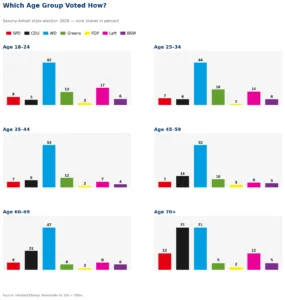
The AfD underperformed among three groups: Women under 25, voters over 70 and affluent inner-city districts. It is not without irony that left-wing parties, which so often portray themselves as the voice of the “common people”, have in fact become the representatives of the entrenched, credentialed and well-off elite.
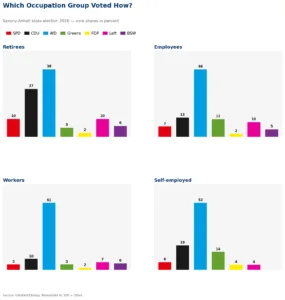
This helps explain why, according to exit polls, 61 per cent of blue-collar workers voted for the AfD as well as 46 per cent of white-collar employees and 52 per cent of self-employed individuals.
As expected, the party only convinced 23 per cent of university graduates and around 29 per cent of civil servants: But that is no surprise. The group most directly employed by the state was the group least willing to vote against it.
Among voters who called their own economic situation bad, the figure was 65 per cent pro-AfD.
These numbers are crucial, because they reflect the phenomenon of a voters’ revolt by those who perceive themselves outside the system against those who are part of the establishment, meaning those who control the media, the universities, and are the majority among civil servants.
It did not take the latter long to downplay the AfD’s success. The standard reply is that protest is one thing and government quite another, and that right-wing parties cannot actually run a country.
 But this claim was always an assertion rather than a conclusion, and where such parties have actually governed the results vary in ways that have nothing whatever to do with how right-wing they are.
Geert Wilders won the Dutch election of 2023, entered government, blew up his own coalition over migration and lost 11 seats at the election that followed in October 2025, a collapse that can be attributed to a poor performance by him and his party in a first attempt at government.
In Sweden, on the other hand, the right-wing Sweden Democrats are not even part of the administration but they have basically written the migration policy from outside of it, leading to some actual changes. Asylum applications, for example, fell in 2025 to 6,735, with asylum-related immigration at its lowest level since 1985.
Ultimately, governing is a matter of skill and at this point we simply do not know if the AfD possesses it, but we do know that for the last 26 years Germany and much of Europe have been governed by parties that are responsible for everything from mass migration to deindustrialisation, and it is obvious that more and more people want a course correction.
And this is where the danger lies: Unless the current elite allows for substantial and structural change, the AfD and its sister parties will not be contained at 30 or 40 per cent but march on to 50 per cent, a trend that can already be seen in Austria and presidential polls in France.
Such a structural change will have to include ideas that would have been unthinkable until recently, like changing the European Convention on Human Rights, enabling the return of criminal asylum seekers, cutting EU regulations, supporting nuclear energy and, yes, discussing the broader issue of remigration and the declared goal of almost all European right-wing parties: To keep Europe European, and not turn it into a partially postmodern and partially Islamised continent.
The latter sentence will strike members of the elite as right-wing fearmongering, but it is also the lived experience of many people in European cities.
Christmas markets and street festivals that look like the security zone at an airport are facts of modern life that many reject, and they want a return to conditions where you do not need to stand next to a heavily armed officer while enjoying a cup of mulled wine.
As the people are voting for change in growing numbers, the question is: Will those who are currently in power either adapt their policies or will they make way for new parties to be in charge?
If they should decide to do neither, the confirmation of democracy – as expressed by high voter turnout – can quickly turn against democracy. The voter of today who feels unheard can become the revolutionary of tomorrow who wants to overthrow the system.