










A YouGov poll published on September 14 has put the Christian Democratic Union and its Bavarian sister party, the Christian Social Union (CDU/CSU), at 18 per cent, the lowest figure the institute has recorded for the Union in its monthly voting-intention survey.
The gap with the right-wing Alternative for Germany (AfD), which polled at 29 per cent, grew to 11 points, three more than in August.
The survey drew voting intentions from 1,787 of the 2,161 eligible voters questioned between September 11-14, a week after the AfD’s strong showing in Saxony-Anhalt, eastern Germany, where the local CDU collapsed.
The AfD took 43.8 per cent there on September 6, a record for the party in any state election, against 17.2 per cent for the CDU.
The Greens are on 16 per cent and the Social Democratic Party (SPD), junior partner in Chancellor Friedrich Merz’s coalition, on 13. The Left has slipped to 10 per cent and the Free Democratic Party (FDP) might return to the Bundestag with 5 per cent of the vote.
The Sahra Wagenknecht Alliance is on 4, with other parties on 5.
According to these poll numbers, the Union, SPD and Greens come together to 47 per cent, three points short of half the vote. Because seats go only to parties clearing the 5 per cent threshold, that would still be a narrow Bundestag majority.
YouGov puts the margin of error at 2.32 points for results near 50 per cent and 1.01 points near 5 per cent.
A majority of respondents (59 per cent) still describe the AfD as right-wing extremist, against 30 per cent who do not, barely changed on May 2025.
An increasing number of Germans are, though, now opposing the so-called Brandmauer, or firewall, the principle of excluding the AfD.
Just over half (51 per cent) of those questioned now say other parties should not rule out working with the AfD, up from 44 per cent in August. Among CDU/CSU voters, 55 per cent take that view and 38 per cent the opposite.
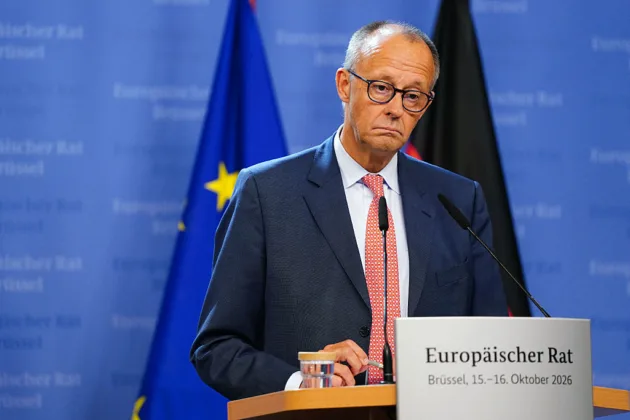
These numbers land on a chancellor already under pressure inside his own party.
Berlin newsletter Table.Briefings, citing Union circles, reported that Merz was considering calling the CDU presidium, its senior leadership body, together late on Sunday, September 20, once the results are in from Mecklenburg-Western Pomerania and Berlin.
The CDU is polling at about 7 per cent in Mecklenburg-Western Pomerania and level with the Left on 20 per cent in Berlin.
He reportedly wanted to put a blunt choice to the grandees, the newsletter said: Either back a harder reform course with the SPD, or remove him and say to his face who takes over.
People close to him say he will not resign of his own accord. No formal invitation had gone out by the evening of September 14.
Merz has put off a September 15 departure for the UN General Assembly in New York so he can sit through the parliamentary group meeting instead.
Despite persistent rumours and talks of an early departure for Merz, there is no agreed successor in the Christian Democrat camp.
Hendrik Wüst, the North Rhine-Westphalia premier, faces his own state election in the spring of 2027 and has not said he would make the move.
Markus Söder, the CSU leader and Bavarian premier, would be easier to sell to the SPD but remains awkward for parts of the CDU after his contest with Armin Laschet in 2021, when many came to see him and his personal ambitions as the reason for a botched campaign.
Boris Rhein of Hesse is floated as a compromise but is not widely known.
Presidium members told Table.Briefings they want more than a promise to communicate better. They said they want a concrete plan for putting Germany back on track.
Merz, the same report says, may put extra tax cuts and lower energy prices on the table for the talks with the Social Democrats. He is described as unwilling to govern as a minority or to sack SPD ministers.
If Merz did not resign voluntarily, the Bundestag could remove him only by electing a successor in the same vote, as Article 67 of the Basic Law requires. Christian Democrats and Social Democrats hold 328 of the 630 seats, a narrow majority of 12.
The survey, published today and widely reported across German media, marks a fresh blow to the Chancellor and his Social Democrat-backed coalition barely a year after Merz took office. https://t.co/gLh3XzETvM
— Brussels Signal (@brusselssignal) April 28, 2026