Ukraine’s prosecutor general, Ruslan Kravchenko, has submitted his resignation after anti-corruption investigators raided his office and arrested a senior subordinate over an alleged protection racket for fraudulent call centres.
Kravchenko, appointed in June 2025, said the step was a “political decision” taken so that the post would not become “a tool for political confrontation”.
He continues to deny any involvement.
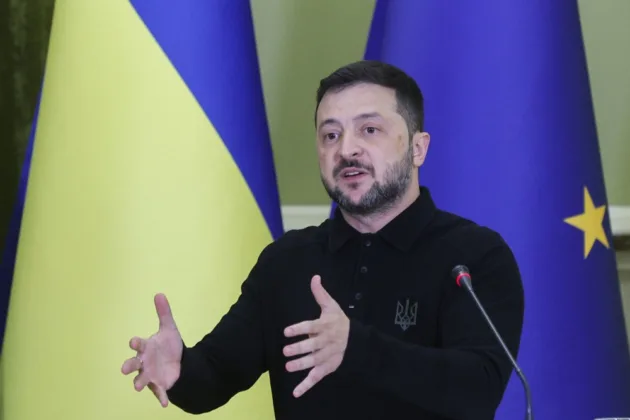
President Volodymyr Zelensky met him on September 7 and said the letter would go to the Verkhovna Rada, Ukraine’s parliament, which must still vote on the dismissal.
The National Anti-Corruption Bureau (NABU) and the Specialised Anti-Corruption Prosecutor’s Office (SAPO) say Operation Carthage uncovered a criminal group led from inside the Prosecutor General’s Office. They allege it was set up in mid-2025 and drew in serving prosecutors as well as outsiders.
Investigators allege that Serhiy Kropyva, deputy head of the international legal co-operation department, organised regular bribes from scam call centres for about $7,000 (€6,020) a month from each site in return for shielding them from prosecution. He then laundered the proceeds.
Detectives searched premises used by Kravchenko shortly after midnight on September 5 after staff initially refused entry. Officers used ladders to scale a gate.
Kropyva was arrested in Lviv.
Recordings published by NABU suggested he was overseeing repairs at Kravchenko’s home in Kozyn, outside Kyiv, while collecting bribes from the call centres. Kravchenko has said his family rents the property.
The bureau released images of a safe filled with bundles of dollar bills and set out its evidence in a 30-minute video. On the tapes a figure identified only as the “boss” is addressed by the patronymic Andriyovych and described as a former head of the State Tax Service, both of which match Kravchenko.
It said it had uncovered five officials behind the scheme but did not name them; the cash, it said, was spent on real estate, jewellery and other valuables. The five face up to 15 years in prison on charges of money laundering and of running or belonging to a criminal organisation.
Kropyva has been remanded in custody, with bail set on September 6 at 120 million hryvnia (€2.3 million). A second suspect, Yelyzaveta Ivakhnenko, was ordered held for 60 days.
Kravchenko has not been named a suspect or a witness.
The case lands on institutions already strained by last year’s clash over the independence of those same agencies.
In July 2025 Zelensky backed a law that would have placed NABU and SAPO under the prosecutor general.
Street protests followed and Western partners objected, forcing the Ukrainian President to reverse course.
Kravchenko’s appointment coincided with that attempt.
A year on, human rights groups still document pressure on detectives, including searches and claims of “Russian links” inside the bureau.
Ukrainska Pravda reported that, on the morning of his resignation, the prosecutor’s office was ordered to assemble files on NABU and SAPO.
Zelensky also met the heads of both agencies the same day.
The European Commission said it would not comment on the case but that fighting corruption was a key requirement for any country seeking to join the EU and that the independence of NABU and SAPO had to be safeguarded.
The resignation is the latest in a sequence of high-level exits.
Andriy Yermak, the long-serving head of the presidential office, left in late November 2025 after NABU’s Energoatom inquiry Operation Midas alleged kickbacks of up to 15 per cent on contracts at the state nuclear company.
Yermak was later named in a related money-laundering case in May 2026.
Iryna Mudra, a former deputy head of the presidential office, is in custody in a separate NABU case pending bail of 20 million hryvnia (€386,000).
Former justice minister Herman Halushchenko has also gone.
Defence minister Mykhailo Fedorov was dismissed on July 15, prompting rare wartime street protests, and then accused the commander-in-chief, General Oleksandr Syrskyi, of obstructing military reform. Syrskyi was replaced six days later.
A change of prime minister in July added to the sense of a government under simultaneous investigative and political pressure.
Ukraine has become one of Europe’s main bases for industrial telephone fraud. The Global Initiative Against Transnational Organized Crime estimates that about 1,000 illicit call centres employ some 60,000 people and generate as much as $1 billion (€860 million) a month, more than the country’s drug trade.
“Cold callers” ring lists of numbers across dozens of countries. Anyone who engages is passed to a closer who pushes fake bank or police alerts, romance pitches or bogus cryptocurrency investments, often persuading the victim to install remote-access software or send money to wallets the gang controls.
Centres in Dnipro, Kyiv and elsewhere have been documented targeting European pensioners among others.
NABU says the group it has identified so far numbered five people and laundered tens of millions of hryvnia. Sources cited by Ukrainska Pravda put the network’s reach at up to 500 centres at its peak this year, worth as much as $3.5 million (€3 million) a month.
On September 2 Zelensky sent parliament a bill creating a separate criminal offence of organising or financing such centres. Parliament has yet to act on Kravchenko’s letter.
The European Commission has transferred a further €3.47 billion to Ukraine to pay for drones, missiles, air defence systems and combat aircraft, the latest instalment of the European Union’s €90 billion support loan. https://t.co/88qIjS1tNO
— Brussels Signal (@brusselssignal) July 30, 2026