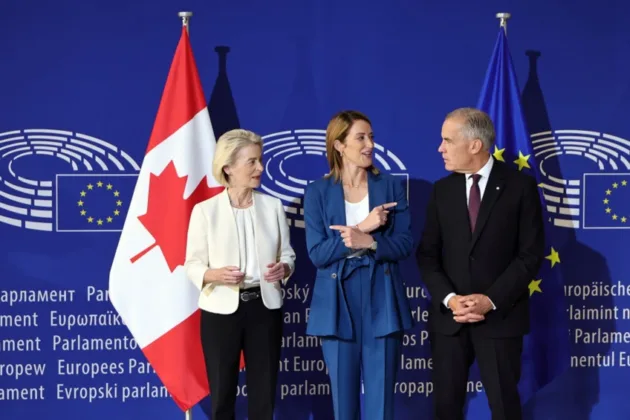






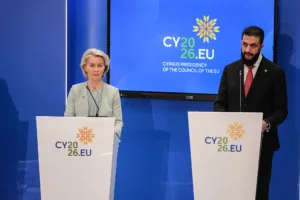

European Commission President Ursula von der Leyen has announced plans for Canada to become the first associate member of the European Union, a status that does not exist under the bloc’s treaties. She set out the plan on September 16 in her annual State of the European Union address to the European Parliament.
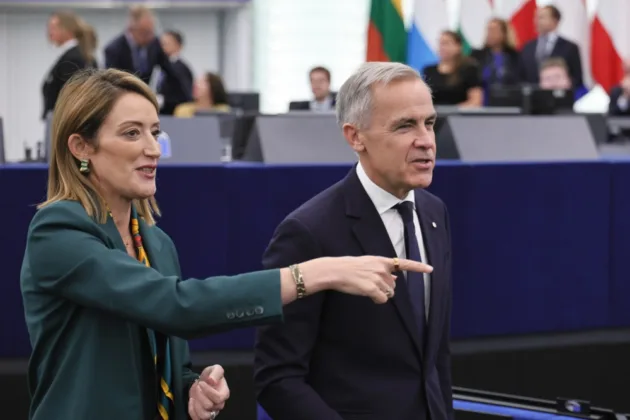
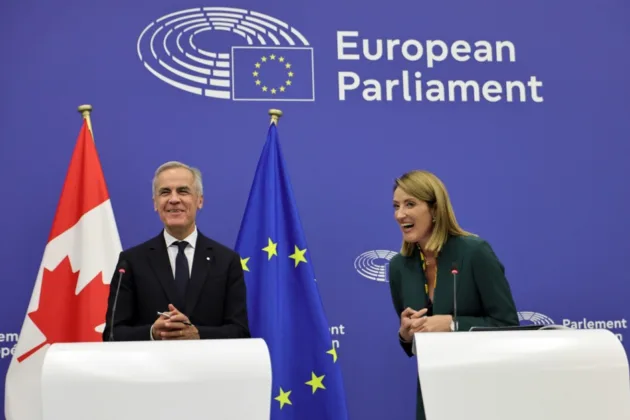
Canadian Prime Minister Mark Carney sat in the chamber as a special guest and received a standing ovation from MEPs. He is due to address the Parliament on September 17.
“I would like to work with you on opening the door for Canada being the first associate member of the EU,” von der Leyen told him.
She presented the announcement as a response to what she called the fracture in the international rules-based system, saying the EU had to re-imagine its partnerships with like-minded countries.
Von der Leyen said the two sides saw the world through the same eyes on questions from artificial intelligence and climate change to the Arctic and geopolitics. She pointed to cultural, historical and personal ties, along with common positions on Ukraine and defence.
The Commission President said the relationship would move beyond the Comprehensive Economic and Trade Agreement (CETA) towards what she called an Alliance for the Future, meant to create a common space of prosperity and economic security.
That framework would take in a technology partnership, closer integration of European and Canadian defence industries and a joint Arctic project, she said. She added that trade in goods between the two had grown by 75 per cent in under a decade.
Carney had already ruled out full membership on September 13, saying Ottawa wanted a “unique alliance” with Brussels rather than a place inside the bloc.
The overture followed the collapse of trade talks between Ottawa and Washington, which imposed 50 per cent tariffs on about C$28 billion (€17.74 billion) of Canadian goods on August 22. Canadian counter-measures took effect on September 8.
Any such status would require member states to agree on what it involves. German Chancellor Friedrich Merz floated a comparable formula for Ukraine in May, which drew a cool response from capitals and was dismissed by Kyiv.
Von der Leyen also used the speech to call for a European Security Council bringing together the EU and partners such as Canada, Britain and Norway.
Conservative leader Pierre Poilievre has criticised the plan, writing that Canada would never be the 28th EU state.
CETA has been applied provisionally since 2017 and 10 member states, among them France, Italy, Belgium and Ireland, have still to ratify it. A Canada-EU summit is due on October 29-30.
Von der Leyen said the aim was to take the relationship to the highest level possible, insisting the plan was not aimed against anyone.