








Canada wants a “unique alliance” with the European Union but is not seeking to join the bloc, Prime Minister Mark Carney has said, after a report that Ottawa and Brussels were exploring a new “associate member” status that does not yet exist.
Speaking to reporters at the Toronto International Film Festival on September 13, Carney rejected the idea of full membership.
“We’re not looking to become a member of the European Union,” he said. “What we are looking, and will begin discussions for, is a unique alliance between Canada and the European Union. We share the same values, we have the same priorities and we have very complementary strengths.”
The remarks followed a Wall Street Journal report that Carney had, for months, privately pressed European leaders on how to plug Canada more deeply into the 27-nation club short of joining the EU or its single market.
Unnamed Canadian and EU officials told the paper that Brussels was open to creating an associate-member category.
German Chancellor Friedrich Merz had floated a similar formula for Ukraine earlier this year, with a seat at summits without voting rights, access to some EU programmes and, in that case, discussion of mutual assistance. In a letter to EU leaders sent on May 18, Merz proposed a political commitment to apply Article 42.7, the mutual defence clause, to Ukraine. Kyiv dismissed the offer as unfair.
Canadian officials have since sought to cool the label. A senior source told the Globe and Mail that talks remain exploratory, that Ottawa is not pursuing a Norway-style arrangement, and that the phrase “associate member” originated in Brussels rather than Canada.
The priority, the official said, was substance: labour and student mobility, research links and closer economic and security co-operation without sacrificing sovereignty.
The EU ambassador to Canada, Geneviève Tuts, said the bloc was preparing something that would not resemble its arrangements with Switzerland, Norway or the United Kingdom. “What we have in mind is something different from what we have with other countries,” she said.
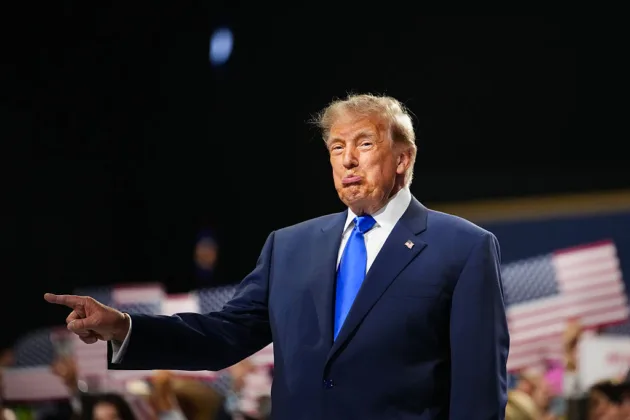
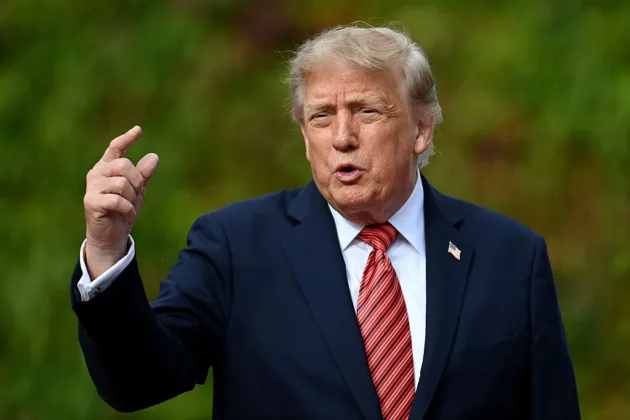
The push comes as trade talks with Washington have broken down and President Donald Trump has combined tariffs with talk of Canada as a 51st American state. The United States imposed 50 per cent tariffs on about C$28 billion (€17.74 billion) of Canadian goods on August 22 and Canadian counter-measures took effect on September 8.
Conservative leader Pierre Poilievre said the reported plan showed Carney was out of touch. “We will NEVER be the 28th EU state,” he wrote on social media.
About 68 per cent of Canadian goods exports went to the United States in the first half of 2026, according to Statistics Canada data, down from close to three-quarters before the trade war.
The EU is Canada’s second-largest trading partner, with two-way goods and services trade of about C$178 billion (€112.74 billion) in 2025.
EU foreign direct investment stock in Canada was put at C$217 billion (€137.45 billion) in the same year. Canadian investment in the EU stood at C$315 billion (€199.52 billion).
Officials on both sides have discussed easing movement of goods, services and specialised workers in energy, artificial intelligence, defence and critical minerals, as well as co-operation on subsea cables, data centres, cloud storage, satellites and infrastructure to ship Canadian energy and fertiliser to Europe.
Carney has also raised visa-free travel and work with European leaders, including France’s Emmanuel Macron. The two are due to meet on September 20 in Saint-Pierre and Miquelon, the French territory off the coast of Newfoundland.
EU ambassadors discussed a deeper pact in Brussels this month. Politico reported that no capital objected, including governments usually wary of antagonising the Trump administration.
The Comprehensive Economic and Trade Agreement (CETA) has been applied provisionally since 2017 but is still not ratified by every member state, so parts of the deal remain unused. Ten member states, among them France, Italy, Belgium and Ireland, have yet to complete ratification.
In June 2025 Ottawa and Brussels launched a “Strategic Partnership of the Future” and a security and defence partnership.
In February Canada became the first non-European country to join the EU’s Security Action for Europe (SAFE) defence-procurement scheme, signing the agreement on February 14 on the margins of the Munich Security Conference. Carney was also the first non-European leader to attend a European Political Community summit, in Armenia on May 4.
Canada is associated with Horizon Europe.
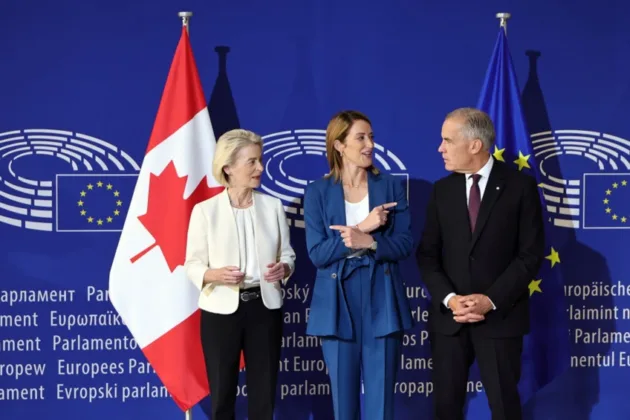
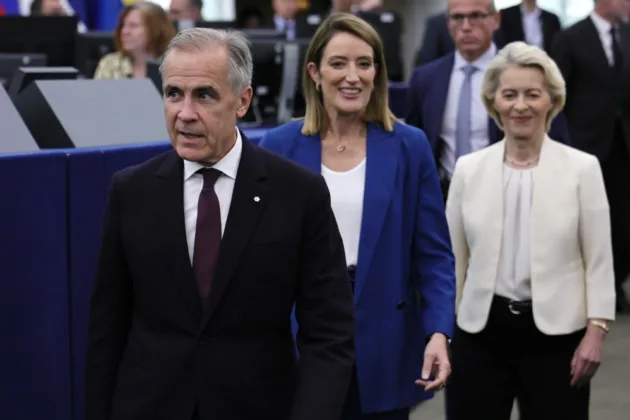
Carney travels to Strasbourg and Liverpool from September 15 to 17. He will attend European Commission President Ursula von der Leyen’s State of the European Union address on September 16, speak to the European Parliament at the invitation of its President Roberta Metsola, and meet British Prime Minister Andy Burnham.
A Canada-EU summit is scheduled in Canada on October 29-30.