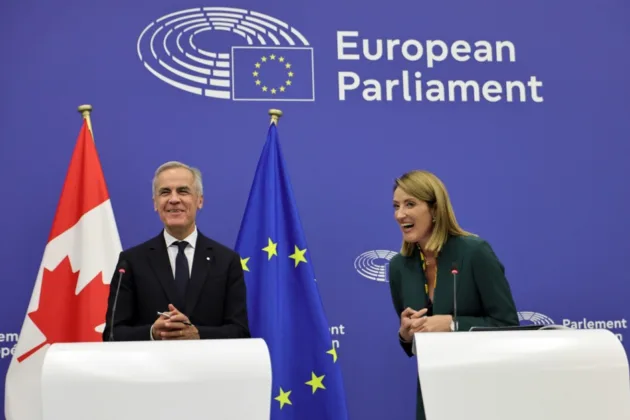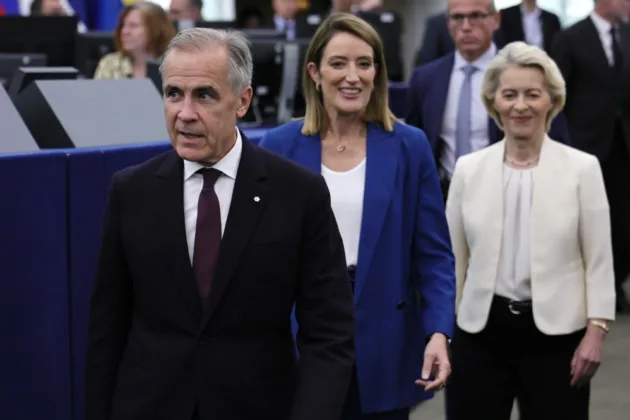





European Parliament President Roberta Metsola has suggested that Australia and New Zealand could follow Canada into “associate membership” of the European Union, a status that does not yet exist in the bloc’s treaties.
Speaking to Euronews on September 17, hours before Canadian Prime Minister Mark Carney addressed MEPs in Strasbourg, Metsola described the proposed arrangement as a third way between full accession and candidate status.
“There are countries with which we want to deepen our relationship,” she said. She added that others would come knocking at the EU’s door and that, in a time of uncertainty, having friends mattered.
The idea came from European Commission President Ursula von der Leyen, who used her State of the European Union address on September 16 to open the door to Canada becoming the EU’s first associate member, an offer built on trade, defence, critical minerals and energy.
Metsola said the talks were at an early stage. She pointed to deeper trade relations, access to critical raw materials and common rules on questions such as social media and the protection of minors.
Australia and New Zealand both already have trade agreements with the EU. Von der Leyen and Australian Prime Minister Anthony Albanese concluded a free trade deal in Canberra on March 24 after eight years of negotiations, signing a security and defence partnership on the same day.
No category of associate membership exists in the EU treaties. Any such status would have to be built from scratch and agreed by all 27 member states.
Carney welcomed the offer in his address to the European Parliament. He told MEPs that Canada and Europe were each strong but stronger together, and said he was not proposing a third bloc or a great-power rival with better manners.
US President Donald Trump had already warned against the plan. Speaking to reporters in North Carolina on September 16, he called the prospect laughable, described Canada as a terrible trade partner and said he would impose serious tariffs, or stop trading with Europe on many things, if he judged the move a hostile act.
The European Commission rejected that reading. Spokesman Olof Gill said the proposed strengthening of the partnership with Canada was not aimed against anyone else.
France’s Europe Minister Benjamin Haddad went further, telling Public Sénat that it was not for the United States, or anyone else, to choose the political direction of Europeans.
Washington has also taken aim at Canberra. On September 9 the White House criticised Australian draft legislation on social media algorithms, with a spokesman saying Trump had warned trading partners against fines and digital services taxes on American technology firms.