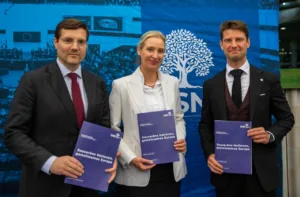


Alternative for Germany (AfD) and its allies in the Europe of Sovereign Nations (ESN) group have unveiled a blueprint to overhaul the European Union’s supranational architecture, calling for core competences to be returned to national capitals and rejecting Brussels’ push towards closer federal integration.
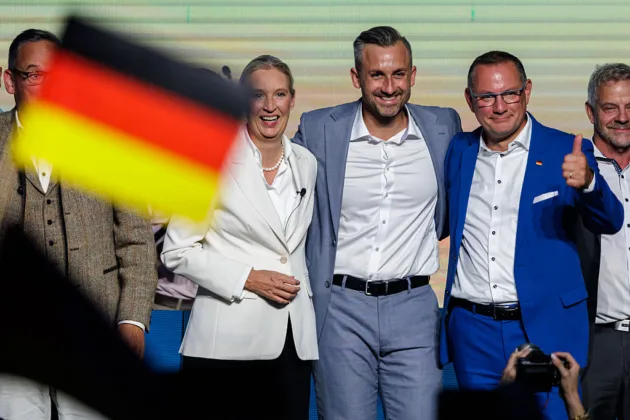
Presented on October 21 at the European Parliament in Strasbourg by AfD co-leader Alice Weidel alongside René Aust, the ESN co-chairman who also heads the party’s delegation in the assembly, the document outlines an alternative European framework based on sovereign nation-states and the principle of subsidiarity.
The plan marks a strategic shift. Rather than focusing primarily on an immediate, unilateral “Dexit”, or German withdrawal from the EU, the party proposes overhauling EU governance from within under the banner of “Cooperative Sovereignty”.
Weidel said that if the Union were not rebuilt along those lines, the AfD would press for a referendum on Germany’s continued membership.
Under the proposal, “the European Parliament should no longer be elected directly, but instead be composed of delegates appointed by national parliaments”, thereby bringing democratic legitimacy directly into the work of European institutions.
Decision-making powers would return to the European Council, where heads of state and government deliberate and decide, while the European Commission would be restricted to a coordinating and executive role rather than acting as a de facto government.
Current Commission agencies and directorates would be dissolved, reducing it to a core.
National law would take precedence over secondary EU law, while the existing Court of Justice of the European Union would be transformed into a European Court of Arbitration.
The document states that Germany’s role as an “excessively burdened paymaster”, a position it says has developed over decades, “must end!” It also calls for a return to the original stability criteria of the Maastricht Treaty and for the European Central Bank to return to neutrality in monetary policy.
The paper goes further on the single currency, demanding a redesign of the euro system to correct what it calls a structural malfunction, confining the ECB to its price-stability mandate and giving Germany greater weight on the bank’s governing council.
In response to what it describes as the “creeping expansion of European competences into areas of national self-determination and public services”, the manifesto proposes making greater use of opt-out mechanisms to restore national sovereignty.
Weidel named the Schengen passport-free travel area as one such arrangement, saying Germany should leave it and secure its own borders if it continued to fail.
Addressing reporters at the presentation, Weidel argued that Brussels’ current institutional arrangements had exceeded their democratic mandate and required fundamental treaty changes.
“From our perspective, we believe that the European Union, in its current form, is in great need of reform,” Weidel stated.
“We need to rebuild the European Union. We need to put competencies back to the national parliaments and governments. They need to take over the decision-making process.”
Weidel warned that the European Commission had evolved into a self-aggrandising executive seeking to override member states’ sovereignty. She insisted that treaty renegotiations must strip Brussels of its unilateral regulatory and budgetary powers.
ESN leaders echoed that position, describing the group’s core mission as a fundamental correction to decades of centralisation. Aust, for his part, described the AfD as a pro-European party whose approach was co-operative rather than destructive.
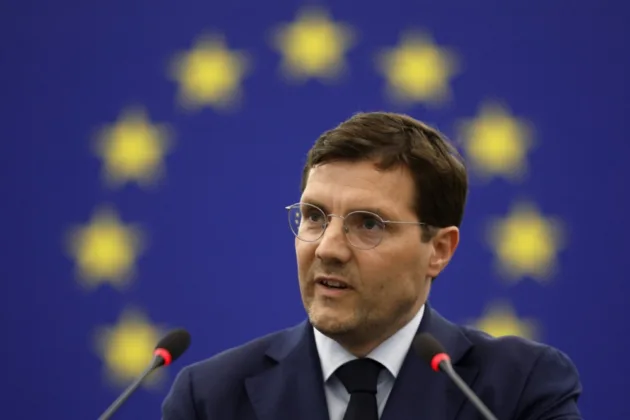
“Voters across Europe are seeing that the European Union has failed to deliver on security, prosperity, and peace for European citizens. Open borders have led to rising crime rates; the European Green Deal has undermined our industrial competitiveness; and Ursula von der Leyen has been unable to present a peace plan for Ukraine,” AfD MEP Alexander Sell told Brussels Signal.
“That is why we have put forward proposals to scale back the dysfunctional Brussels bureaucracy and work together more effectively in a Europe of sovereign nations.”
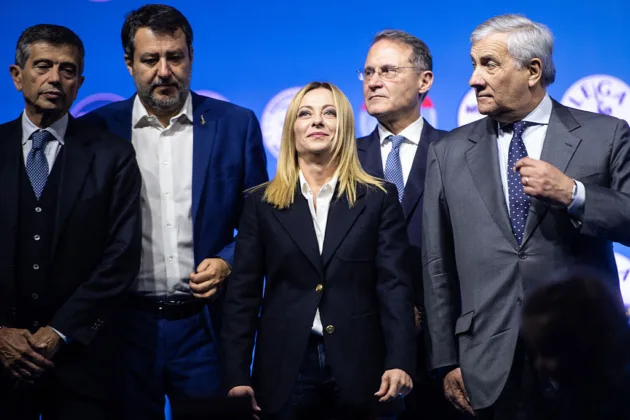
“We are very glad that colleagues from ESN, Patriots, and ECR joined our event to engage in this important debate on the future of our continent.”
The strategy paper sets out an agenda built around four main pillars.
On institutional governance, the group seeks to restore subsidiarity by stripping the European Commission of its legislative monopoly, ending the primacy of EU law over national constitutional courts, and returning regulatory authority over domestic affairs directly to national parliaments.
On border control and migration, the alliance calls for the complete dismantling of the EU Pact on Migration and Asylum.
In its place, the paper proposes reinstating permanent national border controls, establishing external asylum processing centres outside Europe, and returning full jurisdiction over deportations to national governments.
Despite its emphasis on sovereignty, the blueprint envisages greater European cooperation in some areas, including the protection of “Europe’s natural heritage”, covering its air, bodies of water and biodiversity.
The same approach applies to armaments and defence technology, as well as research and technological development, where closer cooperation and joint projects are proposed to reduce dependence on powers outside Europe.
“Here, cooperation serves technological self-reliance and industrial scale, while command over soldiers must remain firmly in national hands.”
The document also calls for the preservation of Europe’s Christian and Western heritage.
Economic and fiscal sovereignty form another key pillar of the blueprint. The document seeks to permanently prohibit joint EU borrowing instruments and EU-wide taxation, while reversing Net Zero mandates and Green Deal regulations that the faction blames for widespread deindustrialisation across the continent.
Instead of what it describes as ideological redistribution, the group proposes a framework of intergovernmental investment consortia.
Under this model, the EU would act as an administrative coordinator for major industrial and technological projects, with member states retaining sovereign control over funding decisions.
The document places considerable emphasis on cultural and social policy, calling for legal protections for traditional family structures and national identity against what it describes as ideological social engineering and centralising anti-discrimination directives originating from European institutions.
Funding for NGOs and social policy programmes promoting “values” or “democratic education”, which the document argues serve as vehicles for one-sided political influence, should be abolished without replacement.
The presentation comes amid growing domestic momentum for the AfD, which has led national polling for months, scoring between 27 and 30 per cent in surveys published on October 20, around 10 points clear of the CDU/CSU.
In regional elections it took 43.8 per cent in Saxony-Anhalt on September 6, three seats short of an absolute majority, and 38.2 per cent in Mecklenburg-Vorpommern on September 20, where the CDU fell below the 5 per cent threshold and lost its seats in the regional parliament altogether.
While mainstream centre-right, socialist and liberal groups in the European Parliament maintain a strict political cordon sanitaire, excluding ESN from committee leadership positions, the strategy paper points to increasing convergence among Europe’s nationalist factions. ESN holds 27 of the Parliament’s 720 seats, making it the chamber’s smallest group.
By presenting their approach as a structural overhaul rather than an abrupt withdrawal, AfD and ESN strategists are seeking to build tactical alliances across the right-wing benches, block future integration treaties and return powers to the member states.
The Europe of Sovereign Nations (ESN) has moved a step closer to losing its access to EU funding and potentially its registration as a European political party as Brussels moves ahead with a procedure examining whether the party has breached the bloc’s fundamental values.…
— Brussels Signal (@brusselssignal) October 5, 2026