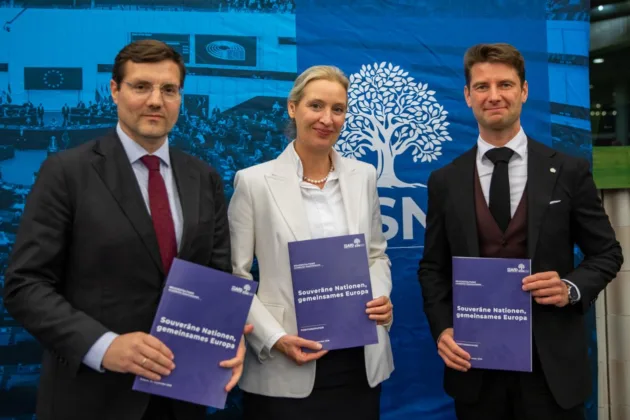












The Alternative for Germany (AfD) has moved away from an immediate German exit from the euro and the European Union — often referred to as “Dexit” — proposing instead a radical restructuring of both the EU and the single currency.
If those reforms fail, Germans would ultimately be asked to decide in a referendum on the country’s “future European and monetary path”, according to a new internal AfD strategy paper.
The change was first reported by German newspaper Bild on October 4, 2026, which said it had obtained the internal paper.
The document was discussed on September 29 by AfD representatives from the European Parliament, the Bundestag and Germany’s State parliaments, with party co-leader Tino Chrupalla among those present. It is not a newly adopted party manifesto, but an internal strategy paper setting out a proposed change in approach.
The key shift is from exit first to reform first. The AfD had previously advocated Germany leaving the euro and, ultimately, the EU in its current form. Its 2025 federal election programme explicitly stated that “Germany must leave the euro system”.
The new paper does not rule out withdrawal, but moves it to the end of a process. First, the party wants to radically reform the EU and the eurozone. Only if those efforts fail would Germans vote on the country’s future European and monetary course.
On the EU, the paper proposes transforming the bloc into a “Bund souveräner Nationen”, or “union of sovereign nations”. The EU would focus on areas including the single market, external border protection, cross-border crime and security cooperation, while national governments would regain powers in areas such as migration, social policy and financial affairs through opt-outs.
The paper sets 2029 as its horizon, the year Germans next elect a Bundestag and the EU holds European elections, by which point the party hopes to be in government and able to press for the changes.
The paper also reportedly proposes ending direct elections to the European Parliament, with MEPs instead appointed by national parliaments according to their domestic parliamentary strength.
The euro would face equally far-reaching changes. According to Bild, the AfD wants to end what it describes as indirect European Central Bank financing of governments, settle TARGET balances, the claims and liabilities that build up between national central banks inside the eurozone payment system, and establish rules allowing eurozone states to become insolvent.
The stated aim is to put the monetary union on a basis of “responsibility and liability”. The paper describes the single currency as having produced a debt and liability union “through the back door”.
The proposed shift comes as the AfD has grown from a protest party into one of Germany’s strongest political forces, making the economic and geopolitical implications of its European policy more significant.
On September 6 the party took 43.8 per cent in the Saxony-Anhalt state election, more than double its 2021 score of 20.8 per cent. An INSA survey published on August 2 put it on 28 per cent nationally, seven points ahead of the Christian Democratic Union (CDU) and its Bavarian sister party.
The economic stakes are set out in the German debate. The Cologne-based Institut der deutschen Wirtschaft has estimated that a euro exit would cost Germany around €700 billion over five years and some 2.5 million jobs, figures cited in a ZDF analysis on September 1.
The same analysis quoted Consorsbank market analyst Jochen Stanzl saying that uncertainty during any transition would be “poison for the business climate, investment and growth”. Against this backdrop, the AfD’s “reform first” approach allows it to maintain its Eurosceptic position while presenting withdrawal as a last resort.
The proposal therefore represents a change in strategy, not a formal abandonment of Dexit. The possibility of leaving the euro and the EU remains, but it would become a fallback option if the AfD’s proposed reforms cannot be achieved.
The change also comes after pro-exit statements from AfD co-leader Alice Weidel. In August she called the euro an unstable “soft currency” and said her party would close Germany’s borders and terminate the Schengen agreement.
AfD European Parliament delegation head René Aust, who also presides over the Europe of Sovereign Nations (ESN) group, told Bild the position paper showed the AfD was “a Europe-friendly party” that wanted to work with Germany’s neighbours while strengthening national sovereignty, protecting free movement and reinforcing the EU’s external borders. He also called for the European treaties to be renegotiated.
The AfD’s new formula can therefore be summarised as “reform first, referendum if reform fails”. For Brussels, the proposal would amount to a fundamental redesign of the EU’s institutional and monetary architecture rather than simply a change in Germany’s membership.